
TEAS 6 EXAM QUESTIONS AND ANSWERS - 2026/2027 Edition - ATI TEAS Version 6 (Nursing Admission) Page 1
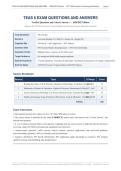
TEAS 6 EXAM QUESTIONS AND ANSWERS
Verified Questions and Correct Answers — 2026/2027 Edition
Aligned with ATI TEAS Version 6 Content Outline and Nursing Program Admission Standards
Total Questions 100 (exactly)
Sections 4 sections (Reading 22 + Math 22 + Science 28 + English 28)
Cognitive Mix 30% Recall / 40% Application / 30% Analysis
Question Style 60% Scenario-Based (clinical/practical) / 40% Direct Knowledge
Question Format Multiple Choice, 4 options (A-D), ONE correct
Target Audience Pre-nursing and allied health program applicants
Special Inclusions 15 math calculations, 15 anatomy & physiology, 10 grammar & punctuation, 10 reading comprehension
Doctrine Basis ATI TEAS Version 6 Content Outline (2026/2027 Edition)
Section Breakdown
Section Topic Q Range Count
1 Reading (Key Ideas, Craft & Structure, Integration of Knowledge, Vocabulary in Context)
Q1 - Q22 22
2 Mathematics (Numbers & Operations, Algebra & Functions, Measurement & Data)Q23 - Q44 22
3 Science (Anatomy & Physiology, Life Science, Physical Science, Scientific Reasoning)
Q45 - Q72 28
4 English and Language Usage (Grammar & Punctuation, Usage & Mechanics, Vocabulary)
Q73 - Q100 28
TOTAL 100
Exam Instructions
• Each question presents four options (A, B, C, D). Only ONE option is correct.
• The correct answer is identified by the inline [CORRECT] marker and is also stated in the "Correct Answer:" line
beneath each question.
• A 1-to-2 sentence rationale follows each question, explaining why the correct answer is right and why the distractors
are wrong, citing ATI TEAS curriculum and standardized test references.
• Scenario-based questions (~60%) present clinical contexts, practical applications, and real-world problems;
direct-knowledge questions (~40%) test factual recall and definitions.
• Cognitive distribution: 30% Recall (definitional), 40% Application (apply knowledge to scenarios), 30% Analysis
(problem-solving, critical thinking, data interpretation).
Aligned with ATI TEAS Version 6 Content Outline and Nursing Program Admission Standards (2026/2027 Edition) A+ Graded - Verified Correct Answers
,TEAS 6 EXAM QUESTIONS AND ANSWERS - 2026/2027 Edition - ATI TEAS Version 6 (Nursing Admission) Page 2
Section 1: Reading
Coverage: Key Ideas & Details, Craft & Structure, Integration of Knowledge & Ideas, Vocabulary in Context.
Q1: Read the following passage and identify the main idea.
"Nurses on the cardiac unit implemented a new bedside handoff protocol in which outgoing nurses walked
rounds with incoming nurses at shift change. Over the next six months, medication errors decreased by
32%, and patient satisfaction scores related to 'knowing my nurse' rose by 18%. The unit's nurse manager
attributed the improvement to better information transfer and the visual confirmation of IV lines and
drains at the bedside."
A. Medication errors are the most common type of error on cardiac units.
B. Bedside handoff protocols can improve both patient safety and patient satisfaction on a cardiac unit.
[CORRECT]
C. Patient satisfaction scores are more important than medication error rates.
D. The nurse manager was responsible for the decrease in medication errors.
Correct Answer: B
Rationale: The main idea must encompass the whole passage. Option B captures both outcomes (errors down, satisfaction up)
tied to the intervention (bedside handoff). Options A, C, and D are either tangential details or overstate single elements of the
passage.
Q2: Which of the following statements from a patient education brochure is an OPINION rather than a
fact?
A. "Insulin was first used to treat diabetes in 1922."
B. "Patients with type 1 diabetes require lifelong insulin therapy."
C. "The Mediterranean diet is the best eating pattern for everyone with type 2 diabetes." [CORRECT]
D. "Regular exercise can lower blood glucose levels in people with diabetes."
Correct Answer: C
Rationale: Option C contains the value judgment 'the best ... for everyone,' which is a subjective claim, not verifiable. Options
A, B, and D are verifiable factual statements supported by medical history and clinical evidence.
Q3: A clinical journal article states: "The study found a statistically significant reduction in
hospital-acquired infections after the introduction of copper-infused linens (p < 0.05). However, the
sample size was only 47 patients across two wards, and no control ward was included." Which conclusion
is most justified by the text?
A. Copper-infused linens definitively reduce hospital-acquired infections and should be adopted
immediately.
B. Copper-infused linens show promise, but the small sample size and absence of a control group limit the
strength of the conclusion. [CORRECT]
C. Hospital-acquired infections are caused by linen choices.
D. The study proves that copper is more effective than silver for infection control.
Aligned with ATI TEAS Version 6 Content Outline and Nursing Program Admission Standards (2026/2027 Edition) A+ Graded - Verified Correct Answers
, TEAS 6 EXAM QUESTIONS AND ANSWERS - 2026/2027 Edition - ATI TEAS Version 6 (Nursing Admission) Page 3
Correct Answer: B
Rationale: The passage reports a significant finding but explicitly notes sample-size and control-group limitations. Option B is
the inference that integrates both the finding and its limits. Options A, C, and D overstate or misread the evidence.
Q4: Which organizational structure is most clearly used in the following excerpt?
"When the patient first arrived in the ER, his blood pressure was 90/50, his heart rate was 130, and his
skin was cool and clammy. Within 30 minutes of fluid resuscitation, his blood pressure had risen to 110/70,
his heart rate had dropped to 95, and his skin was warm and dry."
A. Cause and effect
B. Compare and contrast
C. Sequence / chronological [CORRECT]
D. Problem and solution
Correct Answer: C
Rationale: The excerpt moves from arrival (time 0) to 30 minutes later, organizing events by time. Options A, B, and D
misidentify the structure — the passage does not contrast two things, solve a stated problem, or analyze causes.
Q5: Read the passage:
"Many older adults experience polypharmacy — the concurrent use of multiple medications. While each
drug may be appropriately prescribed, the cumulative effect can lead to adverse drug interactions,
increased fall risk, and cognitive impairment. Healthcare providers must therefore regularly review all
medications a patient is taking."
Based on context clues, what does "polypharmacy" most likely mean?
A. A pharmacy that fills many prescriptions per day
B. The concurrent use of multiple medications [CORRECT]
C. An allergic reaction to a medication
D. A specialty pharmacy for older adults
Correct Answer: B
Rationale: The passage explicitly defines polypharmacy as 'the concurrent use of multiple medications' immediately after
introducing the term. Options A, C, and D are inconsistent with the surrounding context.
Q6: An author writes about a controversial new vaccination policy and uses the phrases 'so-called experts,'
'alleged benefits,' and 'forced upon patients.' These word choices most strongly suggest what tone?
A. Neutral and informative
B. Skeptical and critical [CORRECT]
C. Enthusiastic and supportive
D. Scientific and objective
Correct Answer: B
Rationale: The quoted phrases carry negative connotation ('so-called,' 'alleged,' 'forced'), signaling skepticism toward the
policy. Options A, C, and D misidentify the connotative charge of the language.
Aligned with ATI TEAS Version 6 Content Outline and Nursing Program Admission Standards (2026/2027 Edition) A+ Graded - Verified Correct Answers
TEAS 6 EXAM QUESTIONS AND ANSWERS
Verified Questions and Correct Answers — 2026/2027 Edition
Aligned with ATI TEAS Version 6 Content Outline and Nursing Program Admission Standards
Total Questions 100 (exactly)
Sections 4 sections (Reading 22 + Math 22 + Science 28 + English 28)
Cognitive Mix 30% Recall / 40% Application / 30% Analysis
Question Style 60% Scenario-Based (clinical/practical) / 40% Direct Knowledge
Question Format Multiple Choice, 4 options (A-D), ONE correct
Target Audience Pre-nursing and allied health program applicants
Special Inclusions 15 math calculations, 15 anatomy & physiology, 10 grammar & punctuation, 10 reading comprehension
Doctrine Basis ATI TEAS Version 6 Content Outline (2026/2027 Edition)
Section Breakdown
Section Topic Q Range Count
1 Reading (Key Ideas, Craft & Structure, Integration of Knowledge, Vocabulary in Context)
Q1 - Q22 22
2 Mathematics (Numbers & Operations, Algebra & Functions, Measurement & Data)Q23 - Q44 22
3 Science (Anatomy & Physiology, Life Science, Physical Science, Scientific Reasoning)
Q45 - Q72 28
4 English and Language Usage (Grammar & Punctuation, Usage & Mechanics, Vocabulary)
Q73 - Q100 28
TOTAL 100
Exam Instructions
• Each question presents four options (A, B, C, D). Only ONE option is correct.
• The correct answer is identified by the inline [CORRECT] marker and is also stated in the "Correct Answer:" line
beneath each question.
• A 1-to-2 sentence rationale follows each question, explaining why the correct answer is right and why the distractors
are wrong, citing ATI TEAS curriculum and standardized test references.
• Scenario-based questions (~60%) present clinical contexts, practical applications, and real-world problems;
direct-knowledge questions (~40%) test factual recall and definitions.
• Cognitive distribution: 30% Recall (definitional), 40% Application (apply knowledge to scenarios), 30% Analysis
(problem-solving, critical thinking, data interpretation).
Aligned with ATI TEAS Version 6 Content Outline and Nursing Program Admission Standards (2026/2027 Edition) A+ Graded - Verified Correct Answers
,TEAS 6 EXAM QUESTIONS AND ANSWERS - 2026/2027 Edition - ATI TEAS Version 6 (Nursing Admission) Page 2
Section 1: Reading
Coverage: Key Ideas & Details, Craft & Structure, Integration of Knowledge & Ideas, Vocabulary in Context.
Q1: Read the following passage and identify the main idea.
"Nurses on the cardiac unit implemented a new bedside handoff protocol in which outgoing nurses walked
rounds with incoming nurses at shift change. Over the next six months, medication errors decreased by
32%, and patient satisfaction scores related to 'knowing my nurse' rose by 18%. The unit's nurse manager
attributed the improvement to better information transfer and the visual confirmation of IV lines and
drains at the bedside."
A. Medication errors are the most common type of error on cardiac units.
B. Bedside handoff protocols can improve both patient safety and patient satisfaction on a cardiac unit.
[CORRECT]
C. Patient satisfaction scores are more important than medication error rates.
D. The nurse manager was responsible for the decrease in medication errors.
Correct Answer: B
Rationale: The main idea must encompass the whole passage. Option B captures both outcomes (errors down, satisfaction up)
tied to the intervention (bedside handoff). Options A, C, and D are either tangential details or overstate single elements of the
passage.
Q2: Which of the following statements from a patient education brochure is an OPINION rather than a
fact?
A. "Insulin was first used to treat diabetes in 1922."
B. "Patients with type 1 diabetes require lifelong insulin therapy."
C. "The Mediterranean diet is the best eating pattern for everyone with type 2 diabetes." [CORRECT]
D. "Regular exercise can lower blood glucose levels in people with diabetes."
Correct Answer: C
Rationale: Option C contains the value judgment 'the best ... for everyone,' which is a subjective claim, not verifiable. Options
A, B, and D are verifiable factual statements supported by medical history and clinical evidence.
Q3: A clinical journal article states: "The study found a statistically significant reduction in
hospital-acquired infections after the introduction of copper-infused linens (p < 0.05). However, the
sample size was only 47 patients across two wards, and no control ward was included." Which conclusion
is most justified by the text?
A. Copper-infused linens definitively reduce hospital-acquired infections and should be adopted
immediately.
B. Copper-infused linens show promise, but the small sample size and absence of a control group limit the
strength of the conclusion. [CORRECT]
C. Hospital-acquired infections are caused by linen choices.
D. The study proves that copper is more effective than silver for infection control.
Aligned with ATI TEAS Version 6 Content Outline and Nursing Program Admission Standards (2026/2027 Edition) A+ Graded - Verified Correct Answers
, TEAS 6 EXAM QUESTIONS AND ANSWERS - 2026/2027 Edition - ATI TEAS Version 6 (Nursing Admission) Page 3
Correct Answer: B
Rationale: The passage reports a significant finding but explicitly notes sample-size and control-group limitations. Option B is
the inference that integrates both the finding and its limits. Options A, C, and D overstate or misread the evidence.
Q4: Which organizational structure is most clearly used in the following excerpt?
"When the patient first arrived in the ER, his blood pressure was 90/50, his heart rate was 130, and his
skin was cool and clammy. Within 30 minutes of fluid resuscitation, his blood pressure had risen to 110/70,
his heart rate had dropped to 95, and his skin was warm and dry."
A. Cause and effect
B. Compare and contrast
C. Sequence / chronological [CORRECT]
D. Problem and solution
Correct Answer: C
Rationale: The excerpt moves from arrival (time 0) to 30 minutes later, organizing events by time. Options A, B, and D
misidentify the structure — the passage does not contrast two things, solve a stated problem, or analyze causes.
Q5: Read the passage:
"Many older adults experience polypharmacy — the concurrent use of multiple medications. While each
drug may be appropriately prescribed, the cumulative effect can lead to adverse drug interactions,
increased fall risk, and cognitive impairment. Healthcare providers must therefore regularly review all
medications a patient is taking."
Based on context clues, what does "polypharmacy" most likely mean?
A. A pharmacy that fills many prescriptions per day
B. The concurrent use of multiple medications [CORRECT]
C. An allergic reaction to a medication
D. A specialty pharmacy for older adults
Correct Answer: B
Rationale: The passage explicitly defines polypharmacy as 'the concurrent use of multiple medications' immediately after
introducing the term. Options A, C, and D are inconsistent with the surrounding context.
Q6: An author writes about a controversial new vaccination policy and uses the phrases 'so-called experts,'
'alleged benefits,' and 'forced upon patients.' These word choices most strongly suggest what tone?
A. Neutral and informative
B. Skeptical and critical [CORRECT]
C. Enthusiastic and supportive
D. Scientific and objective
Correct Answer: B
Rationale: The quoted phrases carry negative connotation ('so-called,' 'alleged,' 'forced'), signaling skepticism toward the
policy. Options A, C, and D misidentify the connotative charge of the language.
Aligned with ATI TEAS Version 6 Content Outline and Nursing Program Admission Standards (2026/2027 Edition) A+ Graded - Verified Correct Answers

