
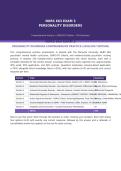
NURS 663 EXAM 3
PERSONALITY DISORDERS
Comprehensive Practice • 2026/2027 Edition • 150 Questions
NURS 663 EXAM 3
PERSONALITY DISORDERS COMPREHENSIVE PRACTICE (2026/2027 EDITION)
This comprehensive practice examination is aligned with the Maryville University NURS 663
psychiatric mental health curriculum, DSM-5-TR criteria, and evidence-based psychiatric nursing
practice. It contains 150 multiple-choice questions organized into seven sections, each with a
complete rationale for the correct answer. Coverage reflects the exam cognitive mix: approximately
30% recall, 50% application, and 20% analysis. Questions emphasize scenario-based application
(≈75%) alongside direct knowledge items (≈25%), with four options (A–D) and exactly one correct
response per item.
Section Topic Questions
Section 1 Personality Disorders Overview – General Criteria, Cluster A, B, C, DSM-5 Criteria,
40 Mnemonics
Section 2 Borderline Personality Disorder – Key Features, DBT Treatment, Differential Diagnosis,
25 Pharmacotherapy
Section 3 Antisocial Personality Disorder – Hallmark Features, Conduct Disorder History,20
Differential Diagnosis
Section 4 Differential Diagnosis & Mnemonics – Mnemonics (SUSPECT, DISTANT, CORRUPT,
25 IMPULSIVE, GRANDIOSE, CRI
Section 5 Autism Spectrum Disorder – DSM-5 Criteria, Screening/Diagnostic Tools, Neurobiology,
20 Comorbidities, Pharma
Section 6 Trauma-Related Disorders & ADHD – PTSD Treatment, SSRIs, Prazosin, TF-CBT,
10EMDR, ADHD
Section 7 Integrated Clinical Scenarios – Complex Psychiatric Presentations 10
TOTAL 150
How to use this exam: Work through the sections in order, marking your answers. Each item shows
four options (A–D) with exactly one correct response, followed by the answer and a rationale. A
consolidated answer key appears at the end for quick scoring.
,NURS 663 EXAM 3 — PERSONALITY DISORDERS Comprehensive Practice (2026/2027)
Section 1: Personality Disorders Overview – General Criteria, Cluster A, B, C, DSM-5
Criteria, Mnemonics
Q1: Personality disorders are characterized by behavior patterns that are:
A. persistent and long duration, usually since the teens or early adulthood [CORRECT]
B. brief and episodic
C. only present during acute stress
D. limited to childhood only
Correct Answer: A
Rationale: Personality disorders involve enduring, long-standing patterns evident since adolescence/early
adulthood.
Q2: According to the DSM-5 general criteria, diagnosis of a personality disorder requires impairment in
how many of the four domains?
A. 2 out of 4 [CORRECT]
B. 1 out of 4
C. 3 out of 4
D. all 4
Correct Answer: A
Rationale: Diagnosis requires impairment in at least 2 of 4 domains: cognition, affectivity, interpersonal
functioning, and impulse control.
Q3: The four domains assessed for personality disorders are:
A. cognitive/perceptual, mood/affect, interpersonal, and behavioral (impulse control) [CORRECT]
B. memory, language, motor, and sensory
C. sleep, appetite, energy, and libido
D. social, financial, occupational, and legal
Correct Answer: A
Rationale: The DSM-5-TR domains are cognition, affectivity, interpersonal functioning, and impulse control.
Q4: A personality disorder diagnosis is excluded if the pattern is better explained by:
A. another mental disorder, substance use, or another medical illness [CORRECT]
B. the patient's upbringing only
C. a recent stressful event only
D. normal personality variation
Correct Answer: A
Rationale: The pattern must not be attributable to another mental disorder, substance, or medical condition.
Q5: Cluster A personality disorders are described as:
A. odd or eccentric [CORRECT]
B. dramatic or emotional
C. anxious or fearful
D. calm and stable
Correct Answer: A
Rationale: Cluster A (paranoid, schizoid, schizotypal) is the 'odd/eccentric' cluster.
Page 2 of 29
, NURS 663 EXAM 3 — PERSONALITY DISORDERS Comprehensive Practice (2026/2027)
Q6: Cluster B personality disorders are described as:
A. dramatic or emotional [CORRECT]
B. odd or eccentric
C. anxious or fearful
D. withdrawn and shy
Correct Answer: A
Rationale: Cluster B (antisocial, borderline, histrionic, narcissistic) is 'dramatic/emotional/erratic.'
Q7: Cluster C personality disorders are described as:
A. anxious or fearful [CORRECT]
B. odd or eccentric
C. dramatic or emotional
D. impulsive and reckless
Correct Answer: A
Rationale: Cluster C (avoidant, dependent, OCPD) is the 'anxious/fearful' cluster.
Q8: Which disorders belong to Cluster A?
A. Paranoid, Schizoid, Schizotypal [CORRECT]
B. Antisocial, Borderline, Histrionic, Narcissistic
C. Avoidant, Dependent, Obsessive-Compulsive
D. Depressive, Bipolar, Schizophrenia
Correct Answer: A
Rationale: Cluster A includes paranoid, schizoid, and schizotypal personality disorders.
Q9: Which disorders belong to Cluster B?
A. Antisocial, Borderline, Histrionic, Narcissistic [CORRECT]
B. Paranoid, Schizoid, Schizotypal
C. Avoidant, Dependent, Obsessive-Compulsive
D. Panic, Phobia, OCD
Correct Answer: A
Rationale: Cluster B includes antisocial, borderline, histrionic, and narcissistic PDs.
Q10: Which disorders belong to Cluster C?
A. Avoidant, Dependent, Obsessive-Compulsive [CORRECT]
B. Paranoid, Schizoid, Schizotypal
C. Antisocial, Borderline, Histrionic, Narcissistic
D. ADHD, ASD, PTSD
Correct Answer: A
Rationale: Cluster C includes avoidant, dependent, and obsessive-compulsive PDs.
Q11: The hallmark of Paranoid Personality Disorder is:
A. pervasive distrust and suspiciousness of others [CORRECT]
B. grandiosity and need for admiration
C. emotional instability
D. detachment from relationships
Correct Answer: A
Rationale: Paranoid PD is defined by pervasive distrust and suspiciousness of others' motives.
Page 3 of 29
PERSONALITY DISORDERS
Comprehensive Practice • 2026/2027 Edition • 150 Questions
NURS 663 EXAM 3
PERSONALITY DISORDERS COMPREHENSIVE PRACTICE (2026/2027 EDITION)
This comprehensive practice examination is aligned with the Maryville University NURS 663
psychiatric mental health curriculum, DSM-5-TR criteria, and evidence-based psychiatric nursing
practice. It contains 150 multiple-choice questions organized into seven sections, each with a
complete rationale for the correct answer. Coverage reflects the exam cognitive mix: approximately
30% recall, 50% application, and 20% analysis. Questions emphasize scenario-based application
(≈75%) alongside direct knowledge items (≈25%), with four options (A–D) and exactly one correct
response per item.
Section Topic Questions
Section 1 Personality Disorders Overview – General Criteria, Cluster A, B, C, DSM-5 Criteria,
40 Mnemonics
Section 2 Borderline Personality Disorder – Key Features, DBT Treatment, Differential Diagnosis,
25 Pharmacotherapy
Section 3 Antisocial Personality Disorder – Hallmark Features, Conduct Disorder History,20
Differential Diagnosis
Section 4 Differential Diagnosis & Mnemonics – Mnemonics (SUSPECT, DISTANT, CORRUPT,
25 IMPULSIVE, GRANDIOSE, CRI
Section 5 Autism Spectrum Disorder – DSM-5 Criteria, Screening/Diagnostic Tools, Neurobiology,
20 Comorbidities, Pharma
Section 6 Trauma-Related Disorders & ADHD – PTSD Treatment, SSRIs, Prazosin, TF-CBT,
10EMDR, ADHD
Section 7 Integrated Clinical Scenarios – Complex Psychiatric Presentations 10
TOTAL 150
How to use this exam: Work through the sections in order, marking your answers. Each item shows
four options (A–D) with exactly one correct response, followed by the answer and a rationale. A
consolidated answer key appears at the end for quick scoring.
,NURS 663 EXAM 3 — PERSONALITY DISORDERS Comprehensive Practice (2026/2027)
Section 1: Personality Disorders Overview – General Criteria, Cluster A, B, C, DSM-5
Criteria, Mnemonics
Q1: Personality disorders are characterized by behavior patterns that are:
A. persistent and long duration, usually since the teens or early adulthood [CORRECT]
B. brief and episodic
C. only present during acute stress
D. limited to childhood only
Correct Answer: A
Rationale: Personality disorders involve enduring, long-standing patterns evident since adolescence/early
adulthood.
Q2: According to the DSM-5 general criteria, diagnosis of a personality disorder requires impairment in
how many of the four domains?
A. 2 out of 4 [CORRECT]
B. 1 out of 4
C. 3 out of 4
D. all 4
Correct Answer: A
Rationale: Diagnosis requires impairment in at least 2 of 4 domains: cognition, affectivity, interpersonal
functioning, and impulse control.
Q3: The four domains assessed for personality disorders are:
A. cognitive/perceptual, mood/affect, interpersonal, and behavioral (impulse control) [CORRECT]
B. memory, language, motor, and sensory
C. sleep, appetite, energy, and libido
D. social, financial, occupational, and legal
Correct Answer: A
Rationale: The DSM-5-TR domains are cognition, affectivity, interpersonal functioning, and impulse control.
Q4: A personality disorder diagnosis is excluded if the pattern is better explained by:
A. another mental disorder, substance use, or another medical illness [CORRECT]
B. the patient's upbringing only
C. a recent stressful event only
D. normal personality variation
Correct Answer: A
Rationale: The pattern must not be attributable to another mental disorder, substance, or medical condition.
Q5: Cluster A personality disorders are described as:
A. odd or eccentric [CORRECT]
B. dramatic or emotional
C. anxious or fearful
D. calm and stable
Correct Answer: A
Rationale: Cluster A (paranoid, schizoid, schizotypal) is the 'odd/eccentric' cluster.
Page 2 of 29
, NURS 663 EXAM 3 — PERSONALITY DISORDERS Comprehensive Practice (2026/2027)
Q6: Cluster B personality disorders are described as:
A. dramatic or emotional [CORRECT]
B. odd or eccentric
C. anxious or fearful
D. withdrawn and shy
Correct Answer: A
Rationale: Cluster B (antisocial, borderline, histrionic, narcissistic) is 'dramatic/emotional/erratic.'
Q7: Cluster C personality disorders are described as:
A. anxious or fearful [CORRECT]
B. odd or eccentric
C. dramatic or emotional
D. impulsive and reckless
Correct Answer: A
Rationale: Cluster C (avoidant, dependent, OCPD) is the 'anxious/fearful' cluster.
Q8: Which disorders belong to Cluster A?
A. Paranoid, Schizoid, Schizotypal [CORRECT]
B. Antisocial, Borderline, Histrionic, Narcissistic
C. Avoidant, Dependent, Obsessive-Compulsive
D. Depressive, Bipolar, Schizophrenia
Correct Answer: A
Rationale: Cluster A includes paranoid, schizoid, and schizotypal personality disorders.
Q9: Which disorders belong to Cluster B?
A. Antisocial, Borderline, Histrionic, Narcissistic [CORRECT]
B. Paranoid, Schizoid, Schizotypal
C. Avoidant, Dependent, Obsessive-Compulsive
D. Panic, Phobia, OCD
Correct Answer: A
Rationale: Cluster B includes antisocial, borderline, histrionic, and narcissistic PDs.
Q10: Which disorders belong to Cluster C?
A. Avoidant, Dependent, Obsessive-Compulsive [CORRECT]
B. Paranoid, Schizoid, Schizotypal
C. Antisocial, Borderline, Histrionic, Narcissistic
D. ADHD, ASD, PTSD
Correct Answer: A
Rationale: Cluster C includes avoidant, dependent, and obsessive-compulsive PDs.
Q11: The hallmark of Paranoid Personality Disorder is:
A. pervasive distrust and suspiciousness of others [CORRECT]
B. grandiosity and need for admiration
C. emotional instability
D. detachment from relationships
Correct Answer: A
Rationale: Paranoid PD is defined by pervasive distrust and suspiciousness of others' motives.
Page 3 of 29

