WGU D440
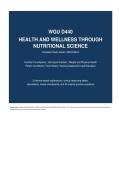
HEALTH AND WELLNESS THROUGH
NUTRITIONAL SCIENCE
Complete Study Guide | 2026 Edition
Nutrition Foundations | Life-Cycle Nutrition | Weight and Physical Health
Patient Conditions | Food Safety | Nursing Assessment and Education
Evidence-based explanations, clinical reasoning tables,
calculations, review checkpoints, and 50 original practice questions
Scope note: Independently aligned to WGU's publicly described 2026 D440 domains. This resource does not reproduce protected course or assessment
content and does not guarantee an assessment result.
,WGU D440 | HEALTH AND WELLNESS THROUGH NUTRITIONAL SCIENCE | 2026
How to Use This Guide
D440 connects nutrition science to nursing observation, patient safety, life-stage needs, health promotion, and common
conditions. Study each chapter by asking: What is the nutrient or principle? How does it affect physiology? What findings suggest
risk? What is the safest nursing response?
Recommended order: Build the science foundation first, then practice assessment and calculations, then apply
concepts across the lifespan and to patient conditions.
Verified 2026 Course-Scope Map
Publicly described D440 domain Guide coverage
Basic nutrition principles Chapters 1-11
Nutrition throughout the life cycle Chapter 14
Weight management and physical health Chapters 4 and 13
Nutrition related to patient conditions Chapters 12 and 15-16
Nutrition and overall health across the lifespan Integrated throughout
Clinical Reasoning Pattern
Step Question
Assess What do intake, weight trend, symptoms, function, labs, medications, culture, and access show?
Identify risk Is there malnutrition, aspiration, food-safety, deficiency, excess, or interaction risk?
Act safely What is within nursing scope now, and what requires referral or provider orders?
Teach What two or three practical changes fit this person?
Evaluate What outcome will show improvement or harm?
Independent educational resource - not affiliated with or endorsed by WGU Page 2
, WGU D440 | HEALTH AND WELLNESS THROUGH NUTRITIONAL SCIENCE | 2026
1. Foundations of Nutrition and Nursing Practice
Nutrition and health
Nutrition examines how food components are ingested, digested, absorbed, transported, metabolized, stored, and excreted.
Nutritional status influences growth, immune function, tissue integrity, cognition, recovery, chronic-disease risk, and quality of
life.
Nursing responsibilities
Collect nutrition history and anthropometrics, recognize risk, connect symptoms with possible intake problems, reinforce
individualized teaching, collaborate with registered dietitian nutritionists, and monitor response. Nurses screen and educate;
complex medical nutrition therapy requires qualified clinicians.
Evidence and context
Good decisions combine evidence, patient condition, culture, access, preferences, medications, laboratory data, and goals. A
single food or nutrient rarely determines health by itself.
High-yield takeaways
• Think in patterns, not “good” and “bad” foods.
• Assess before teaching; personalize rather than assuming.
2. Dietary Reference Intakes and Healthy Patterns
DRI framework
The EAR meets the estimated need of half a healthy group and helps assess populations. The RDA meets nearly all healthy
individuals. An AI is used when evidence is insufficient for an RDA. The UL is the highest average daily intake unlikely to cause
harm. AMDRs describe macronutrient intake ranges associated with adequacy and lower chronic-disease risk.
Current application
DRIs are reference values for generally healthy people, not prescriptions for every clinical condition. Needs vary with age, sex,
pregnancy, lactation, activity, body size, disease, absorption, medications, and recovery.
Diet quality
A sound pattern emphasizes variety, nutrient density, appropriate energy intake, fruits and vegetables, whole grains, protein
variety, and attention to added sugars, saturated fat, and sodium.
High-yield takeaways
• RDA is not a minimum below which deficiency automatically occurs.
• UL addresses toxicity risk, not a target intake.
3. Digestion, Absorption, and Metabolism
GI pathway
Mechanical and chemical digestion begin in the mouth. The stomach mixes food and begins substantial protein digestion. Most
digestion and absorption occur in the small intestine. The large intestine absorbs water and electrolytes and hosts microbiota
that ferment some fibers.
Accessory organs
Independent educational resource - not affiliated with or endorsed by WGU Page 3
HEALTH AND WELLNESS THROUGH
NUTRITIONAL SCIENCE
Complete Study Guide | 2026 Edition
Nutrition Foundations | Life-Cycle Nutrition | Weight and Physical Health
Patient Conditions | Food Safety | Nursing Assessment and Education
Evidence-based explanations, clinical reasoning tables,
calculations, review checkpoints, and 50 original practice questions
Scope note: Independently aligned to WGU's publicly described 2026 D440 domains. This resource does not reproduce protected course or assessment
content and does not guarantee an assessment result.
,WGU D440 | HEALTH AND WELLNESS THROUGH NUTRITIONAL SCIENCE | 2026
How to Use This Guide
D440 connects nutrition science to nursing observation, patient safety, life-stage needs, health promotion, and common
conditions. Study each chapter by asking: What is the nutrient or principle? How does it affect physiology? What findings suggest
risk? What is the safest nursing response?
Recommended order: Build the science foundation first, then practice assessment and calculations, then apply
concepts across the lifespan and to patient conditions.
Verified 2026 Course-Scope Map
Publicly described D440 domain Guide coverage
Basic nutrition principles Chapters 1-11
Nutrition throughout the life cycle Chapter 14
Weight management and physical health Chapters 4 and 13
Nutrition related to patient conditions Chapters 12 and 15-16
Nutrition and overall health across the lifespan Integrated throughout
Clinical Reasoning Pattern
Step Question
Assess What do intake, weight trend, symptoms, function, labs, medications, culture, and access show?
Identify risk Is there malnutrition, aspiration, food-safety, deficiency, excess, or interaction risk?
Act safely What is within nursing scope now, and what requires referral or provider orders?
Teach What two or three practical changes fit this person?
Evaluate What outcome will show improvement or harm?
Independent educational resource - not affiliated with or endorsed by WGU Page 2
, WGU D440 | HEALTH AND WELLNESS THROUGH NUTRITIONAL SCIENCE | 2026
1. Foundations of Nutrition and Nursing Practice
Nutrition and health
Nutrition examines how food components are ingested, digested, absorbed, transported, metabolized, stored, and excreted.
Nutritional status influences growth, immune function, tissue integrity, cognition, recovery, chronic-disease risk, and quality of
life.
Nursing responsibilities
Collect nutrition history and anthropometrics, recognize risk, connect symptoms with possible intake problems, reinforce
individualized teaching, collaborate with registered dietitian nutritionists, and monitor response. Nurses screen and educate;
complex medical nutrition therapy requires qualified clinicians.
Evidence and context
Good decisions combine evidence, patient condition, culture, access, preferences, medications, laboratory data, and goals. A
single food or nutrient rarely determines health by itself.
High-yield takeaways
• Think in patterns, not “good” and “bad” foods.
• Assess before teaching; personalize rather than assuming.
2. Dietary Reference Intakes and Healthy Patterns
DRI framework
The EAR meets the estimated need of half a healthy group and helps assess populations. The RDA meets nearly all healthy
individuals. An AI is used when evidence is insufficient for an RDA. The UL is the highest average daily intake unlikely to cause
harm. AMDRs describe macronutrient intake ranges associated with adequacy and lower chronic-disease risk.
Current application
DRIs are reference values for generally healthy people, not prescriptions for every clinical condition. Needs vary with age, sex,
pregnancy, lactation, activity, body size, disease, absorption, medications, and recovery.
Diet quality
A sound pattern emphasizes variety, nutrient density, appropriate energy intake, fruits and vegetables, whole grains, protein
variety, and attention to added sugars, saturated fat, and sodium.
High-yield takeaways
• RDA is not a minimum below which deficiency automatically occurs.
• UL addresses toxicity risk, not a target intake.
3. Digestion, Absorption, and Metabolism
GI pathway
Mechanical and chemical digestion begin in the mouth. The stomach mixes food and begins substantial protein digestion. Most
digestion and absorption occur in the small intestine. The large intestine absorbs water and electrolytes and hosts microbiota
that ferment some fibers.
Accessory organs
Independent educational resource - not affiliated with or endorsed by WGU Page 3