
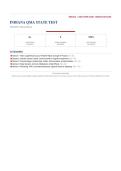
INDIANA · LONG-TERM CARE · MEDICATION AIDE
INDIANA QMA STATE TEST
2026/2027 Official Exam
A+ 5 100%
QUESTIONS EXAM DOMAINS RATIONALES
VERIFIED COVERED INCLUDED
CATEGORIES
■ Section 1: Role, Legal/Ethical Issues, Resident Rights & Scope of Practice (Q1–20)
■ Section 2: Infection Control, Safety, Communication & Cognitive Impairment (Q21–40)
■ Section 3: Pharmacology Fundamentals, Orders, Documentation & Administration (Q41–60)
■ Section 4: Body Systems, Common Medications & Side Effects (Q61–80)
■ Section 5: Monitoring, PRN, Controlled Substances, Special Routes & Reporting (Q81–100)
STUVIAACTUALEXAM
Original practice content aligned to publicly published Indiana QMA curriculum and scope of practice. Not an official product of the Indiana Department of Health.
, SECTION 1: ROLE, LEGAL/ETHICAL ISSUES, RESIDENT RIGHTS & SCOPE OF PRACTICE
Q1. A newly hired QMA is asked by a nursing assistant to give a resident an intramuscular injection of vitamin B12 because the
nurse is busy. The QMA should:
A. Call the pharmacy and ask whether the QMA may give injections at this facility.
B. Refuse and explain that intramuscular injections are outside the QMA scope of practice and must be performed by a licensed nurse.
C. Administer the injection and then document it under the nurse’s name.
D. Give the injection if the nursing assistant demonstrates the technique first.
Correct Answer: B
Rationale: Intramuscular, intravenous, subcutaneous, and intradermal injections are prohibited for QMAs under Indiana scope of practice.
Q2. A resident refuses a routinely scheduled oral medication. The QMA’s correct action is to:
A. Respect the refusal, document it, and report the refusal to the licensed nurse promptly.
B. Tell the resident that refusal is not allowed under facility policy.
C. Crush the medication and mix it in food without telling the resident.
D. Leave the medication at the bedside and hope the resident takes it later.
Correct Answer: A
Rationale: Residents have the right to refuse treatment. The QMA must respect the refusal, document accurately, and notify the nurse.
Q3. While counting controlled substances at shift change, the QMA notices that one tablet of a Schedule II medication is missing.
The first action should be to:
A. Wait until the end of the shift to see if the tablet is found.
B. Document the count as correct to avoid delaying the medication pass.
C. Borrow a tablet from another resident’s supply to make the count correct.
D. Report the discrepancy immediately to the licensed nurse and follow facility policy for controlled-substance discrepancies.
Correct Answer: D
Rationale: Any controlled-substance discrepancy must be reported at once; accuracy and accountability are legal requirements.
Q4. A family member asks the QMA to look up a resident’s diagnosis and medication list so the family can discuss it at home. The
QMA should:
A. Provide a written copy of the medication administration record.
B. Verbally list all diagnoses because the family has a right to know.
C. Decline to share protected health information and refer the family to the licensed nurse or the resident’s authorized representative.
D. Allow the family to read the chart at the nursing station without supervision.
Correct Answer: C
Rationale: QMAs must protect resident confidentiality under HIPAA and facility policy; disclosures are limited to authorized persons.
Q5. The QMA’s scope of practice includes which of the following tasks?
A. Administering regularly prescribed oral, topical, eye, ear, nasal, vaginal, and rectal medications after personal preparation and
documenting only what the QMA administered.
B. Starting intravenous fluids and adjusting the drip rate.
C. Administering medications by any injectable route when the nurse is unavailable.
D. Ordering new medications from the pharmacy without a physician’s order.
Correct Answer: A
Rationale: Indiana QMA scope permits specified non-injectable routes when the QMA personally prepares and administers the dose and
documents only own actions.
STUVIAACTUALEXAM | Page 2 of 20
, Q6. A QMA observes another staff member roughly handling a resident and speaking to the resident in a demeaning way. The
QMA must:
A. Document the incident only in a personal notebook.
B. Report the observed abuse or mistreatment to the licensed nurse or facility supervisor according to state and facility policy.
C. Ignore the behavior if the resident does not complain.
D. Confront the staff member privately and then take no further action.
Correct Answer: B
Rationale: QMAs are mandatory reporters of suspected abuse, neglect, or mistreatment; immediate reporting protects the resident.
Q7. Before administering any medication, the QMA must verify the “six rights.” One of those rights is:
A. Right physician, right pharmacy, right insurance, right diagnosis, right room, and right bed.
B. Right family member, right visitor, right shift, right unit, right chart, and right nurse.
C. Right color, right shape, right size, right smell, right taste, and right cost.
D. Right resident, right medication, right dose, right route, right time, and right documentation.
Correct Answer: D
Rationale: The six rights are the foundation of safe medication administration and must be confirmed every time.
Q8. A physician’s order reads “give acetaminophen 650 mg PO every 6 hours PRN for pain.” The QMA may administer this PRN
medication only when:
A. Authorization is obtained from the facility’s licensed nurse on duty or on call before each PRN dose.
B. The resident asks for it and the QMA decides the pain level is sufficient.
C. The family requests the medication on the resident’s behalf.
D. The previous dose was given more than four hours ago.
Correct Answer: A
Rationale: Indiana rules require licensed-nurse authorization before a QMA administers any previously ordered PRN medication.
Q9. The QMA is preparing to crush a medication for a resident with dysphagia. Before crushing, the QMA must:
A. Confirm that the medication may be crushed according to manufacturer guidelines or a specific physician order and that an
appropriate vehicle is used.
B. Crush enteric-coated and extended-release tablets without checking.
C. Crush every tablet to make administration easier for all residents.
D. Mix the crushed medication into a full meal tray so the resident does not notice.
Correct Answer: A
Rationale: Not all medications can be crushed; doing so can alter absorption or cause harm. Verification is required.
Q10. A QMA documents a medication as given but later realizes the resident did not actually swallow it. The correct action is to:
A. Leave the documentation as written because the medication was offered.
B. Ask another QMA to change the documentation entry.
C. Notify the licensed nurse immediately, document the actual situation accurately, and follow facility policy for medication errors.
D. Wait to see whether the resident experiences any side effects before reporting.
Correct Answer: C
Rationale: Accurate documentation and prompt reporting of errors or omissions protect the resident and meet legal standards.
Q11. Resident rights include the right to:
A. Order the QMA to leave controlled substances unlocked for easy access.
B. Demand that the QMA administer medications by injection.
C. Require the QMA to share other residents’ medical information.
D. Be treated with dignity, refuse medications, and have personal and medical information kept confidential.
Correct Answer: D
Rationale: Core resident rights include dignity, refusal of treatment, and confidentiality; QMAs must uphold them.
STUVIAACTUALEXAM | Page 3 of 20

