
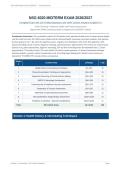
NSG 6020 Midterm Exam 2026/2027 — South University Advanced Health & Physical Assessment
NSG 6020 MIDTERM EXAM 2026/2027
Complete Exam with 120 Verified Questions and 100% Correct Answers (Graded A+)
South University • Advanced Health and Physical Assessment
Aligned with APRN Consensus Model Competencies (2026/2027 Edition)
Examination Instructions: This examination consists of 120 multiple-choice questions divided across 9 content sections aligned
with the South University NSG 6020 course syllabus and the Advanced Health Assessment curriculum standards. Each question
has four options (A, B, C, D); select the single best answer. Cognitive level distribution: 20% recall, 50% application, 30%
analysis (including clinical scenarios, diagnostic reasoning, and prioritization). Approximately 75% of items are scenario-based
(clinical cases, patient presentations, diagnostic reasoning); 25% are direct knowledge items. Recommended time: 2.5 hours
(approximately 75 seconds per item). The exam includes 20 clinical scenario questions, 15 advanced assessment technique
questions (pediatric, geriatric, cultural considerations), and 10 red-flag/urgent-finding items. Marked correct answers are
indicated by *[CORRECT]*; rationales follow each question.
Sectio
Content Area Q Range # Qs
n
1 Health History & Interviewing Techniques Q1–Q15 15
2 Physical Examination Techniques & Approaches Q16–Q30 15
3 Diagnostic Reasoning & Clinical Decision-Making Q31–Q45 15
4 HEENT & Neurologic Assessment Q46–Q60 15
5 Cardiovascular & Peripheral Vascular Assessment Q61–Q75 15
6 Respiratory & Thoracic Assessment Q76–Q87 12
7 Abdominal & Gastrointestinal Assessment Q88–Q99 12
8 Musculoskeletal & Integumentary Assessment Q100–Q109 10
9 Pediatrics & Geriatrics – Special Considerations Q110–Q120 11
Total All Content Areas Q1–Q120 120
Section 1: Health History & Interviewing Techniques
Graded A+ Examination | 120 Verified Questions Page 1
,NSG 6020 Midterm Exam 2026/2027 — South University Advanced Health & Physical Assessment
Q1: A 42-year-old woman presents with abdominal pain. The nurse practitioner uses the OLDCARTS
mnemonic to structure the history of present illness. Which component of OLDCARTS addresses the factors
that make the symptom worse?
A. Onset
B. Characteristics
C. Aggravating factors *[CORRECT]*
D. Timing
Correct Answer: C
Rationale: In the OLDCARTS mnemonic, 'A' represents aggravating factors — elements that worsen the symptom, such as
movement, food, or stress. Onset refers to when the symptom began, characteristics describe its quality (sharp, dull, burning),
and timing refers to its pattern (constant, intermittent, episodic). South University NSG 6020 curriculum emphasizes
OLDCARTS as the standard framework for a complete HPI.
Q2: During a comprehensive health history, the nurse practitioner asks a patient, 'What brings you to the
clinic today?' The patient's response is documented in which section of the health history?
A. Chief complaint *[CORRECT]*
B. Review of systems
C. Family history
D. Past medical history
Correct Answer: A
Rationale: The chief complaint is the patient's own statement of the reason for the visit, usually recorded in the patient's
words in quotation marks. It is distinct from the HPI, which expands on the chief complaint using OLDCARTS, and from the
ROS, which is a structured inventory of body systems. Past medical and family histories document prior conditions and
familial risk, not the present reason for the encounter.
Q3: Which statement best distinguishes the review of systems (ROS) from the physical examination?
A. The ROS focuses only on the cardiovascular and respiratory systems.
B. The ROS is a subjective inventory of body systems obtained through patient interview; the physical
examination is objective data gathered through inspection, palpation, percussion, and auscultation.
*[CORRECT]*
C. The ROS is performed only when the physical examination is abnormal.
D. The ROS and physical examination are interchangeable terms for the same process.
Correct Answer: B
Rationale: The ROS is a subjective, patient-reported inventory of symptoms organized by body system, obtained through
directed questioning during the interview. The physical examination yields objective data through the four examination
techniques. South University NSG 6020 emphasizes that ROS and physical exam are complementary but distinct — ROS
captures what the patient feels, while physical exam captures what the clinician observes and measures.
Graded A+ Examination | 120 Verified Questions Page 2
,NSG 6020 Midterm Exam 2026/2027 — South University Advanced Health & Physical Assessment
Q4: A nurse practitioner documents, 'Patient reports sharp chest pain for 3 days, worse with deep
inspiration.' This finding represents which type of data?
A. Subjective data obtained from the patient's report *[CORRECT]*
B. Objective data obtained through auscultation
C. Laboratory data obtained from diagnostic testing
D. Objective data obtained through palpation
Correct Answer: A
Rationale: Subjective data are symptoms reported by the patient — such as pain quality, duration, and modifiers — obtained
during the interview. Objective data are observable, measurable findings gathered through inspection, palpation, percussion,
auscultation, or diagnostic testing. The phrase 'patient reports' is the key indicator of subjective data. Distinguishing
subjective from objective data is fundamental to accurate documentation in the South University NSG 6020 curriculum.
Q5: Which interviewing technique is most appropriate to begin a comprehensive health history with a new
patient?
A. Asking 'Have you ever been hospitalized?'
B. Asking 'What brings you in to see us today?' *[CORRECT]*
C. Asking 'Do you have any chest pain today?'
D. Asking 'Are you taking your medications as prescribed?'
Correct Answer: B
Rationale: Open-ended questions such as 'What brings you in to see us today?' invite the patient to describe concerns in their
own words and yield richer, more accurate information. The other options are closed (yes/no) questions, which are useful
later for clarification but tend to limit the patient's response when used to open an interview. South University NSG 6020
teaches that interviews should begin open-ended and progressively narrow to closed, focused questions.
Q6: A patient with poorly controlled type 2 diabetes says, 'I know I should eat better, but I just can't seem to
do it.' Which response by the nurse practitioner best demonstrates motivational interviewing?
A. 'I'm going to refer you to a dietitian who will give you a meal plan.'
B. 'It sounds like healthy eating is important to you, but you're finding it difficult. What have you tried so
far?' *[CORRECT]*
C. 'You really need to control your diet or you will lose a foot.'
D. 'Why don't you just try harder?'
Correct Answer: B
Rationale: Motivational interviewing uses reflective listening, open-ended questions, and affirmation to elicit the patient's
own motivation for change. Reflecting the patient's statement and inviting them to explore solutions respects autonomy and
reduces resistance. Lecturing, threatening, or simply referring undermines self-efficacy. The South University curriculum
emphasizes motivational interviewing as a core skill for behavior-change conversations.
Graded A+ Examination | 120 Verified Questions Page 3
, NSG 6020 Midterm Exam 2026/2027 — South University Advanced Health & Physical Assessment
Q7: When conducting a health history with a patient from a cultural background different from the nurse
practitioner's, which framework best guides culturally sensitive care?
A. SPIKES (Setting, Perception, Invitation, Knowledge, Empathy, Strategy)
B. LEARN (Listen, Explain, Acknowledge, Recommend, Negotiate) *[CORRECT]*
C. SBAR (Situation, Background, Assessment, Recommendation)
D. OLDCARTS
Correct Answer: B
Rationale: The LEARN model (Berlin and Fowkes) guides culturally sensitive encounters: Listen to the patient's perception,
Explain your perception, Acknowledge similarities and differences, Recommend a plan, and Negotiate agreement. SBAR is
for clinical handoffs, OLDCARTS structures the HPI, and SPIKES is used for delivering bad news. The South University
curriculum integrates LEARN within its cultural competence module of advanced health assessment.
Q8: When teaching testicular self-examination to a 20-year-old male patient, the nurse practitioner should
recommend performing the examination:
A. Monthly, after a warm bath or shower when the scrotum is relaxed *[CORRECT]*
B. Weekly, after a warm shower
C. Only if a lump is felt
D. Annually, during a clinical visit
Correct Answer: A
Rationale: Testicular self-examination is recommended monthly, ideally after a warm bath or shower when the scrotal skin is
relaxed and the testicles are descended, making palpation easier. Weekly examination is excessive and may cause anxiety,
while annual-only examination delays detection of fast-growing tumors. Testicular cancer is the most common solid
malignancy in men aged 15-35, making monthly self-exam a high-yield health promotion behavior emphasized in NSG 6020.
Q9: A 32-year-old woman asks about breast self-examination (BSE). The nurse practitioner's best response is:
A. BSE should be performed only during annual clinical visits.
B. BSE should be performed 3-5 days after the menstrual period ends, when breasts are least tender.
*[CORRECT]*
C. BSE is no longer recommended under any circumstances.
D. BSE should be performed every day.
Correct Answer: B
Rationale: For menstruating women, BSE is best performed 3-5 days after the menstrual period ends, when hormonal
influence on breast tissue is lowest and breasts are least tender or swollen. Postmenopausal women should pick a fixed
calendar day each month. While the USPSTF notes BSE is an individual decision based on risk and preference, NSG 6020
teaches the proper technique and timing for women who choose to perform it.
Graded A+ Examination | 120 Verified Questions Page 4
NSG 6020 MIDTERM EXAM 2026/2027
Complete Exam with 120 Verified Questions and 100% Correct Answers (Graded A+)
South University • Advanced Health and Physical Assessment
Aligned with APRN Consensus Model Competencies (2026/2027 Edition)
Examination Instructions: This examination consists of 120 multiple-choice questions divided across 9 content sections aligned
with the South University NSG 6020 course syllabus and the Advanced Health Assessment curriculum standards. Each question
has four options (A, B, C, D); select the single best answer. Cognitive level distribution: 20% recall, 50% application, 30%
analysis (including clinical scenarios, diagnostic reasoning, and prioritization). Approximately 75% of items are scenario-based
(clinical cases, patient presentations, diagnostic reasoning); 25% are direct knowledge items. Recommended time: 2.5 hours
(approximately 75 seconds per item). The exam includes 20 clinical scenario questions, 15 advanced assessment technique
questions (pediatric, geriatric, cultural considerations), and 10 red-flag/urgent-finding items. Marked correct answers are
indicated by *[CORRECT]*; rationales follow each question.
Sectio
Content Area Q Range # Qs
n
1 Health History & Interviewing Techniques Q1–Q15 15
2 Physical Examination Techniques & Approaches Q16–Q30 15
3 Diagnostic Reasoning & Clinical Decision-Making Q31–Q45 15
4 HEENT & Neurologic Assessment Q46–Q60 15
5 Cardiovascular & Peripheral Vascular Assessment Q61–Q75 15
6 Respiratory & Thoracic Assessment Q76–Q87 12
7 Abdominal & Gastrointestinal Assessment Q88–Q99 12
8 Musculoskeletal & Integumentary Assessment Q100–Q109 10
9 Pediatrics & Geriatrics – Special Considerations Q110–Q120 11
Total All Content Areas Q1–Q120 120
Section 1: Health History & Interviewing Techniques
Graded A+ Examination | 120 Verified Questions Page 1
,NSG 6020 Midterm Exam 2026/2027 — South University Advanced Health & Physical Assessment
Q1: A 42-year-old woman presents with abdominal pain. The nurse practitioner uses the OLDCARTS
mnemonic to structure the history of present illness. Which component of OLDCARTS addresses the factors
that make the symptom worse?
A. Onset
B. Characteristics
C. Aggravating factors *[CORRECT]*
D. Timing
Correct Answer: C
Rationale: In the OLDCARTS mnemonic, 'A' represents aggravating factors — elements that worsen the symptom, such as
movement, food, or stress. Onset refers to when the symptom began, characteristics describe its quality (sharp, dull, burning),
and timing refers to its pattern (constant, intermittent, episodic). South University NSG 6020 curriculum emphasizes
OLDCARTS as the standard framework for a complete HPI.
Q2: During a comprehensive health history, the nurse practitioner asks a patient, 'What brings you to the
clinic today?' The patient's response is documented in which section of the health history?
A. Chief complaint *[CORRECT]*
B. Review of systems
C. Family history
D. Past medical history
Correct Answer: A
Rationale: The chief complaint is the patient's own statement of the reason for the visit, usually recorded in the patient's
words in quotation marks. It is distinct from the HPI, which expands on the chief complaint using OLDCARTS, and from the
ROS, which is a structured inventory of body systems. Past medical and family histories document prior conditions and
familial risk, not the present reason for the encounter.
Q3: Which statement best distinguishes the review of systems (ROS) from the physical examination?
A. The ROS focuses only on the cardiovascular and respiratory systems.
B. The ROS is a subjective inventory of body systems obtained through patient interview; the physical
examination is objective data gathered through inspection, palpation, percussion, and auscultation.
*[CORRECT]*
C. The ROS is performed only when the physical examination is abnormal.
D. The ROS and physical examination are interchangeable terms for the same process.
Correct Answer: B
Rationale: The ROS is a subjective, patient-reported inventory of symptoms organized by body system, obtained through
directed questioning during the interview. The physical examination yields objective data through the four examination
techniques. South University NSG 6020 emphasizes that ROS and physical exam are complementary but distinct — ROS
captures what the patient feels, while physical exam captures what the clinician observes and measures.
Graded A+ Examination | 120 Verified Questions Page 2
,NSG 6020 Midterm Exam 2026/2027 — South University Advanced Health & Physical Assessment
Q4: A nurse practitioner documents, 'Patient reports sharp chest pain for 3 days, worse with deep
inspiration.' This finding represents which type of data?
A. Subjective data obtained from the patient's report *[CORRECT]*
B. Objective data obtained through auscultation
C. Laboratory data obtained from diagnostic testing
D. Objective data obtained through palpation
Correct Answer: A
Rationale: Subjective data are symptoms reported by the patient — such as pain quality, duration, and modifiers — obtained
during the interview. Objective data are observable, measurable findings gathered through inspection, palpation, percussion,
auscultation, or diagnostic testing. The phrase 'patient reports' is the key indicator of subjective data. Distinguishing
subjective from objective data is fundamental to accurate documentation in the South University NSG 6020 curriculum.
Q5: Which interviewing technique is most appropriate to begin a comprehensive health history with a new
patient?
A. Asking 'Have you ever been hospitalized?'
B. Asking 'What brings you in to see us today?' *[CORRECT]*
C. Asking 'Do you have any chest pain today?'
D. Asking 'Are you taking your medications as prescribed?'
Correct Answer: B
Rationale: Open-ended questions such as 'What brings you in to see us today?' invite the patient to describe concerns in their
own words and yield richer, more accurate information. The other options are closed (yes/no) questions, which are useful
later for clarification but tend to limit the patient's response when used to open an interview. South University NSG 6020
teaches that interviews should begin open-ended and progressively narrow to closed, focused questions.
Q6: A patient with poorly controlled type 2 diabetes says, 'I know I should eat better, but I just can't seem to
do it.' Which response by the nurse practitioner best demonstrates motivational interviewing?
A. 'I'm going to refer you to a dietitian who will give you a meal plan.'
B. 'It sounds like healthy eating is important to you, but you're finding it difficult. What have you tried so
far?' *[CORRECT]*
C. 'You really need to control your diet or you will lose a foot.'
D. 'Why don't you just try harder?'
Correct Answer: B
Rationale: Motivational interviewing uses reflective listening, open-ended questions, and affirmation to elicit the patient's
own motivation for change. Reflecting the patient's statement and inviting them to explore solutions respects autonomy and
reduces resistance. Lecturing, threatening, or simply referring undermines self-efficacy. The South University curriculum
emphasizes motivational interviewing as a core skill for behavior-change conversations.
Graded A+ Examination | 120 Verified Questions Page 3
, NSG 6020 Midterm Exam 2026/2027 — South University Advanced Health & Physical Assessment
Q7: When conducting a health history with a patient from a cultural background different from the nurse
practitioner's, which framework best guides culturally sensitive care?
A. SPIKES (Setting, Perception, Invitation, Knowledge, Empathy, Strategy)
B. LEARN (Listen, Explain, Acknowledge, Recommend, Negotiate) *[CORRECT]*
C. SBAR (Situation, Background, Assessment, Recommendation)
D. OLDCARTS
Correct Answer: B
Rationale: The LEARN model (Berlin and Fowkes) guides culturally sensitive encounters: Listen to the patient's perception,
Explain your perception, Acknowledge similarities and differences, Recommend a plan, and Negotiate agreement. SBAR is
for clinical handoffs, OLDCARTS structures the HPI, and SPIKES is used for delivering bad news. The South University
curriculum integrates LEARN within its cultural competence module of advanced health assessment.
Q8: When teaching testicular self-examination to a 20-year-old male patient, the nurse practitioner should
recommend performing the examination:
A. Monthly, after a warm bath or shower when the scrotum is relaxed *[CORRECT]*
B. Weekly, after a warm shower
C. Only if a lump is felt
D. Annually, during a clinical visit
Correct Answer: A
Rationale: Testicular self-examination is recommended monthly, ideally after a warm bath or shower when the scrotal skin is
relaxed and the testicles are descended, making palpation easier. Weekly examination is excessive and may cause anxiety,
while annual-only examination delays detection of fast-growing tumors. Testicular cancer is the most common solid
malignancy in men aged 15-35, making monthly self-exam a high-yield health promotion behavior emphasized in NSG 6020.
Q9: A 32-year-old woman asks about breast self-examination (BSE). The nurse practitioner's best response is:
A. BSE should be performed only during annual clinical visits.
B. BSE should be performed 3-5 days after the menstrual period ends, when breasts are least tender.
*[CORRECT]*
C. BSE is no longer recommended under any circumstances.
D. BSE should be performed every day.
Correct Answer: B
Rationale: For menstruating women, BSE is best performed 3-5 days after the menstrual period ends, when hormonal
influence on breast tissue is lowest and breasts are least tender or swollen. Postmenopausal women should pick a fixed
calendar day each month. While the USPSTF notes BSE is an individual decision based on risk and preference, NSG 6020
teaches the proper technique and timing for women who choose to perform it.
Graded A+ Examination | 120 Verified Questions Page 4

