

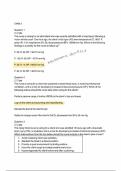
EXAM 3
Question 1
2/2pts
The nurse is caring for an adult client who was recently admitted with a head injury following a
motor vehicle crash. One hour ago, the client’s vital signs (VS) were temperature (T): 98.6° F;
pulse (P): 110; respirations (R): 26; blood pressure (BP): 128/68 mm Hg. Which of the following
findings is a priority for the nurse to follow up?
P:90; R: 32; BP: 130/72 mm Hg d
N&.t/
P:120; R: 26; BP: 110/70 mm Hg m{\O
P:56; R: 14; BP: 166/52 mm Hg.
P:64; R:30; BP: 148/78 mm Hg
Question 2
2/2pts
The nurse is caring for a client who sustained a closed head injury, is receiving mechanical
ventilation, and is at risk for developing increased intracranial pressure (ICP). Which of the
following actions should the nurse take when caring for this client?
Perform passive range of motion (ROM) to the client’s hips and knees
Log roll the client during turning and repositioning.
Elevate the foot of the client’s bed
Notify the charge nurse if the client’s PaCO, decreases from 39 to 35 mm Hg
Question 3
2/2pts
The newly hired nurse is caring for a client who was admitted 12 hours ago with a traumatic
brain injury (TBI), is intubated, and is at risk for developing increased intracranial pressure (ICP).
Which interventions from the box below should the nurse include in the client’s plan of care?
1. Avoid clustering client care activities.-
2. Maintain the head in a flexed position.-
3. Provide a quiet environment by limiting visitors.-
4 Have the client cough and deep breathe every hour.-
5 Hyperoxygenate the client before and after suctioning.-
, 6. Avoid maintaining hips in a flexed position.-
1,3,4,5
1,3,
5, 6.
1,2,4,6
2,4,6
Question 4
2/2pts
The nurse working in the intensive care unit (ICU) is assessing a client who sustained a basilar
skull fracture 24 hours ago. It is most important to follow up with the primary health care
provider (PHCP) if the client
€, \N 5\"8M
becomes irritable and restless.
EEANCAN
has bruises under the eyes.
is unable to name the state capital.
reports having a persistent headache since admission. .=
Question 5
2/2pts
The nurse is assessing a client who has experienced a mild traumatic brain injury (TBI). Which
findings from the box below are consistent with this diagnosis?
1. Dizziness and gait problems.-y
A widened pulse pressure.-n
Increased sensitivity to light or noise.-y
ov AL
A Glasgow Coma Scale (GCS) score of 9.-n
Dilated pupils that are nonreactive to light.-n
Amnesia about the events around the time of
injury.-y
1,3,6.
3,5,6
2,3,4, 5n
1,2,4,6-n
, Question 6
2/2pts
The nurse is providing discharge instructions to the parents of a 15-year-old female who
sustained a concussion while playing field hockey. Which of the following statements by a
parent indicates a need for further teaching?
"We should avoid giving any acetaminophen to treat headaches."-
"We need to bring our daughter back to the emergency department if she exhibits blurred
vision."
"We should provide a consistent routine at home to assist with any behavior changes."
"We will not allow our daughter to engage in strenuous activity for at least 48 hours."
Question 7
2/2pts
The nurse is assessing clients for the risk of sustaining a traumatic brain injury (TBI). Which of
the following clients should the nurse identify as being at greatest risk?
45-year-old who has epilepsy and takes phenytoin
75-year-old who lives alone and has macular degeneration.
7-year-old who is learning how to ride a bicycle without training wheels
20-year-old college student who participates on the tennis team
Question 8
2/2pts
The nurse is providing discharge instructions to the partner of a client who sustained a mild
head injury as a result of a motor vehicle crash. Which of the following statements by a partner
indicates a need for further teaching?
“It is expected that my partner will have drainage from the nose for the next few days.”-
“I will provide my partner with acetaminophen every 4 hours for headache.”
Question 1
2/2pts
The nurse is caring for an adult client who was recently admitted with a head injury following a
motor vehicle crash. One hour ago, the client’s vital signs (VS) were temperature (T): 98.6° F;
pulse (P): 110; respirations (R): 26; blood pressure (BP): 128/68 mm Hg. Which of the following
findings is a priority for the nurse to follow up?
P:90; R: 32; BP: 130/72 mm Hg d
N&.t/
P:120; R: 26; BP: 110/70 mm Hg m{\O
P:56; R: 14; BP: 166/52 mm Hg.
P:64; R:30; BP: 148/78 mm Hg
Question 2
2/2pts
The nurse is caring for a client who sustained a closed head injury, is receiving mechanical
ventilation, and is at risk for developing increased intracranial pressure (ICP). Which of the
following actions should the nurse take when caring for this client?
Perform passive range of motion (ROM) to the client’s hips and knees
Log roll the client during turning and repositioning.
Elevate the foot of the client’s bed
Notify the charge nurse if the client’s PaCO, decreases from 39 to 35 mm Hg
Question 3
2/2pts
The newly hired nurse is caring for a client who was admitted 12 hours ago with a traumatic
brain injury (TBI), is intubated, and is at risk for developing increased intracranial pressure (ICP).
Which interventions from the box below should the nurse include in the client’s plan of care?
1. Avoid clustering client care activities.-
2. Maintain the head in a flexed position.-
3. Provide a quiet environment by limiting visitors.-
4 Have the client cough and deep breathe every hour.-
5 Hyperoxygenate the client before and after suctioning.-
, 6. Avoid maintaining hips in a flexed position.-
1,3,4,5
1,3,
5, 6.
1,2,4,6
2,4,6
Question 4
2/2pts
The nurse working in the intensive care unit (ICU) is assessing a client who sustained a basilar
skull fracture 24 hours ago. It is most important to follow up with the primary health care
provider (PHCP) if the client
€, \N 5\"8M
becomes irritable and restless.
EEANCAN
has bruises under the eyes.
is unable to name the state capital.
reports having a persistent headache since admission. .=
Question 5
2/2pts
The nurse is assessing a client who has experienced a mild traumatic brain injury (TBI). Which
findings from the box below are consistent with this diagnosis?
1. Dizziness and gait problems.-y
A widened pulse pressure.-n
Increased sensitivity to light or noise.-y
ov AL
A Glasgow Coma Scale (GCS) score of 9.-n
Dilated pupils that are nonreactive to light.-n
Amnesia about the events around the time of
injury.-y
1,3,6.
3,5,6
2,3,4, 5n
1,2,4,6-n
, Question 6
2/2pts
The nurse is providing discharge instructions to the parents of a 15-year-old female who
sustained a concussion while playing field hockey. Which of the following statements by a
parent indicates a need for further teaching?
"We should avoid giving any acetaminophen to treat headaches."-
"We need to bring our daughter back to the emergency department if she exhibits blurred
vision."
"We should provide a consistent routine at home to assist with any behavior changes."
"We will not allow our daughter to engage in strenuous activity for at least 48 hours."
Question 7
2/2pts
The nurse is assessing clients for the risk of sustaining a traumatic brain injury (TBI). Which of
the following clients should the nurse identify as being at greatest risk?
45-year-old who has epilepsy and takes phenytoin
75-year-old who lives alone and has macular degeneration.
7-year-old who is learning how to ride a bicycle without training wheels
20-year-old college student who participates on the tennis team
Question 8
2/2pts
The nurse is providing discharge instructions to the partner of a client who sustained a mild
head injury as a result of a motor vehicle crash. Which of the following statements by a partner
indicates a need for further teaching?
“It is expected that my partner will have drainage from the nose for the next few days.”-
“I will provide my partner with acetaminophen every 4 hours for headache.”

