

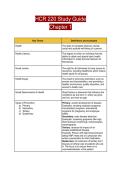
HCR 220 Study Guide
Chapter 1
Key Terms Definitions and examples
Health The state of complete physical, mental,
social and spiritual well-being of a person.
Health Literacy The degree to which an individual has the
ability to obtain and absorb basic health
information to make the best decision for
themselves.
Social Justice The right for all individuals to have access to
resources, including healthcare which means
health equity for all groups.
Health Equity The result of removing restrictions, such as
poverty and discrimination, and providing a
healthy environment, quality education, and
access to health care.
Social Determinants of Health Direct factors or elements that influence the
conditions we are born in, where we grow,
and live, and how we age.
Types of Prevention Primary: avoids development of disease.
a) Primary Examples: smoking cessation programs,
b) Secondary immunization programs, educational
c) Tertiary programs for pregnancy and employee
d) Quaternary safety.
Secondary: early disease detection
Examples: screening programs (like high
blood pressure screening), colonoscopies,
mammograms.
Tertiary: reduces the impact of an
already-established disease.
Example: Person with high blood pressure
taking HBP meds and or a physician who
writes a prescription for that medication.
Quaternary: An extension of tertiary but it
focuses on ethical care of patients who are
ill. The focus is to ensure there is no
overmedicalization of the patient.
Chapter 1
Key Terms Definitions and examples
Health The state of complete physical, mental,
social and spiritual well-being of a person.
Health Literacy The degree to which an individual has the
ability to obtain and absorb basic health
information to make the best decision for
themselves.
Social Justice The right for all individuals to have access to
resources, including healthcare which means
health equity for all groups.
Health Equity The result of removing restrictions, such as
poverty and discrimination, and providing a
healthy environment, quality education, and
access to health care.
Social Determinants of Health Direct factors or elements that influence the
conditions we are born in, where we grow,
and live, and how we age.
Types of Prevention Primary: avoids development of disease.
a) Primary Examples: smoking cessation programs,
b) Secondary immunization programs, educational
c) Tertiary programs for pregnancy and employee
d) Quaternary safety.
Secondary: early disease detection
Examples: screening programs (like high
blood pressure screening), colonoscopies,
mammograms.
Tertiary: reduces the impact of an
already-established disease.
Example: Person with high blood pressure
taking HBP meds and or a physician who
writes a prescription for that medication.
Quaternary: An extension of tertiary but it
focuses on ethical care of patients who are
ill. The focus is to ensure there is no
overmedicalization of the patient.

