
PHTLS 9th Edition Provider Exam | 100 Questions | Grade A Verified Answers
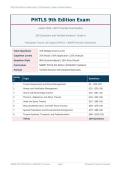
PHTLS 9th Edition Exam
Latest Provider Examination
100 Questions and Verified Answers | Grade A
Prehospital Trauma Life Support (PHTLS) • NAEMT Provider Certification
Total Questions 100 Multiple Choice (A-D)
Cognitive Levels 25% Recall | 50% Application | 25% Analysis
Question Style 80% Scenario-Based | 20% Direct Recall
Curriculum NAEMT PHTLS 9th Edition (2026/2027 Updates)
Format Verified Answers with Detailed Rationales
Sectio
Topic Questions
n
1 Trauma Assessment and Scene Management Q1 - Q20 (20)
2 Airway and Ventilation Management Q21 - Q30 (10)
3 Shock and Hemorrhage Control Q31 - Q42 (12)
4 Thoracic, Abdominal, and Pelvic Trauma Q43 - Q56 (14)
5 Head and Spine Trauma Q57 - Q68 (12)
6 Musculoskeletal, Burn, and Soft Tissue Trauma Q69 - Q78 (10)
7 Special Populations and Environmental Emergencies Q79 - Q88 (10)
8 Trauma Systems, Transport, and Professionalism Q89 - Q100 (12)
TOTAL 100 Questions
NAEMT PHTLS 9th Edition | 2026/2027 Curriculum Page 1 Prehospital Trauma Life Support
,PHTLS 9th Edition Provider Exam | 100 Questions | Grade A Verified Answers
Section 1: Trauma Assessment and Scene Management
Scene Safety, Primary Survey, Secondary Survey, & Rapid Transport
Q1: You arrive on scene to a two-vehicle MVC with downed power lines across
one vehicle. Steam is rising from a cracked radiator, and one patient is
screaming for help inside the vehicle touching the power lines. What is your
FIRST action?
A. Approach the vehicle quickly while maintaining a low center of gravity
B. Establish a danger zone of at least one full span of the downed power line in all
directions and request utility company response [CORRECT]
C. Use a dry wooden broom handle to push the power line off the vehicle
D. Quickly extract the screaming patient using a long spine board
Correct Answer: B | Establish a danger zone of at least one full span of the
downed power line in all directions and request utility company response
Rationale:
Scene safety is the absolute first priority in PHTLS 9th Edition, and downed power lines require
establishing a danger zone equal to at least one full span of the wire in every direction, plus
notifying the utility company for confirmed de-energization. Approaching, pushing the wire, or
extracting the patient before power is confirmed off places the rescuer at lethal risk of
electrocution and creates additional patients. PHTLS emphasizes that no patient care action
should precede a safe scene, even when a patient is visibly suffering. Only after the utility
company confirms the line is de-energized should rescuers enter the danger zone.
Q2: During scene size-up at a factory explosion, you identify chemical residue,
multiple casualties, and an unresponsive worker in the hot zone. Which action
best reflects the PHTLS 9th Edition principle of situational awareness?
A. Don structural firefighting PPE and immediately remove the unresponsive worker
B. Identify the chemical using placards/SDS, establish hot/warm/cold zones, and
wait for a trained hazmat team to perform rescue [CORRECT]
C. Move all ambulatory patients to the cold zone before any chemical identification
D. Begin triage of all visible patients while wearing standard BSI gloves
Correct Answer: B | Identify the chemical using placards/SDS, establish
hot/warm/cold zones, and wait for a trained hazmat team to perform rescue
Rationale:
PHTLS 9th Edition reinforces that situational awareness requires identifying hazards (chemical
identification via placards, SDS, or CHEMTREC), establishing zones, and recognizing personal
limitations before any patient contact. Entering a hot zone without proper PPE and training
creates additional casualties and violates the principle that rescuer safety supersedes patient
care. Moving patients before chemical identification risks cross-contamination, and standard
gloves provide no chemical protection. Hazmat-trained teams with appropriate Level A/B PPE
must perform rescue from the hot zone.
NAEMT PHTLS 9th Edition | 2026/2027 Curriculum Page 2 Prehospital Trauma Life Support
,PHTLS 9th Edition Provider Exam | 100 Questions | Grade A Verified Answers
Q3: You respond to a bar fight where one patient has a stab wound to the
chest and the assailant is still at large. Law enforcement is en route but not on
scene. What is the most appropriate action?
A. Begin primary survey on the stabbing victim while your partner maintains visual
surveillance
B. Stage the ambulance several blocks away in a safe location until law
enforcement secures the scene [CORRECT]
C. Remove the patient to the ambulance rapidly, then perform the primary survey en route
D. Enter the scene with a flashlight drawn to locate the assailant
Correct Answer: B | Stage the ambulance several blocks away in a safe location
until law enforcement secures the scene
Rationale:
PHTLS 9th Edition teaches that scenes involving violence or potential violence require staging
in a safe location until law enforcement explicitly secures the scene. Entering an unsecured
violent scene places EMS providers at risk of becoming additional victims and compromises
the entire response. Rapid removal without assessment is dangerous if the patient has a
life-threatening injury such as a tension pneumothorax, and provider weapons or self-defense
is outside the EMS scope. Law enforcement notification and scene security must precede
provider entry.
Q4: A 24-year-old unrestrained driver is extricated from a vehicle after a
high-speed frontal impact. The patient is unresponsive, has snoring
respirations, and a faint radial pulse. Using the PHTLS primary survey
sequence (ABCDE), what is your FIRST intervention?
A. Apply a cervical collar and log-roll to assess the back
B. Open the airway using the jaw-thrust maneuver and insert an oropharyngeal
airway [CORRECT]
C. Apply high-flow oxygen via non-rebreather mask at 15 L/min
D. Perform a rapid trauma assessment to identify life threats
Correct Answer: B | Open the airway using the jaw-thrust maneuver and insert an
oropharyngeal airway
Rationale:
PHTLS 9th Edition uses the ABCDE primary survey where Airway is the first priority after
catastrophic hemorrhage control (XABCDE in some integrated algorithms). Snoring
respirations indicate a partial upper airway obstruction from tongue displacement, which the
jaw-thrust maneuver corrects while maintaining cervical spine alignment. An oropharyngeal
airway (OPA) maintains airway patency in an unresponsive patient without a gag reflex.
Applying oxygen to an obstructed airway does not fix the obstruction, and full assessment of
the back or rapid trauma survey follows initial airway management. Cervical collar application
can wait seconds while the airway is opened.
NAEMT PHTLS 9th Edition | 2026/2027 Curriculum Page 3 Prehospital Trauma Life Support
, PHTLS 9th Edition Provider Exam | 100 Questions | Grade A Verified Answers
Q5: During the primary survey of a patient with a gunshot wound to the thigh,
you note bright red blood spurting from the wound. What is the correct
sequence of intervention per PHTLS 9th Edition?
A. Apply direct pressure, then a tourniquet proximal to the wound if bleeding is not
controlled
B. Apply a tourniquet immediately 2-3 inches proximal to the wound [CORRECT]
C. Pack the wound with hemostatic gauze and apply direct pressure
D. Apply pressure to the femoral artery at the groin
Correct Answer: B | Apply a tourniquet immediately 2-3 inches proximal to the
wound
Rationale:
PHTLS 9th Edition and the Stop the Bleed initiative emphasize that life-threatening extremity
hemorrhage with arterial spurting requires immediate tourniquet application 2-3 inches
proximal to the wound, not escalating from direct pressure first. Direct pressure is the
first-line intervention for compressible bleeding, but a clearly arterial bleed on an extremity
warrants immediate tourniquet placement to prevent exsanguination. Wound packing with
hemostatic agents is reserved for junctional wounds where tourniquets cannot be applied.
Femoral artery pressure points are less reliable than direct tourniquet application. Immediate
tourniquet use has been shown to dramatically improve survival in military and civilian
literature.
Q6: A patient involved in a 30-foot fall is alert and oriented with a patent
airway, RR 24, SpO2 96% on room air, and a radial pulse of 120. During the
secondary survey using DCAP-BTLS, what does the 'P' represent?
A. Pallor or pulsations
B. Punctures or penetrations [CORRECT]
C. Paresthesia or paralysis
D. Peritoneal signs
Correct Answer: B | Punctures or penetrations
Rationale:
DCAP-BTLS is the PHTLS 9th Edition acronym for secondary survey inspection and palpation of
the body: Deformities, Contusions, Abrasions, Punctures/Penetrations, Burns, Tenderness,
Lacerations, and Swelling. The 'P' specifically represents punctures or penetrations, which are
critical to identify because they may indicate underlying organ damage not immediately
visible. Pallor and peritoneal signs are assessment findings, not part of DCAP-BTLS.
Paresthesia and paralysis are neurologic findings assessed separately during the spinal cord
and peripheral nerve evaluation. Recognizing puncture wounds is essential because
penetrating injuries carry a high risk of internal organ, vascular, or cavity involvement.
Q7: Which of the following findings would be a critical (life-threatening)
finding identified during the primary survey requiring immediate intervention
NAEMT PHTLS 9th Edition | 2026/2027 Curriculum Page 4 Prehospital Trauma Life Support
PHTLS 9th Edition Exam
Latest Provider Examination
100 Questions and Verified Answers | Grade A
Prehospital Trauma Life Support (PHTLS) • NAEMT Provider Certification
Total Questions 100 Multiple Choice (A-D)
Cognitive Levels 25% Recall | 50% Application | 25% Analysis
Question Style 80% Scenario-Based | 20% Direct Recall
Curriculum NAEMT PHTLS 9th Edition (2026/2027 Updates)
Format Verified Answers with Detailed Rationales
Sectio
Topic Questions
n
1 Trauma Assessment and Scene Management Q1 - Q20 (20)
2 Airway and Ventilation Management Q21 - Q30 (10)
3 Shock and Hemorrhage Control Q31 - Q42 (12)
4 Thoracic, Abdominal, and Pelvic Trauma Q43 - Q56 (14)
5 Head and Spine Trauma Q57 - Q68 (12)
6 Musculoskeletal, Burn, and Soft Tissue Trauma Q69 - Q78 (10)
7 Special Populations and Environmental Emergencies Q79 - Q88 (10)
8 Trauma Systems, Transport, and Professionalism Q89 - Q100 (12)
TOTAL 100 Questions
NAEMT PHTLS 9th Edition | 2026/2027 Curriculum Page 1 Prehospital Trauma Life Support
,PHTLS 9th Edition Provider Exam | 100 Questions | Grade A Verified Answers
Section 1: Trauma Assessment and Scene Management
Scene Safety, Primary Survey, Secondary Survey, & Rapid Transport
Q1: You arrive on scene to a two-vehicle MVC with downed power lines across
one vehicle. Steam is rising from a cracked radiator, and one patient is
screaming for help inside the vehicle touching the power lines. What is your
FIRST action?
A. Approach the vehicle quickly while maintaining a low center of gravity
B. Establish a danger zone of at least one full span of the downed power line in all
directions and request utility company response [CORRECT]
C. Use a dry wooden broom handle to push the power line off the vehicle
D. Quickly extract the screaming patient using a long spine board
Correct Answer: B | Establish a danger zone of at least one full span of the
downed power line in all directions and request utility company response
Rationale:
Scene safety is the absolute first priority in PHTLS 9th Edition, and downed power lines require
establishing a danger zone equal to at least one full span of the wire in every direction, plus
notifying the utility company for confirmed de-energization. Approaching, pushing the wire, or
extracting the patient before power is confirmed off places the rescuer at lethal risk of
electrocution and creates additional patients. PHTLS emphasizes that no patient care action
should precede a safe scene, even when a patient is visibly suffering. Only after the utility
company confirms the line is de-energized should rescuers enter the danger zone.
Q2: During scene size-up at a factory explosion, you identify chemical residue,
multiple casualties, and an unresponsive worker in the hot zone. Which action
best reflects the PHTLS 9th Edition principle of situational awareness?
A. Don structural firefighting PPE and immediately remove the unresponsive worker
B. Identify the chemical using placards/SDS, establish hot/warm/cold zones, and
wait for a trained hazmat team to perform rescue [CORRECT]
C. Move all ambulatory patients to the cold zone before any chemical identification
D. Begin triage of all visible patients while wearing standard BSI gloves
Correct Answer: B | Identify the chemical using placards/SDS, establish
hot/warm/cold zones, and wait for a trained hazmat team to perform rescue
Rationale:
PHTLS 9th Edition reinforces that situational awareness requires identifying hazards (chemical
identification via placards, SDS, or CHEMTREC), establishing zones, and recognizing personal
limitations before any patient contact. Entering a hot zone without proper PPE and training
creates additional casualties and violates the principle that rescuer safety supersedes patient
care. Moving patients before chemical identification risks cross-contamination, and standard
gloves provide no chemical protection. Hazmat-trained teams with appropriate Level A/B PPE
must perform rescue from the hot zone.
NAEMT PHTLS 9th Edition | 2026/2027 Curriculum Page 2 Prehospital Trauma Life Support
,PHTLS 9th Edition Provider Exam | 100 Questions | Grade A Verified Answers
Q3: You respond to a bar fight where one patient has a stab wound to the
chest and the assailant is still at large. Law enforcement is en route but not on
scene. What is the most appropriate action?
A. Begin primary survey on the stabbing victim while your partner maintains visual
surveillance
B. Stage the ambulance several blocks away in a safe location until law
enforcement secures the scene [CORRECT]
C. Remove the patient to the ambulance rapidly, then perform the primary survey en route
D. Enter the scene with a flashlight drawn to locate the assailant
Correct Answer: B | Stage the ambulance several blocks away in a safe location
until law enforcement secures the scene
Rationale:
PHTLS 9th Edition teaches that scenes involving violence or potential violence require staging
in a safe location until law enforcement explicitly secures the scene. Entering an unsecured
violent scene places EMS providers at risk of becoming additional victims and compromises
the entire response. Rapid removal without assessment is dangerous if the patient has a
life-threatening injury such as a tension pneumothorax, and provider weapons or self-defense
is outside the EMS scope. Law enforcement notification and scene security must precede
provider entry.
Q4: A 24-year-old unrestrained driver is extricated from a vehicle after a
high-speed frontal impact. The patient is unresponsive, has snoring
respirations, and a faint radial pulse. Using the PHTLS primary survey
sequence (ABCDE), what is your FIRST intervention?
A. Apply a cervical collar and log-roll to assess the back
B. Open the airway using the jaw-thrust maneuver and insert an oropharyngeal
airway [CORRECT]
C. Apply high-flow oxygen via non-rebreather mask at 15 L/min
D. Perform a rapid trauma assessment to identify life threats
Correct Answer: B | Open the airway using the jaw-thrust maneuver and insert an
oropharyngeal airway
Rationale:
PHTLS 9th Edition uses the ABCDE primary survey where Airway is the first priority after
catastrophic hemorrhage control (XABCDE in some integrated algorithms). Snoring
respirations indicate a partial upper airway obstruction from tongue displacement, which the
jaw-thrust maneuver corrects while maintaining cervical spine alignment. An oropharyngeal
airway (OPA) maintains airway patency in an unresponsive patient without a gag reflex.
Applying oxygen to an obstructed airway does not fix the obstruction, and full assessment of
the back or rapid trauma survey follows initial airway management. Cervical collar application
can wait seconds while the airway is opened.
NAEMT PHTLS 9th Edition | 2026/2027 Curriculum Page 3 Prehospital Trauma Life Support
, PHTLS 9th Edition Provider Exam | 100 Questions | Grade A Verified Answers
Q5: During the primary survey of a patient with a gunshot wound to the thigh,
you note bright red blood spurting from the wound. What is the correct
sequence of intervention per PHTLS 9th Edition?
A. Apply direct pressure, then a tourniquet proximal to the wound if bleeding is not
controlled
B. Apply a tourniquet immediately 2-3 inches proximal to the wound [CORRECT]
C. Pack the wound with hemostatic gauze and apply direct pressure
D. Apply pressure to the femoral artery at the groin
Correct Answer: B | Apply a tourniquet immediately 2-3 inches proximal to the
wound
Rationale:
PHTLS 9th Edition and the Stop the Bleed initiative emphasize that life-threatening extremity
hemorrhage with arterial spurting requires immediate tourniquet application 2-3 inches
proximal to the wound, not escalating from direct pressure first. Direct pressure is the
first-line intervention for compressible bleeding, but a clearly arterial bleed on an extremity
warrants immediate tourniquet placement to prevent exsanguination. Wound packing with
hemostatic agents is reserved for junctional wounds where tourniquets cannot be applied.
Femoral artery pressure points are less reliable than direct tourniquet application. Immediate
tourniquet use has been shown to dramatically improve survival in military and civilian
literature.
Q6: A patient involved in a 30-foot fall is alert and oriented with a patent
airway, RR 24, SpO2 96% on room air, and a radial pulse of 120. During the
secondary survey using DCAP-BTLS, what does the 'P' represent?
A. Pallor or pulsations
B. Punctures or penetrations [CORRECT]
C. Paresthesia or paralysis
D. Peritoneal signs
Correct Answer: B | Punctures or penetrations
Rationale:
DCAP-BTLS is the PHTLS 9th Edition acronym for secondary survey inspection and palpation of
the body: Deformities, Contusions, Abrasions, Punctures/Penetrations, Burns, Tenderness,
Lacerations, and Swelling. The 'P' specifically represents punctures or penetrations, which are
critical to identify because they may indicate underlying organ damage not immediately
visible. Pallor and peritoneal signs are assessment findings, not part of DCAP-BTLS.
Paresthesia and paralysis are neurologic findings assessed separately during the spinal cord
and peripheral nerve evaluation. Recognizing puncture wounds is essential because
penetrating injuries carry a high risk of internal organ, vascular, or cavity involvement.
Q7: Which of the following findings would be a critical (life-threatening)
finding identified during the primary survey requiring immediate intervention
NAEMT PHTLS 9th Edition | 2026/2027 Curriculum Page 4 Prehospital Trauma Life Support

