
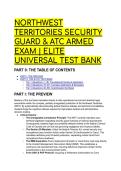
NORTHWEST
TERRITORIES SECURITY
GUARD & ATC ARMED
EXAM | ELITE
UNIVERSAL TEST BANK
PART 0: THE TABLE OF CONTENTS
● PART I: THE PREVIEW
● PART II: THE ELITE TEST BANK
○ Tier 1 (Questions 1–18): Foundational Syntax & Application
○ Tier 2 (Questions 19–37): Complex Application & Simulation
○ Tier 3 (Questions 38–55): Grandmaster Synthesis
PART I: THE PREVIEW
Mastery of this test bank translates directly to elite operational survival and absolute legal
exoneration within the complex, partially unregulated jurisdiction of the Northwest Territories
(NWT). By systematically deconstructing federal firearms statutes and territorial civil liabilities,
students forge the cognitive reflexes required for high-stakes tactical and administrative
decision-making.
● Critical Axioms:
○ The Unregulated Jurisdiction Principle: The NWT currently maintains zero
territorial legislation regulating security guard licensing or training requirements.
Consequently, baseline legal accountability defaults entirely to the federal Criminal
Code of Canada and civil tort law governing negligence and vicarious liability.
○ The Section 20 Mandate: Under the federal Firearms Act, armed security and
occupational carry function strictly under Section 20 (Authorization to Carry). This
mandates definitive proof of lawful profession, separating civilian transit from
occupational force readiness.
○ The IMIM Imperative: Every deployment of kinetic or visual force must map directly
to the Incident Management Intervention Model (IMIM). This establishes a
continuous risk assessment loop, ensuring defensive responses remain strictly
proportionate to the evolving threat matrix.
○ Form 5491 & POP Protocol: Acquiring a Wilderness Authorization to Carry
, (WATC) or an occupational ATC requires the submission of Form RCMP 5491,
coupled with a highly formalized Proof of Proficiency (POP) assessment that strictly
governs hardware and holster parameters.
ATC Section Statutory Justification Target Demographic Caliber Restrictions
Section 20(a) Imminent danger to life; Exceedingly rare Restricted parameters
police protection (historically ~2 active
insufficient nationwide)
Section 20(b) / WATC Protection from wild Remote geologists, Minimum .357 Magnum
animals in remote guides, resource (handgun) or
wilderness workers non-restricted rifles
Section 20(c) Lawful occupation of Licensed professional Maximum .22 rimfire
trapping trappers unless specifically
exempted
Section 20(3)(a) Protection of cash, Armored car personnel, Restricted parameters
negotiable instruments, high-value asset transit
substantial value
PART II: THE ELITE TEST BANK
Tier 1 (Questions 1–18): Foundational Syntax & Application
Q1: An applicant in the Northwest Territories is compiling documentation to carry a restricted
firearm for remote geological surveying. Based on the principles of the Canadian Firearms
Program, which specific application document is the FIRST mandatory submission for this
capability?
A) A standard Possession and Acquisition Licence (PAL) renewal request without restricted
privileges B) A territorial Security Guard License application under the Business Licence Act C)
Form RCMP 5491, Application for Authorization to Carry Restricted Firearms and Prohibited
Handguns D) A municipal business exemption certificate mapped to the Charter Communities
Act
● Answer: C (Form RCMP 5491, Application for Authorization to Carry Restricted Firearms
and Prohibited Handguns)
● Distractor Analysis:
○ A is incorrect: A non-restricted PAL is legally insufficient for the possession or
transport of handguns, which are inherently classified as restricted or prohibited.
○ B is incorrect: The Northwest Territories completely lacks territorial security guard
licensing legislation; such an application does not exist.
○ D is incorrect: Municipal business exemptions govern local commerce, holding zero
jurisdictional weight over federal firearms authorizations.
The Mentor's Analysis: Securing an Authorization to Carry (ATC) requires bypassing local
territorial commerce laws and engaging directly with federal statutes via specific RCMP
documentation. The structural foundation of occupational firearms possession relies entirely on
the federal government's centralized tracking system. By utilizing Form RCMP 5491, the
applicant satisfies the primary bureaucratic threshold, bypassing the common novice trap of
confusing local business zoning regulations with federal lethal-force authorizations. Professional
Intuition: Federal firearms statutes absolute supersede territorial and municipal business
regulations.
Q2: An armored car operative deploying in Yellowknife is applying for an ATC under Section 20
, of the Firearms Act. Based on the principles of occupational firearms categorization, which
operational justification is the MOST APPROPRIATE?
A) Protection of life from imminent danger where municipal police response times are
insufficient B) Handling, transportation, or protection of cash, negotiable instruments, or other
goods of substantial value C) Engagement in the occupation of trapping within a heavily
forested territorial development zone D) General deterrence of property theft and vandalism at
static, non-valuable industrial mining sites
● Answer: B (Handling, transportation, or protection of cash, negotiable instruments, or
other goods of substantial value)
● Distractor Analysis:
○ A is incorrect: Protection of life falls under Section 20(a), which is practically
inaccessible for civilians (historically limited to two nationwide) and fundamentally
distinct from occupational transit.
○ C is incorrect: Trapping is a valid Section 20(c) requirement, but is entirely
inapplicable to armored transit logistics.
○ D is incorrect: General property deterrence fails to meet the strict statutory
threshold of "substantial value" required for an occupational ATC.
The Mentor's Analysis: Section 20 of the Firearms Act rigidly demarcates the legal conditions
under which a civilian may bear arms in public. The legislation actively funnels asset-transit
professionals into a specific legal corridor designed to weigh the public risk of armed guards
against the economic risk of organized high-value robbery. By utilizing Section 20(3)(a), the
applicant correctly identifies their socioeconomic function within the law, bypassing the nearly
impossible administrative threshold of Section 20(a) "Protection of Life." Professional Intuition:
Occupational ATCs for armored transit strictly demand the physical presence of
substantial, negotiable valuables.
Q3: A professional conducting remote ecological surveys in the Northwest Territories seeks a
Wilderness Authorization to Carry (WATC). Based on the principles of the Proof of Proficiency
(POP) assessment, which logistical parameter is MANDATORY?
A) The use of a minimum .22 rimfire handgun for all wilderness protection assessments B)
Administration of the exam by a self-certified corporate health and safety officer C) Executing
the qualification using the exact firearm the applicant intends to carry in the field D) The
deployment of reactive steel targets to simulate rapid animal movement during the test
● Answer: C (Executing the qualification using the exact firearm the applicant intends to
carry in the field)
● Distractor Analysis:
○ A is incorrect: The .22 rimfire cartridge is legislatively capped for trapping dispatch,
whereas .357 Magnum serves as the ballistic minimum for wilderness predator
defense.
○ B is incorrect: The administrator must hold a valid restricted PAL and be a
recognized range officer or certified instructor, not merely an internal corporate
representative.
○ D is incorrect: The use of steel targets is expressly prohibited during the POP
assessment due to ricochet hazards and standardized scoring metrics.
The Mentor's Analysis: The POP standard acts as a critical liability filter, ensuring operator
competence is directly mapped to specific hardware configurations rather than theoretical
marksmanship. The Chief Firearms Officer (CFO) requires definitive proof that the applicant can
manage the specific recoil, action, and holstering mechanics of their deployed asset. By
qualifying with the exact intended firearm, the administrator generates a legally binding audit
TERRITORIES SECURITY
GUARD & ATC ARMED
EXAM | ELITE
UNIVERSAL TEST BANK
PART 0: THE TABLE OF CONTENTS
● PART I: THE PREVIEW
● PART II: THE ELITE TEST BANK
○ Tier 1 (Questions 1–18): Foundational Syntax & Application
○ Tier 2 (Questions 19–37): Complex Application & Simulation
○ Tier 3 (Questions 38–55): Grandmaster Synthesis
PART I: THE PREVIEW
Mastery of this test bank translates directly to elite operational survival and absolute legal
exoneration within the complex, partially unregulated jurisdiction of the Northwest Territories
(NWT). By systematically deconstructing federal firearms statutes and territorial civil liabilities,
students forge the cognitive reflexes required for high-stakes tactical and administrative
decision-making.
● Critical Axioms:
○ The Unregulated Jurisdiction Principle: The NWT currently maintains zero
territorial legislation regulating security guard licensing or training requirements.
Consequently, baseline legal accountability defaults entirely to the federal Criminal
Code of Canada and civil tort law governing negligence and vicarious liability.
○ The Section 20 Mandate: Under the federal Firearms Act, armed security and
occupational carry function strictly under Section 20 (Authorization to Carry). This
mandates definitive proof of lawful profession, separating civilian transit from
occupational force readiness.
○ The IMIM Imperative: Every deployment of kinetic or visual force must map directly
to the Incident Management Intervention Model (IMIM). This establishes a
continuous risk assessment loop, ensuring defensive responses remain strictly
proportionate to the evolving threat matrix.
○ Form 5491 & POP Protocol: Acquiring a Wilderness Authorization to Carry
, (WATC) or an occupational ATC requires the submission of Form RCMP 5491,
coupled with a highly formalized Proof of Proficiency (POP) assessment that strictly
governs hardware and holster parameters.
ATC Section Statutory Justification Target Demographic Caliber Restrictions
Section 20(a) Imminent danger to life; Exceedingly rare Restricted parameters
police protection (historically ~2 active
insufficient nationwide)
Section 20(b) / WATC Protection from wild Remote geologists, Minimum .357 Magnum
animals in remote guides, resource (handgun) or
wilderness workers non-restricted rifles
Section 20(c) Lawful occupation of Licensed professional Maximum .22 rimfire
trapping trappers unless specifically
exempted
Section 20(3)(a) Protection of cash, Armored car personnel, Restricted parameters
negotiable instruments, high-value asset transit
substantial value
PART II: THE ELITE TEST BANK
Tier 1 (Questions 1–18): Foundational Syntax & Application
Q1: An applicant in the Northwest Territories is compiling documentation to carry a restricted
firearm for remote geological surveying. Based on the principles of the Canadian Firearms
Program, which specific application document is the FIRST mandatory submission for this
capability?
A) A standard Possession and Acquisition Licence (PAL) renewal request without restricted
privileges B) A territorial Security Guard License application under the Business Licence Act C)
Form RCMP 5491, Application for Authorization to Carry Restricted Firearms and Prohibited
Handguns D) A municipal business exemption certificate mapped to the Charter Communities
Act
● Answer: C (Form RCMP 5491, Application for Authorization to Carry Restricted Firearms
and Prohibited Handguns)
● Distractor Analysis:
○ A is incorrect: A non-restricted PAL is legally insufficient for the possession or
transport of handguns, which are inherently classified as restricted or prohibited.
○ B is incorrect: The Northwest Territories completely lacks territorial security guard
licensing legislation; such an application does not exist.
○ D is incorrect: Municipal business exemptions govern local commerce, holding zero
jurisdictional weight over federal firearms authorizations.
The Mentor's Analysis: Securing an Authorization to Carry (ATC) requires bypassing local
territorial commerce laws and engaging directly with federal statutes via specific RCMP
documentation. The structural foundation of occupational firearms possession relies entirely on
the federal government's centralized tracking system. By utilizing Form RCMP 5491, the
applicant satisfies the primary bureaucratic threshold, bypassing the common novice trap of
confusing local business zoning regulations with federal lethal-force authorizations. Professional
Intuition: Federal firearms statutes absolute supersede territorial and municipal business
regulations.
Q2: An armored car operative deploying in Yellowknife is applying for an ATC under Section 20
, of the Firearms Act. Based on the principles of occupational firearms categorization, which
operational justification is the MOST APPROPRIATE?
A) Protection of life from imminent danger where municipal police response times are
insufficient B) Handling, transportation, or protection of cash, negotiable instruments, or other
goods of substantial value C) Engagement in the occupation of trapping within a heavily
forested territorial development zone D) General deterrence of property theft and vandalism at
static, non-valuable industrial mining sites
● Answer: B (Handling, transportation, or protection of cash, negotiable instruments, or
other goods of substantial value)
● Distractor Analysis:
○ A is incorrect: Protection of life falls under Section 20(a), which is practically
inaccessible for civilians (historically limited to two nationwide) and fundamentally
distinct from occupational transit.
○ C is incorrect: Trapping is a valid Section 20(c) requirement, but is entirely
inapplicable to armored transit logistics.
○ D is incorrect: General property deterrence fails to meet the strict statutory
threshold of "substantial value" required for an occupational ATC.
The Mentor's Analysis: Section 20 of the Firearms Act rigidly demarcates the legal conditions
under which a civilian may bear arms in public. The legislation actively funnels asset-transit
professionals into a specific legal corridor designed to weigh the public risk of armed guards
against the economic risk of organized high-value robbery. By utilizing Section 20(3)(a), the
applicant correctly identifies their socioeconomic function within the law, bypassing the nearly
impossible administrative threshold of Section 20(a) "Protection of Life." Professional Intuition:
Occupational ATCs for armored transit strictly demand the physical presence of
substantial, negotiable valuables.
Q3: A professional conducting remote ecological surveys in the Northwest Territories seeks a
Wilderness Authorization to Carry (WATC). Based on the principles of the Proof of Proficiency
(POP) assessment, which logistical parameter is MANDATORY?
A) The use of a minimum .22 rimfire handgun for all wilderness protection assessments B)
Administration of the exam by a self-certified corporate health and safety officer C) Executing
the qualification using the exact firearm the applicant intends to carry in the field D) The
deployment of reactive steel targets to simulate rapid animal movement during the test
● Answer: C (Executing the qualification using the exact firearm the applicant intends to
carry in the field)
● Distractor Analysis:
○ A is incorrect: The .22 rimfire cartridge is legislatively capped for trapping dispatch,
whereas .357 Magnum serves as the ballistic minimum for wilderness predator
defense.
○ B is incorrect: The administrator must hold a valid restricted PAL and be a
recognized range officer or certified instructor, not merely an internal corporate
representative.
○ D is incorrect: The use of steel targets is expressly prohibited during the POP
assessment due to ricochet hazards and standardized scoring metrics.
The Mentor's Analysis: The POP standard acts as a critical liability filter, ensuring operator
competence is directly mapped to specific hardware configurations rather than theoretical
marksmanship. The Chief Firearms Officer (CFO) requires definitive proof that the applicant can
manage the specific recoil, action, and holstering mechanics of their deployed asset. By
qualifying with the exact intended firearm, the administrator generates a legally binding audit

