
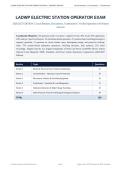
LADWP ELECTRIC STATION OPERATOR EXAM | 2026/2027 EDITION Circuit Breakers | Disconnects | Transformers
LADWP ELECTRIC STATION OPERATOR EXAM
2026/2027 EDITION | Circuit Breakers, Disconnects, Transformers | Verified Questions with Passed
Answers
Examination Blueprint: 150 questions total | 6 sections | Cognitive levels: 30% recall, 50% application,
20% analysis. Special inclusions: 20 calculation-based questions, 25 scenario-based switching/emergency
response questions, 15 questions on circuit breaker types, interrupting ratings, and protective relaying.
Style: 75% scenario-based (substation operations, switching decisions, fault analysis), 25% direct
knowledge. Aligned with the Los Angeles Department of Water and Power (LADWP) Electric Station
Operator Exam Blueprint, NERC Standards, and Power System Operations Competencies (2026/2027
Edition).
Section Topic Questions
Section 1 Electrical Theory & Power System Fundamentals 25
Section 2 Circuit Breakers - Operation, Types & Protection 30
Section 3 Disconnects, Isolators & Switching Equipment 20
Section 4 Transformers - Operation & Load Management 25
Section 5 Substation Operations & High-Voltage Switching 20
Section 6 Safety Protocols, Protective Relaying & Emergency Response 30
TOTAL 150
Verified Questions with Passed Answers Page 1 Aligned with LADWP Blueprint & NERC Standards
,LADWP ELECTRIC STATION OPERATOR EXAM | 2026/2027 EDITION Circuit Breakers | Disconnects | Transformers
Section 1: Electrical Theory & Power System Fundamentals
*Q1:* A substation operator monitoring the LADWP 60 Hz grid observes the system frequency has drifted to
59.85 Hz during peak load. Per NERC BAL-004 time error correction standards, what is the proper
interpretation of this reading and the appropriate operating action?
A. Frequency is within normal tolerance; no action required since 60 Hz +/- 0.05 Hz is the LADWP operating band
B. Frequency is below the 59.95 Hz operating threshold; governor response and possible load shedding must be
considered to restore 60 Hz *[CORRECT]*
C. Frequency is acceptable since U.S. interconnection tolerates 58.5 Hz continuously without consequence
D. Frequency is high; shed generation to return to 60 Hz
Correct Answer: B
Rationale: The U.S. standard nominal frequency is 60 Hz and NERC BAL-004 requires tight frequency control (typically +/-
0.05 Hz). A reading of 59.85 Hz indicates generation deficit, requiring governor response and possible operating reserve
deployment. LADWP, as a Balancing Authority, must take corrective action well before the 59.95 Hz under-frequency load
shedding (UFLS) trigger. Options A and C underestimate grid discipline; Option D misreads the direction of the deviation.
*Q2:* On a 3-phase, 4-wire, 12,470Y/7,200 V LADWP distribution feeder, a phase-to-neutral connected PT
has a turns ratio of 60:1. What secondary voltage will the PT indicate when the primary phase-to-neutral
voltage is exactly 7,200 V?
A. 120 V *[CORRECT]*
B. 208 V
C. 277 V
D. 7,200 V
Correct Answer: A
Rationale: A potential transformer (PT) steps down primary voltage by its turns ratio for safe metering. With a 60:1 ratio
applied to 7,200 V phase-to-neutral: 7, = 120 V on the secondary. This is the standard LADWP metering potential of
120 V. Option B (208 V) is line-to-line of a 120Y/208 system; Option C (277 V) is phase voltage of 480Y/277; Option D
ignores the PT ratio entirely.
*Q3:* An operator measures 4,160 V at a substation bus nominal rating of 4,160 V, but the customer end of a
1,500 ft feeder reads 3,920 V. Calculate the percentage voltage drop and determine whether it is within the
LADWP 5% ANSI C84.1 Range A service limit.
A. 5.76% - exceeds the 5% limit, corrective action required *[CORRECT]*
B. 5.76% - within the 5% limit because the formula uses actual in the numerator
C. 4.81% - within the 5% limit, no action required
D. 2.40% - well within limit
Correct Answer: A
Rationale: Percentage voltage drop = ((Nominal - Actual) / Nominal) x 100 = ((4,160 - 3,920) / 4,160) x 100 = (,160) x
100 = 5.77%, which exceeds the ANSI C84.1 Range A limit of 5%. LADWP operating procedure requires feeder regulator or
capacitor bank switching. Option C incorrectly uses nominal 4,160 with a 200 V drop math error; Option D misapplies the
Verified Questions with Passed Answers Page 2 Aligned with LADWP Blueprint & NERC Standards
,LADWP ELECTRIC STATION OPERATOR EXAM | 2026/2027 EDITION Circuit Breakers | Disconnects | Transformers
formula by using actual voltage in the denominator.
*Q4:* A wye-connected 3-phase transformer bank on an LADWP 13,800 V system has its phase windings
connected phase-to-neutral. What is the voltage across each individual phase winding, and what is the
resulting line-to-line voltage?
A. Phase voltage = 13,800 V; Line voltage = 13,800 V
B. Phase voltage = 7,967 V; Line voltage = 13,800 V *[CORRECT]*
C. Phase voltage = 7,967 V; Line voltage = 23,900 V
D. Phase voltage = 13,800 V; Line voltage = 23,900 V
Correct Answer: B
Rationale: In a wye (Y) connection, line-to-line voltage VL = VP x sqrt(3). Therefore VP = VL / sqrt(3) = 13,.732 =
7,967 V across each phase winding. The stated 13,800 V is the line-to-line value. Option A confuses wye with delta; Option C
incorrectly multiplies instead of dividing; Option D double-multiplies the relationship.
*Q5:* A delta-connected 3-phase system on an LADWP 4,160 V sub-transmission circuit has each winding
connected between two lines. What is the voltage across each individual phase winding?
A. 2,400 V
B. 4,160 V *[CORRECT]*
C. 7,200 V
D. 12,470 V
Correct Answer: B
Rationale: In a delta connection, VL = VP; the voltage across each phase winding equals the line-to-line voltage. Therefore
each winding sees the full 4,160 V. Option A incorrectly applies wye relationship (4,.732 = 2,400 V); Options C and D
are unrelated voltage levels commonly confused with delta configurations.
*Q6:* During morning load pickup, an LADWP operator measures a circuit carrying 200 A through a 0.5
ohm reactor. Applying Ohm's Law, what voltage drop is produced across the reactor, and what is the
resulting power loss in watts?
A. 100 V drop; 20,000 W loss *[CORRECT]*
B. 400 V drop; 80,000 W loss
C. 100 V drop; 100 W loss
D. 200 V drop; 40,000 W loss
Correct Answer: A
Rationale: Ohm's Law: V = I x R = 200 A x 0.5 ohm = 100 V drop across the reactor. Power loss P = I^2 x R = 200^2 x 0.5 =
40,000 x 0.5 = 20,000 W (20 kW). LADWP operators track such losses for efficiency accounting. Option B miscalculates V
as I^2 x R; Option C omits the squared current term; Option D uses I x R^2.
Verified Questions with Passed Answers Page 3 Aligned with LADWP Blueprint & NERC Standards
, LADWP ELECTRIC STATION OPERATOR EXAM | 2026/2027 EDITION Circuit Breakers | Disconnects | Transformers
*Q7:* A substation load draws 800 kW of real power and 600 kVAR of reactive power. What is the apparent
power and the resulting power factor of this load?
A. 1,000 kVA; PF = 0.80 lagging *[CORRECT]*
B. 1,400 kVA; PF = 0.57 lagging
C. 500 kVA; PF = 1.60 lagging
D. 1,000 kVA; PF = 1.00 unity
Correct Answer: A
Rationale: Apparent power S = sqrt(P^2 + Q^2) = sqrt(800^2 + 600^2) = sqrt(640,000 + 360,000) = sqrt(1,000,000) = 1,000
kVA. Power factor PF = P / S = ,000 = 0.80 lagging (positive Q indicates inductive load). LADWP targets PF above
0.95 to minimize line losses and avoid reactive billing penalties. Option B adds P+Q directly; Option C subtracts; Option D
ignores the reactive component.
*Q8:* An LADWP transmission operator needs to identify the dielectric strength of atmospheric air at sea
level. Why is this value critical when designing minimum approach distances (MAD) for live-line work?
A. Air dielectric strength is approximately 10,000 volts per inch; this sets the baseline for MAD calculations per
OSHA 1910.269 *[CORRECT]*
B. Air dielectric strength is approximately 100,000 volts per inch; therefore MAD can be reduced by half
C. Air dielectric strength is approximately 1,000 volts per inch; therefore MAD must be doubled
D. Air dielectric strength equals 30 kV/cm and is unaffected by humidity or altitude
Correct Answer: A
Rationale: Air has a dielectric strength of approximately 10,000 V per inch (about 30 kV/cm under standard conditions),
which sets the baseline for Minimum Approach Distance (MAD) calculations in OSHA 1910.269 Table R-6. LADWP
live-line work procedures apply correction factors for altitude, humidity, and transient overvoltage. Options B and C misstate
the magnitude by an order of magnitude; Option D ignores environmental correction factors that LADWP procedures
explicitly require.
*Q9:* Why is alternating current (AC) easier to interrupt than direct current (DC) in a circuit breaker, and
how does this affect LADWP's breaker design philosophy?
A. AC is harder to interrupt because it has no zero crossing; DC breakers must use special air-blast designs
B. AC naturally crosses zero twice per cycle (120 times per second at 60 Hz), giving the arc a chance to extinguish at
each current zero; DC requires forced current interruption *[CORRECT]*
C. AC is easier because the sine wave provides continuous voltage; DC must rely on resistance only
D. AC and DC are equally easy to interrupt because both produce arcs of equal magnitude
Correct Answer: B
Rationale: At 60 Hz, AC current passes through zero 120 times per second (twice per cycle), providing a natural opportunity
for the arc to extinguish when the breaker contacts open. Modern LADWP breakers (SF6, vacuum) exploit this by rapidly
building dielectric strength across the gap at current zero. DC has no natural zero crossing, requiring forced commutation or
special arc chutes. Options A, C, and D misstate fundamental interrupting physics.
Verified Questions with Passed Answers Page 4 Aligned with LADWP Blueprint & NERC Standards
LADWP ELECTRIC STATION OPERATOR EXAM
2026/2027 EDITION | Circuit Breakers, Disconnects, Transformers | Verified Questions with Passed
Answers
Examination Blueprint: 150 questions total | 6 sections | Cognitive levels: 30% recall, 50% application,
20% analysis. Special inclusions: 20 calculation-based questions, 25 scenario-based switching/emergency
response questions, 15 questions on circuit breaker types, interrupting ratings, and protective relaying.
Style: 75% scenario-based (substation operations, switching decisions, fault analysis), 25% direct
knowledge. Aligned with the Los Angeles Department of Water and Power (LADWP) Electric Station
Operator Exam Blueprint, NERC Standards, and Power System Operations Competencies (2026/2027
Edition).
Section Topic Questions
Section 1 Electrical Theory & Power System Fundamentals 25
Section 2 Circuit Breakers - Operation, Types & Protection 30
Section 3 Disconnects, Isolators & Switching Equipment 20
Section 4 Transformers - Operation & Load Management 25
Section 5 Substation Operations & High-Voltage Switching 20
Section 6 Safety Protocols, Protective Relaying & Emergency Response 30
TOTAL 150
Verified Questions with Passed Answers Page 1 Aligned with LADWP Blueprint & NERC Standards
,LADWP ELECTRIC STATION OPERATOR EXAM | 2026/2027 EDITION Circuit Breakers | Disconnects | Transformers
Section 1: Electrical Theory & Power System Fundamentals
*Q1:* A substation operator monitoring the LADWP 60 Hz grid observes the system frequency has drifted to
59.85 Hz during peak load. Per NERC BAL-004 time error correction standards, what is the proper
interpretation of this reading and the appropriate operating action?
A. Frequency is within normal tolerance; no action required since 60 Hz +/- 0.05 Hz is the LADWP operating band
B. Frequency is below the 59.95 Hz operating threshold; governor response and possible load shedding must be
considered to restore 60 Hz *[CORRECT]*
C. Frequency is acceptable since U.S. interconnection tolerates 58.5 Hz continuously without consequence
D. Frequency is high; shed generation to return to 60 Hz
Correct Answer: B
Rationale: The U.S. standard nominal frequency is 60 Hz and NERC BAL-004 requires tight frequency control (typically +/-
0.05 Hz). A reading of 59.85 Hz indicates generation deficit, requiring governor response and possible operating reserve
deployment. LADWP, as a Balancing Authority, must take corrective action well before the 59.95 Hz under-frequency load
shedding (UFLS) trigger. Options A and C underestimate grid discipline; Option D misreads the direction of the deviation.
*Q2:* On a 3-phase, 4-wire, 12,470Y/7,200 V LADWP distribution feeder, a phase-to-neutral connected PT
has a turns ratio of 60:1. What secondary voltage will the PT indicate when the primary phase-to-neutral
voltage is exactly 7,200 V?
A. 120 V *[CORRECT]*
B. 208 V
C. 277 V
D. 7,200 V
Correct Answer: A
Rationale: A potential transformer (PT) steps down primary voltage by its turns ratio for safe metering. With a 60:1 ratio
applied to 7,200 V phase-to-neutral: 7, = 120 V on the secondary. This is the standard LADWP metering potential of
120 V. Option B (208 V) is line-to-line of a 120Y/208 system; Option C (277 V) is phase voltage of 480Y/277; Option D
ignores the PT ratio entirely.
*Q3:* An operator measures 4,160 V at a substation bus nominal rating of 4,160 V, but the customer end of a
1,500 ft feeder reads 3,920 V. Calculate the percentage voltage drop and determine whether it is within the
LADWP 5% ANSI C84.1 Range A service limit.
A. 5.76% - exceeds the 5% limit, corrective action required *[CORRECT]*
B. 5.76% - within the 5% limit because the formula uses actual in the numerator
C. 4.81% - within the 5% limit, no action required
D. 2.40% - well within limit
Correct Answer: A
Rationale: Percentage voltage drop = ((Nominal - Actual) / Nominal) x 100 = ((4,160 - 3,920) / 4,160) x 100 = (,160) x
100 = 5.77%, which exceeds the ANSI C84.1 Range A limit of 5%. LADWP operating procedure requires feeder regulator or
capacitor bank switching. Option C incorrectly uses nominal 4,160 with a 200 V drop math error; Option D misapplies the
Verified Questions with Passed Answers Page 2 Aligned with LADWP Blueprint & NERC Standards
,LADWP ELECTRIC STATION OPERATOR EXAM | 2026/2027 EDITION Circuit Breakers | Disconnects | Transformers
formula by using actual voltage in the denominator.
*Q4:* A wye-connected 3-phase transformer bank on an LADWP 13,800 V system has its phase windings
connected phase-to-neutral. What is the voltage across each individual phase winding, and what is the
resulting line-to-line voltage?
A. Phase voltage = 13,800 V; Line voltage = 13,800 V
B. Phase voltage = 7,967 V; Line voltage = 13,800 V *[CORRECT]*
C. Phase voltage = 7,967 V; Line voltage = 23,900 V
D. Phase voltage = 13,800 V; Line voltage = 23,900 V
Correct Answer: B
Rationale: In a wye (Y) connection, line-to-line voltage VL = VP x sqrt(3). Therefore VP = VL / sqrt(3) = 13,.732 =
7,967 V across each phase winding. The stated 13,800 V is the line-to-line value. Option A confuses wye with delta; Option C
incorrectly multiplies instead of dividing; Option D double-multiplies the relationship.
*Q5:* A delta-connected 3-phase system on an LADWP 4,160 V sub-transmission circuit has each winding
connected between two lines. What is the voltage across each individual phase winding?
A. 2,400 V
B. 4,160 V *[CORRECT]*
C. 7,200 V
D. 12,470 V
Correct Answer: B
Rationale: In a delta connection, VL = VP; the voltage across each phase winding equals the line-to-line voltage. Therefore
each winding sees the full 4,160 V. Option A incorrectly applies wye relationship (4,.732 = 2,400 V); Options C and D
are unrelated voltage levels commonly confused with delta configurations.
*Q6:* During morning load pickup, an LADWP operator measures a circuit carrying 200 A through a 0.5
ohm reactor. Applying Ohm's Law, what voltage drop is produced across the reactor, and what is the
resulting power loss in watts?
A. 100 V drop; 20,000 W loss *[CORRECT]*
B. 400 V drop; 80,000 W loss
C. 100 V drop; 100 W loss
D. 200 V drop; 40,000 W loss
Correct Answer: A
Rationale: Ohm's Law: V = I x R = 200 A x 0.5 ohm = 100 V drop across the reactor. Power loss P = I^2 x R = 200^2 x 0.5 =
40,000 x 0.5 = 20,000 W (20 kW). LADWP operators track such losses for efficiency accounting. Option B miscalculates V
as I^2 x R; Option C omits the squared current term; Option D uses I x R^2.
Verified Questions with Passed Answers Page 3 Aligned with LADWP Blueprint & NERC Standards
, LADWP ELECTRIC STATION OPERATOR EXAM | 2026/2027 EDITION Circuit Breakers | Disconnects | Transformers
*Q7:* A substation load draws 800 kW of real power and 600 kVAR of reactive power. What is the apparent
power and the resulting power factor of this load?
A. 1,000 kVA; PF = 0.80 lagging *[CORRECT]*
B. 1,400 kVA; PF = 0.57 lagging
C. 500 kVA; PF = 1.60 lagging
D. 1,000 kVA; PF = 1.00 unity
Correct Answer: A
Rationale: Apparent power S = sqrt(P^2 + Q^2) = sqrt(800^2 + 600^2) = sqrt(640,000 + 360,000) = sqrt(1,000,000) = 1,000
kVA. Power factor PF = P / S = ,000 = 0.80 lagging (positive Q indicates inductive load). LADWP targets PF above
0.95 to minimize line losses and avoid reactive billing penalties. Option B adds P+Q directly; Option C subtracts; Option D
ignores the reactive component.
*Q8:* An LADWP transmission operator needs to identify the dielectric strength of atmospheric air at sea
level. Why is this value critical when designing minimum approach distances (MAD) for live-line work?
A. Air dielectric strength is approximately 10,000 volts per inch; this sets the baseline for MAD calculations per
OSHA 1910.269 *[CORRECT]*
B. Air dielectric strength is approximately 100,000 volts per inch; therefore MAD can be reduced by half
C. Air dielectric strength is approximately 1,000 volts per inch; therefore MAD must be doubled
D. Air dielectric strength equals 30 kV/cm and is unaffected by humidity or altitude
Correct Answer: A
Rationale: Air has a dielectric strength of approximately 10,000 V per inch (about 30 kV/cm under standard conditions),
which sets the baseline for Minimum Approach Distance (MAD) calculations in OSHA 1910.269 Table R-6. LADWP
live-line work procedures apply correction factors for altitude, humidity, and transient overvoltage. Options B and C misstate
the magnitude by an order of magnitude; Option D ignores environmental correction factors that LADWP procedures
explicitly require.
*Q9:* Why is alternating current (AC) easier to interrupt than direct current (DC) in a circuit breaker, and
how does this affect LADWP's breaker design philosophy?
A. AC is harder to interrupt because it has no zero crossing; DC breakers must use special air-blast designs
B. AC naturally crosses zero twice per cycle (120 times per second at 60 Hz), giving the arc a chance to extinguish at
each current zero; DC requires forced current interruption *[CORRECT]*
C. AC is easier because the sine wave provides continuous voltage; DC must rely on resistance only
D. AC and DC are equally easy to interrupt because both produce arcs of equal magnitude
Correct Answer: B
Rationale: At 60 Hz, AC current passes through zero 120 times per second (twice per cycle), providing a natural opportunity
for the arc to extinguish when the breaker contacts open. Modern LADWP breakers (SF6, vacuum) exploit this by rapidly
building dielectric strength across the gap at current zero. DC has no natural zero crossing, requiring forced commutation or
special arc chutes. Options A, C, and D misstate fundamental interrupting physics.
Verified Questions with Passed Answers Page 4 Aligned with LADWP Blueprint & NERC Standards

