
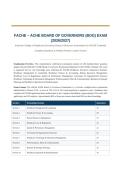
FACHE – ACHE BOARD OF GOVERNORS (BOG) EXAM
(2026/2027)
American College of Healthcare Executives Board of Governors Examination for FACHE Credential
Complete Questions & Verified Answers | Latest Version
Examination Overview. This comprehensive certification examination consists of 230 multiple-choice questions
aligned with the 2026/2027 ACHE Board of Governors Examination Blueprint for the FACHE credential. The exam
is organized into ten core knowledge areas reflecting the FACHE Healthcare Executive Competency Domains:
Healthcare Management & Leadership; Healthcare Finance & Accounting; Human Resources Management;
Healthcare Laws & Regulations; Quality & Performance Management; Governance & Organizational Structure;
Healthcare Technology & Information Management; Professionalism, Ethics & Communication; Business & Strategic
Planning; and Healthcare Operations & Reimbursement.
Exam Format. The official ACHE Board of Governors Examination is a six-hour, multiple-choice examination
administered by Pearson VUE. A score of 75% (113 of 150 scored questions) is required to pass. Candidates must
complete the FACHE application before authorization to test. Cognitive distribution is approximately 25% recall, 50%
application, and 25% analysis. Approximately 80% of items are scenario-based and 20% are direct knowledge.
Section Knowledge Domain Questions
Section 1 Healthcare Management & Leadership 30
Section 2 Healthcare Finance & Accounting 28
Section 3 Human Resources Management 25
Section 4 Healthcare Laws & Regulations 22
Section 5 Quality & Performance Management 22
Section 6 Governance & Organizational Structure 25
Section 7 Healthcare Technology & Information Management 20
Section 8 Professionalism, Ethics & Communication 20
Section 9 Business & Strategic Planning 20
Section 10 Healthcare Operations & Reimbursement 18
,Total All Domains 230
,American College of Healthcare Executives – FACHE Credential Examination
Section 1: Healthcare Management & Leadership
Q1: A 320-bed community hospital is implementing a shared governance model. The CNO is evaluating which
decision-making authority to delegate to the new Professional Practice Council. Which decision is MOST
appropriate to delegate to the council rather than to nursing administration?
A. Revising the hospital's capital budget allocation for the nursing division
B. Establishing clinical competencies and standards for bedside RN practice *[CORRECT]*
C. Setting the salary structure and shift differentials for RNs
D. Approving the strategic plan for the entire organization
Correct Answer: B
Rationale: Shared governance empowers clinical staff to own decisions closest to practice; establishing clinical
competencies and practice standards is the classic domain of a Professional Practice Council. Budget allocations,
compensation structures, and organization-wide strategic plans remain fiduciary and executive responsibilities and
are not delegated to a practice council. ACHE BOG methodology tests whether candidates distinguish
clinical/professional autonomy from executive fiduciary authority.
Q2: A CEO uses transformational leadership when leading a major service-line expansion. Which behavior BEST
reflects transformational leadership as defined by Bass and Avolio?
A. Monitoring weekly productivity variances and applying corrective discipline
B. Issuing detailed task instructions and inspecting compliance daily
C. Articulating a compelling vision and developing followers into future leaders *[CORRECT]*
D. Maintaining strict span-of-control to ensure predictable operational outcomes
Correct Answer: C
Rationale: Transformational leadership rests on the four 'I's: idealized influence, inspirational motivation,
intellectual stimulation, and individualized consideration. Articulating a compelling vision and developing followers
into future leaders is the hallmark behavior. The other options reflect transactional or command-and-control
leadership, which Bass explicitly distinguished from transformational leadership. The FACHE competency framework
for Healthcare Management and Leadership treats transformational leadership as a core executive skill for
sustainable change.
Q3: An executive team is using Kotter's eight-step model to implement a new EHR. After forming a powerful
coalition, they communicate the change vision extensively but adoption remains low. According to Kotter, the
MOST common error at this stage is:
A. Declaring victory too soon
B. Under-communicating the vision by a factor of ten *[CORRECT]*
C. Failing to anchor the change in the organizational culture
D. Permitting obstacles to block the new vision
Correct Answer: B
Rationale: Kotter's research found that change efforts fail most often because leaders under-communicate the vision
by a factor of ten relative to what is needed. Declaring victory too soon, permitting obstacles, and failing to anchor in
culture are later-stage errors. The correct response here is the communication-stage error, which the scenario
directly implicates given that adoption remains low despite 'extensive' communication that is still not enough.
FACHE – ACHE Board of Governors Exam (2026/2027) – Latest Version Page 3
, American College of Healthcare Executives – FACHE Credential Examination
Q4: A CNO applies Lewin's three-stage change model to phase out a legacy documentation system. Which
sequence correctly describes Lewin's stages?
A. Refreezing → Unfreezing → Moving
B. Unfreezing → Moving → Refreezing *[CORRECT]*
C. Moving → Refreezing → Unfreezing
D. Unfreezing → Refreezing → Moving
Correct Answer: B
Rationale: Lewin's model is Unfreezing (creating readiness and breaking equilibrium) → Moving/Changing
(implementing the new behavior or system) → Refreezing (stabilizing the change so it becomes the new norm). The
other sequences misorder the stages. ACHE BOG expects candidates to distinguish Lewin's force-field approach from
Kotter's eight-step process and to select the appropriate model for the scenario.
Q5: A COO with high emotional intelligence is mediating a dispute between two service-line directors. Per
Goleman's mixed model, which combination of EI domains is MOST directly engaged?
A. Self-awareness and self-management only
B. Self-awareness, self-management, social awareness, and relationship management *[CORRECT]*
C. Social awareness and relationship management only
D. Self-management and relationship management only
Correct Answer: B
Rationale: Goleman's mixed model comprises four domains: self-awareness, self-management, social awareness, and
relationship management. Effective mediation engages all four because the leader must recognize their own bias
(self-awareness), regulate their reactions (self-management), read both parties' concerns (social awareness), and
influence the outcome (relationship management). Limiting to two domains reflects a partial model and is a common
ACHE distractor.
Q6: A just culture framework is being adopted after a serious medication error. Which principle BEST
distinguishes a just culture from a punitive culture?
A. All errors are forgiven without consequence
B. Human error is managed console-ably, while reckless behavior is accountable *[CORRECT]*
C. Reporting errors is encouraged but employees are still terminated for any mistake
D. Blame is always assigned to the system, never the individual
Correct Answer: B
Rationale: Just culture distinguishes among human error (managed through console and system redesign), at-risk
behavior (coaching), and reckless behavior (accountable, including discipline or termination). The model is neither
blanket forgiveness nor blanket punishment. ACHE BOG tests whether candidates recognize that just culture is
essential to psychological safety and that accountability remains for reckless conduct while human error is addressed
systemically.
FACHE – ACHE Board of Governors Exam (2026/2027) – Latest Version Page 4
(2026/2027)
American College of Healthcare Executives Board of Governors Examination for FACHE Credential
Complete Questions & Verified Answers | Latest Version
Examination Overview. This comprehensive certification examination consists of 230 multiple-choice questions
aligned with the 2026/2027 ACHE Board of Governors Examination Blueprint for the FACHE credential. The exam
is organized into ten core knowledge areas reflecting the FACHE Healthcare Executive Competency Domains:
Healthcare Management & Leadership; Healthcare Finance & Accounting; Human Resources Management;
Healthcare Laws & Regulations; Quality & Performance Management; Governance & Organizational Structure;
Healthcare Technology & Information Management; Professionalism, Ethics & Communication; Business & Strategic
Planning; and Healthcare Operations & Reimbursement.
Exam Format. The official ACHE Board of Governors Examination is a six-hour, multiple-choice examination
administered by Pearson VUE. A score of 75% (113 of 150 scored questions) is required to pass. Candidates must
complete the FACHE application before authorization to test. Cognitive distribution is approximately 25% recall, 50%
application, and 25% analysis. Approximately 80% of items are scenario-based and 20% are direct knowledge.
Section Knowledge Domain Questions
Section 1 Healthcare Management & Leadership 30
Section 2 Healthcare Finance & Accounting 28
Section 3 Human Resources Management 25
Section 4 Healthcare Laws & Regulations 22
Section 5 Quality & Performance Management 22
Section 6 Governance & Organizational Structure 25
Section 7 Healthcare Technology & Information Management 20
Section 8 Professionalism, Ethics & Communication 20
Section 9 Business & Strategic Planning 20
Section 10 Healthcare Operations & Reimbursement 18
,Total All Domains 230
,American College of Healthcare Executives – FACHE Credential Examination
Section 1: Healthcare Management & Leadership
Q1: A 320-bed community hospital is implementing a shared governance model. The CNO is evaluating which
decision-making authority to delegate to the new Professional Practice Council. Which decision is MOST
appropriate to delegate to the council rather than to nursing administration?
A. Revising the hospital's capital budget allocation for the nursing division
B. Establishing clinical competencies and standards for bedside RN practice *[CORRECT]*
C. Setting the salary structure and shift differentials for RNs
D. Approving the strategic plan for the entire organization
Correct Answer: B
Rationale: Shared governance empowers clinical staff to own decisions closest to practice; establishing clinical
competencies and practice standards is the classic domain of a Professional Practice Council. Budget allocations,
compensation structures, and organization-wide strategic plans remain fiduciary and executive responsibilities and
are not delegated to a practice council. ACHE BOG methodology tests whether candidates distinguish
clinical/professional autonomy from executive fiduciary authority.
Q2: A CEO uses transformational leadership when leading a major service-line expansion. Which behavior BEST
reflects transformational leadership as defined by Bass and Avolio?
A. Monitoring weekly productivity variances and applying corrective discipline
B. Issuing detailed task instructions and inspecting compliance daily
C. Articulating a compelling vision and developing followers into future leaders *[CORRECT]*
D. Maintaining strict span-of-control to ensure predictable operational outcomes
Correct Answer: C
Rationale: Transformational leadership rests on the four 'I's: idealized influence, inspirational motivation,
intellectual stimulation, and individualized consideration. Articulating a compelling vision and developing followers
into future leaders is the hallmark behavior. The other options reflect transactional or command-and-control
leadership, which Bass explicitly distinguished from transformational leadership. The FACHE competency framework
for Healthcare Management and Leadership treats transformational leadership as a core executive skill for
sustainable change.
Q3: An executive team is using Kotter's eight-step model to implement a new EHR. After forming a powerful
coalition, they communicate the change vision extensively but adoption remains low. According to Kotter, the
MOST common error at this stage is:
A. Declaring victory too soon
B. Under-communicating the vision by a factor of ten *[CORRECT]*
C. Failing to anchor the change in the organizational culture
D. Permitting obstacles to block the new vision
Correct Answer: B
Rationale: Kotter's research found that change efforts fail most often because leaders under-communicate the vision
by a factor of ten relative to what is needed. Declaring victory too soon, permitting obstacles, and failing to anchor in
culture are later-stage errors. The correct response here is the communication-stage error, which the scenario
directly implicates given that adoption remains low despite 'extensive' communication that is still not enough.
FACHE – ACHE Board of Governors Exam (2026/2027) – Latest Version Page 3
, American College of Healthcare Executives – FACHE Credential Examination
Q4: A CNO applies Lewin's three-stage change model to phase out a legacy documentation system. Which
sequence correctly describes Lewin's stages?
A. Refreezing → Unfreezing → Moving
B. Unfreezing → Moving → Refreezing *[CORRECT]*
C. Moving → Refreezing → Unfreezing
D. Unfreezing → Refreezing → Moving
Correct Answer: B
Rationale: Lewin's model is Unfreezing (creating readiness and breaking equilibrium) → Moving/Changing
(implementing the new behavior or system) → Refreezing (stabilizing the change so it becomes the new norm). The
other sequences misorder the stages. ACHE BOG expects candidates to distinguish Lewin's force-field approach from
Kotter's eight-step process and to select the appropriate model for the scenario.
Q5: A COO with high emotional intelligence is mediating a dispute between two service-line directors. Per
Goleman's mixed model, which combination of EI domains is MOST directly engaged?
A. Self-awareness and self-management only
B. Self-awareness, self-management, social awareness, and relationship management *[CORRECT]*
C. Social awareness and relationship management only
D. Self-management and relationship management only
Correct Answer: B
Rationale: Goleman's mixed model comprises four domains: self-awareness, self-management, social awareness, and
relationship management. Effective mediation engages all four because the leader must recognize their own bias
(self-awareness), regulate their reactions (self-management), read both parties' concerns (social awareness), and
influence the outcome (relationship management). Limiting to two domains reflects a partial model and is a common
ACHE distractor.
Q6: A just culture framework is being adopted after a serious medication error. Which principle BEST
distinguishes a just culture from a punitive culture?
A. All errors are forgiven without consequence
B. Human error is managed console-ably, while reckless behavior is accountable *[CORRECT]*
C. Reporting errors is encouraged but employees are still terminated for any mistake
D. Blame is always assigned to the system, never the individual
Correct Answer: B
Rationale: Just culture distinguishes among human error (managed through console and system redesign), at-risk
behavior (coaching), and reckless behavior (accountable, including discipline or termination). The model is neither
blanket forgiveness nor blanket punishment. ACHE BOG tests whether candidates recognize that just culture is
essential to psychological safety and that accountability remains for reckless conduct while human error is addressed
systemically.
FACHE – ACHE Board of Governors Exam (2026/2027) – Latest Version Page 4

