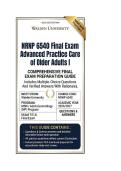
,NRNP 6540 Final exam Advanced Practice Care of Older Adults I
Questions And Answers 2026/2027 Walden University
NRNP 6540 Final Exam Practice Bank
Course: NRNP 6540
University: Walden University
Assessment: Final Exam
Area: Advanced Practice Care of Older Adults
1.
A 76-year-old patient presents with a painful vesicular eruption limited to the
right side of the chest in a dermatomal distribution. Which diagnosis is most
likely?
A) Cellulitis
B) Herpes zoster
C) Impetigo
D) Contact dermatitis
Answer: B) Herpes zoster
Rationale: Herpes zoster results from reactivation of varicella-zoster virus
and classically produces a painful unilateral vesicular eruption following a
dermatome.
2.
An older adult presents 36 hours after developing a localized shingles rash.
Which treatment is most appropriate?
A) Oral antiviral therapy
B) Topical antibiotic alone
C) Oral anticoagulation
D) No treatment because antivirals are ineffective after the rash appears
Answer: A) Oral antiviral therapy
Rationale: Antiviral therapy is most beneficial when started early,
preferably within 72 hours of rash onset.
3.
An older adult develops a rapidly expanding erythematous area on the lower
leg accompanied by fever, warmth, swelling, and tenderness. Which
diagnosis is most likely?
,A) Cellulitis
B) Psoriasis
C) Vitiligo
D) Herpes zoster
Answer: A) Cellulitis
Rationale: Cellulitis is an acute bacterial infection involving the skin and
subcutaneous tissue and commonly causes erythema, warmth, swelling, and
tenderness.
4.
Which finding should raise the greatest concern for necrotizing fasciitis?
A) Mild pruritus
B) Severe pain out of proportion to the visible skin findings
C) Stable dry skin
D) Symmetric hyperpigmentation
Answer: B) Severe pain out of proportion to the visible skin findings
Rationale: Disproportionate pain, rapid progression, systemic toxicity,
bullae, and skin discoloration are important warning signs of necrotizing soft-
tissue infection.
5.
A 78-year-old patient has a chronic nonhealing ulcer near the medial
malleolus with lower-leg edema and brownish skin discoloration. Which
condition is most likely?
A) Chronic venous insufficiency
B) Acute arterial embolism
C) Herpes zoster
D) Melanoma
Answer: A) Chronic venous insufficiency
Rationale: Venous stasis disease commonly produces edema, hemosiderin-
related discoloration, and ulcers near the medial ankle.
6.
Which finding is more characteristic of arterial insufficiency than venous
insufficiency?
A) Warm skin with edema
B) Diminished pulses and cool extremities
, C) Brown pigmentation around the ankles
D) Medial malleolar ulceration
Answer: B) Diminished pulses and cool extremities
Rationale: Arterial disease reduces blood flow, producing cool skin,
diminished pulses, ischemic pain, and poor wound healing.
7.
An older adult has intact skin over the sacrum with persistent nonblanchable
erythema. Which pressure-injury stage is most appropriate?
A) Stage 1
B) Stage 2
C) Stage 3
D) Stage 4
Answer: A) Stage 1
Rationale: Stage 1 pressure injury consists of intact skin with persistent
nonblanchable erythema.
8.
A patient has full-thickness skin loss with visible adipose tissue but no
exposed fascia, muscle, tendon, cartilage, or bone. Which stage is most
likely?
A) Stage 1
B) Stage 2
C) Stage 3
D) Stage 4
Answer: C) Stage 3
Rationale: Stage 3 involves full-thickness skin loss with exposed adipose or
granulation tissue but without exposed deeper supporting structures.
9.
Which intervention is most important for preventing pressure injuries in a
bedbound older adult?
A) Routine repositioning and pressure redistribution
B) Massage over reddened bony areas
C) Restricting fluids
D) Keeping the patient in one position to minimize movement
Questions And Answers 2026/2027 Walden University
NRNP 6540 Final Exam Practice Bank
Course: NRNP 6540
University: Walden University
Assessment: Final Exam
Area: Advanced Practice Care of Older Adults
1.
A 76-year-old patient presents with a painful vesicular eruption limited to the
right side of the chest in a dermatomal distribution. Which diagnosis is most
likely?
A) Cellulitis
B) Herpes zoster
C) Impetigo
D) Contact dermatitis
Answer: B) Herpes zoster
Rationale: Herpes zoster results from reactivation of varicella-zoster virus
and classically produces a painful unilateral vesicular eruption following a
dermatome.
2.
An older adult presents 36 hours after developing a localized shingles rash.
Which treatment is most appropriate?
A) Oral antiviral therapy
B) Topical antibiotic alone
C) Oral anticoagulation
D) No treatment because antivirals are ineffective after the rash appears
Answer: A) Oral antiviral therapy
Rationale: Antiviral therapy is most beneficial when started early,
preferably within 72 hours of rash onset.
3.
An older adult develops a rapidly expanding erythematous area on the lower
leg accompanied by fever, warmth, swelling, and tenderness. Which
diagnosis is most likely?
,A) Cellulitis
B) Psoriasis
C) Vitiligo
D) Herpes zoster
Answer: A) Cellulitis
Rationale: Cellulitis is an acute bacterial infection involving the skin and
subcutaneous tissue and commonly causes erythema, warmth, swelling, and
tenderness.
4.
Which finding should raise the greatest concern for necrotizing fasciitis?
A) Mild pruritus
B) Severe pain out of proportion to the visible skin findings
C) Stable dry skin
D) Symmetric hyperpigmentation
Answer: B) Severe pain out of proportion to the visible skin findings
Rationale: Disproportionate pain, rapid progression, systemic toxicity,
bullae, and skin discoloration are important warning signs of necrotizing soft-
tissue infection.
5.
A 78-year-old patient has a chronic nonhealing ulcer near the medial
malleolus with lower-leg edema and brownish skin discoloration. Which
condition is most likely?
A) Chronic venous insufficiency
B) Acute arterial embolism
C) Herpes zoster
D) Melanoma
Answer: A) Chronic venous insufficiency
Rationale: Venous stasis disease commonly produces edema, hemosiderin-
related discoloration, and ulcers near the medial ankle.
6.
Which finding is more characteristic of arterial insufficiency than venous
insufficiency?
A) Warm skin with edema
B) Diminished pulses and cool extremities
, C) Brown pigmentation around the ankles
D) Medial malleolar ulceration
Answer: B) Diminished pulses and cool extremities
Rationale: Arterial disease reduces blood flow, producing cool skin,
diminished pulses, ischemic pain, and poor wound healing.
7.
An older adult has intact skin over the sacrum with persistent nonblanchable
erythema. Which pressure-injury stage is most appropriate?
A) Stage 1
B) Stage 2
C) Stage 3
D) Stage 4
Answer: A) Stage 1
Rationale: Stage 1 pressure injury consists of intact skin with persistent
nonblanchable erythema.
8.
A patient has full-thickness skin loss with visible adipose tissue but no
exposed fascia, muscle, tendon, cartilage, or bone. Which stage is most
likely?
A) Stage 1
B) Stage 2
C) Stage 3
D) Stage 4
Answer: C) Stage 3
Rationale: Stage 3 involves full-thickness skin loss with exposed adipose or
granulation tissue but without exposed deeper supporting structures.
9.
Which intervention is most important for preventing pressure injuries in a
bedbound older adult?
A) Routine repositioning and pressure redistribution
B) Massage over reddened bony areas
C) Restricting fluids
D) Keeping the patient in one position to minimize movement