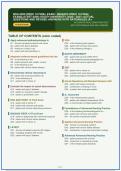
NSG 6020 WEEK 10 FINAL EXAM / NSG6020 WEEK 10 FINAL
EXAM(LATEST-2026) SOUTH UNIVERSITY () ACTUAL
QUESTIONS AND REVISED ANSWERS WITH RATIONALES (A+
ACCURATE REAL EXAM PRACTICE
50 QUESTIONS WITH RATIONALES AND WHY WRONG
TABLE OF CONTENTS (color coded)
Apply advanced pathophysiology to 2026
Q1 - 45-year-old patient presents with acute Q24 - of the following best explains
Q2 - patient with type 2 diabetes Q25 - patient with cirrhosis and ascites
Q3 - finding on a chest X-ray Q26 - of the following findings is
Q4 - patient with atrial fibrillation is
SOUTH UNIVERSITY
Integrate evidence-based guidelines into the Q27 - patient with severe COPD (FEV1
Q5 - of the following is the Q28 - of the following electrocardiographic fin...
Q6 - patient presents with sudden, severe Q29 - patient with severe sepsis and
Q7 - of the following is the
Q8 - patient with chronic kidney disease 2027
Q30 - patient with a history of
Demonstrate clinical reasoning in Q31 - a patient with acute decompensated
Q9 - patient with acute pancreatitis has Q32 - pathophysiological mechanism best explain...
Q10 - of the following is a
Q11 - patient with a history of Actual Questions and Revised Answers with
Q33 - patient with sepsis and acute
Evaluate the impact of social determinants Q34 - combination of findings is most
Q12 - patient with type 2 diabetes Q35 - a patient with acute pancreatitis
Q13 - patient on long-term warfarin therapy
Q14 - patient is prescribed a new A+ Guarantee
Q36 - of the following best explains
NSG 6020 WEEK 10 Final Exam Q37 - patient with diabetic ketoacidosis (DKA)
Q15 - patient with a history of Q38 - a mechanically ventilated patient with
Q16 - patient with cirrhosis and ascites
Q17 - patient with chronic obstructive pulmonary Foundations of Advanced Nursing Practice
Q39 - of the following electrocardiographic fin...
NSG6020 WEEK 10 Final Exam Q40 - patient with cirrhosis and ascites
Q18 - patient is diagnosed with community-acquired Q41 - the context of advanced health
Q19 - patient with chronic kidney disease
Q20 - patient with a history of Applied Advanced Nursing Practice
Q42 - clinician is evaluating a patient
LATEST Q43 - patient with chronic kidney disease
Q21 - 45-year-old patient presents with fatigue, Q44 - combination of physical examination findings
Q22 - managing a patient with chronic
Q23 - patient with type 2 diabetes Advanced Advanced Nursing Practice
Q45 - patient presents with a blood
Q46 - researcher is interpreting a study
Q47 - of the following best describes
Page 1
, Advanced Nursing Practice Review
Q48 - patient on long-term warfarin therapy
Q49 - finding on a chest radiograph
Q50 - patient with sepsis and acute
50 representative Advanced Nursing Practice exam questions with the correct answer highlighted and a rationale.
Q1 APPLY ADVANCED PATHOPHYSIOLOGY TO DIFFERENTIAL DIAGNOSIS ACROSS THE LIFESPAN
A 45-year-old patient presents with acute onset of vertigo, nausea, and horizontal
nystagmus. The Dix-Hallpike maneuver reproduces symptoms with torsional
nystagmus. Which intervention is most appropriate as first-line management?
A. Prescribe meclizine 25 mg orally three times daily
B. Perform the Epley maneuver CORRECT
C. Order an MRI of the brain to rule out central causes
D. Start a short course of oral prednisone
RATIONALE: The presentation is classic for benign paroxysmal positional vertigo (BPPV), and
the Epley maneuver is the standard of care, providing immediate relief in most cases. Meclizine
may help symptoms but does not treat the underlying canalithiasis. MRI is not indicated without
red flags. Prednisone is used for vestibular neuritis, not BPPV.
Q2 APPLY ADVANCED PATHOPHYSIOLOGY TO DIFFERENTIAL DIAGNOSIS ACROSS THE LIFESPAN
A patient with type 2 diabetes has an eGFR of 20 mL/min/1.73m² and is currently
on metformin, lisinopril, and insulin. Which medication adjustment is most
appropriate?
A. Continue metformin at the current dose
B. Discontinue metformin due to contraindication CORRECT
C. Increase lisinopril to protect renal function
D. Switch from insulin to a sulfonylurea
RATIONALE: Metformin is contraindicated when eGFR falls below 30 mL/min/1.73m² due to the
risk of lactic acidosis. Lisinopril can be continued but dose adjustment may be needed;
increasing it is not automatically indicated. Sulfonylureas may be used but insulin is often
preferred in advanced CKD; switching is not the primary adjustment.
Page 2
, Q3 APPLY ADVANCED PATHOPHYSIOLOGY TO DIFFERENTIAL DIAGNOSIS ACROSS THE LIFESPAN
Which finding on a chest X-ray is most indicative of a tension pneumothorax?
A. Widening of the mediastinum
B. Tracheal deviation to the contralateral side CORRECT
C. Air-fluid level within the pleural space
D. Elevation of the ipsilateral hemidiaphragm
RATIONALE: Tracheal deviation away from the affected side is a hallmark of tension
pneumothorax due to mediastinal shift. Widening of the mediastinum suggests aortic dissection.
Air-fluid level indicates hemopneumothorax or empyema. Hemidiaphragm elevation is
nonspecific and may occur with atelectasis or phrenic nerve palsy.
Q4 APPLY ADVANCED PATHOPHYSIOLOGY TO DIFFERENTIAL DIAGNOSIS ACROSS THE LIFESPAN
A patient with atrial fibrillation is started on warfarin. Which laboratory value
would indicate that the therapy is at a therapeutic level for most indications?
A. International normalized ratio (INR) of 1.0
B. International normalized ratio (INR) of 2.5 CORRECT
C. Activated partial thromboplastin time (aPTT) of 60 seconds
D. Prothrombin time (PT) of 12 seconds
RATIONALE: For non-valvular atrial fibrillation, the target INR is typically 2.0-3.0, so 2.5 is
therapeutic. An INR of 1.0 indicates no anticoagulation. aPTT is used to monitor heparin, not
warfarin. PT alone is not standardized; the INR is the correct measure.
Page 3