

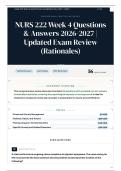
NURS 222 WEEK 4 QUESTIONS & ANSWERS 2026-2027 | UPDAT… EXAM
P R O F E S S I O N A L P R A C T I C E M AT E R I A L S
NURS 222 Week 4 Questions
& Answers 2026-2027 |
Updated Exam Review
(Rationales)
Verified Answers Exam Ready With Rationales 56 QUESTIONS
DOCUMENT OVERVIEW
This comprehensive review document contains 56 questions with provided correct answers
and detailed rationales, covering the psychological aspects of nursing care. It is ideal for
students to study and review key concepts in preparation for exams and certification.
TOPICS
Stress and Anxiety Management Q1–Q22
Violence, Abuse, and Trauma Q23–Q39
Pharmacology for Anxiety Disorders Q40–Q54
Specific Anxiety and Related Disorders Q55–Q56
E XA M Q U EST I O N S
Q1 QUESTION 1 OF 56
A client with chronic ongoing stress complains of physical symptoms. The nurse caring for
him is aware that the most common chronic problem caused by stress is which of the
following?
Page 1
, CORRECT ANSWER
Headaches
RATIONALE
Chronic stress commonly manifests somatically, with tension headaches being a prevalent physical
symptom due to sustained muscle contraction and altered neurotransmitter activity. The
underlying principle is the body's physiological response to prolonged psychological distress.
Q2 QUESTION 2 OF 56
Stress reduction is likely to result in which of the following?
CORRECT ANSWER
-Reduced pain
-Lower blood pressure
-decreased gastrointestinal problems
RATIONALE
Stress reduction attenuates the sympathetic nervous system's fight-or-flight response, thereby
decreasing physiological arousal that exacerbates pain perception, elevates blood pressure, and
disrupts gastrointestinal motility. This principle highlights the psychophysiological link between
mental state and somatic symptoms.
Q3 QUESTION 3 OF 56
What would a client experience during a progressive relaxation session?
CORRECT ANSWER
Instruction in sequential tensing and relaxing of various muscle groups until the entire body is
relaxed
RATIONALE
Progressive muscle relaxation involves systematically tensing and then releasing different muscle
groups to promote a state of deep physical relaxation. This technique allows individuals to
differentiate between tension and relaxation, thereby reducing somatic anxiety.
Page 2
, Q4 QUESTION 4 OF 56
A patient nervously says, "financial problems are stressing my marriage. I've heard rumors
about cutbacks at work; I am afraid I might get laid off." The patient's pulse is 112/minute;
respirations are 26/minute; and blood pressure is 166/88. Which nursing intervention will
the nurse implement?
CORRECT ANSWER
Direct the patient in slow and deep breathing via use of a positive, repeated word.
RATIONALE
Slow, deep diaphragmatic breathing, often facilitated by a mantra, activates the parasympathetic
nervous system to counteract the sympathetic "fight-or-flight" response, thereby lowering
elevated heart rate and blood pressure. This intervention addresses the physiological
manifestations of acute anxiety by promoting relaxation and reducing stress hormones.
Q5 QUESTION 5 OF 56
A 32-year-old male client is experiencing severe anxiety over a recent failed relationship.
What nursing intervention should be given highest priority?
CORRECT ANSWER
Take the client to a quiet environment
RATIONALE
Removing the client from the stimulating environment reduces external stimuli that can exacerbate
anxiety, promoting a sense of safety and calm. This intervention addresses the immediate need to
de-escalate the client's acute anxiety response.
Q6 QUESTION 6 OF 56
A nurse is closely monitoring a newly admitted client who is anxious. At what anxiety level
might this client become assaultive and a potential threat to himself and others?
CORRECT ANSWER
Panic
Page 3
P R O F E S S I O N A L P R A C T I C E M AT E R I A L S
NURS 222 Week 4 Questions
& Answers 2026-2027 |
Updated Exam Review
(Rationales)
Verified Answers Exam Ready With Rationales 56 QUESTIONS
DOCUMENT OVERVIEW
This comprehensive review document contains 56 questions with provided correct answers
and detailed rationales, covering the psychological aspects of nursing care. It is ideal for
students to study and review key concepts in preparation for exams and certification.
TOPICS
Stress and Anxiety Management Q1–Q22
Violence, Abuse, and Trauma Q23–Q39
Pharmacology for Anxiety Disorders Q40–Q54
Specific Anxiety and Related Disorders Q55–Q56
E XA M Q U EST I O N S
Q1 QUESTION 1 OF 56
A client with chronic ongoing stress complains of physical symptoms. The nurse caring for
him is aware that the most common chronic problem caused by stress is which of the
following?
Page 1
, CORRECT ANSWER
Headaches
RATIONALE
Chronic stress commonly manifests somatically, with tension headaches being a prevalent physical
symptom due to sustained muscle contraction and altered neurotransmitter activity. The
underlying principle is the body's physiological response to prolonged psychological distress.
Q2 QUESTION 2 OF 56
Stress reduction is likely to result in which of the following?
CORRECT ANSWER
-Reduced pain
-Lower blood pressure
-decreased gastrointestinal problems
RATIONALE
Stress reduction attenuates the sympathetic nervous system's fight-or-flight response, thereby
decreasing physiological arousal that exacerbates pain perception, elevates blood pressure, and
disrupts gastrointestinal motility. This principle highlights the psychophysiological link between
mental state and somatic symptoms.
Q3 QUESTION 3 OF 56
What would a client experience during a progressive relaxation session?
CORRECT ANSWER
Instruction in sequential tensing and relaxing of various muscle groups until the entire body is
relaxed
RATIONALE
Progressive muscle relaxation involves systematically tensing and then releasing different muscle
groups to promote a state of deep physical relaxation. This technique allows individuals to
differentiate between tension and relaxation, thereby reducing somatic anxiety.
Page 2
, Q4 QUESTION 4 OF 56
A patient nervously says, "financial problems are stressing my marriage. I've heard rumors
about cutbacks at work; I am afraid I might get laid off." The patient's pulse is 112/minute;
respirations are 26/minute; and blood pressure is 166/88. Which nursing intervention will
the nurse implement?
CORRECT ANSWER
Direct the patient in slow and deep breathing via use of a positive, repeated word.
RATIONALE
Slow, deep diaphragmatic breathing, often facilitated by a mantra, activates the parasympathetic
nervous system to counteract the sympathetic "fight-or-flight" response, thereby lowering
elevated heart rate and blood pressure. This intervention addresses the physiological
manifestations of acute anxiety by promoting relaxation and reducing stress hormones.
Q5 QUESTION 5 OF 56
A 32-year-old male client is experiencing severe anxiety over a recent failed relationship.
What nursing intervention should be given highest priority?
CORRECT ANSWER
Take the client to a quiet environment
RATIONALE
Removing the client from the stimulating environment reduces external stimuli that can exacerbate
anxiety, promoting a sense of safety and calm. This intervention addresses the immediate need to
de-escalate the client's acute anxiety response.
Q6 QUESTION 6 OF 56
A nurse is closely monitoring a newly admitted client who is anxious. At what anxiety level
might this client become assaultive and a potential threat to himself and others?
CORRECT ANSWER
Panic
Page 3

