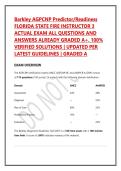
Barkley AGPCNP Predictor/Readiness
FLORIDA STATE FIRE INSTRUCTOR 3
ACTUAL EXAM ALL QUESTIONS AND
ANSWERS ALREADY GRADED A+. 100%
VERIFIED SOLUTIONS | UPDATED PER
LATEST GUIDELINES | GRADED A
EXAM OVERVIEW
The AGPCNP certification exams (ANCC AGPCNP-BC and AANPCB A-GNP) consist
of 175 questions (150 scored, 25 pretest) with the following domain distribution :
Domain ANCC AANPCB
Assessment 24% 28%
Diagnosis — 25%
Plan of Care 60% 25%
Professional Practice 16% —
Evaluation — 22%
The Barkley Diagnostic Readiness Test (DRT) is a 100-item exam with a 100-minute
time limit. A score of ≥80% indicates mastery of the material .
,SECTION 1: ASSESSMENT & DIAGNOSIS –
CARDIOLOGY (Questions 1-25)
Question 1
A 68-year-old female has a blood pressure of 154/92 mmHg on three separate
occasions. She has no diabetes or known cardiovascular disease. According to the 2017
ACC/AHA guideline, what is her stage of hypertension?
A) Stage 1 hypertension
B) Stage 2 hypertension
C) Elevated blood pressure
D) Normal blood pressure
Answer: B) Stage 2 hypertension
Rationale: Stage 2 hypertension is defined as systolic BP ≥140 or diastolic BP ≥90
mmHg. Stage 1 is systolic 130-139 or diastolic 80-89. This patient's BP of 154/92 falls
into Stage 2, requiring pharmacologic therapy in addition to lifestyle modifications .
Question 2
A 65-year-old male with a 40-pack-year smoking history presents with a persistent
cough and unintentional weight loss. Which of the following is the most appropriate
initial screening test for lung cancer?
A) Chest X-ray
B) Sputum cytology
,C) Low-dose CT (LDCT)
D) Bronchoscopy
Answer: C) Low-dose CT (LDCT)
Rationale: The USPSTF recommends annual LDCT for adults aged 50-80 years with a
≥20 pack-year smoking history who currently smoke or have quit within the past 15
years. LDCT reduces lung-cancer mortality, while chest X-ray is not recommended for
screening .
Question 3
A 72-year-old male with a history of hypertension presents with acute-onset severe
tearing chest pain radiating to the back. Blood pressure is 160/90 mmHg in the right
arm and 110/70 mmHg in the left arm. What is the most appropriate next step?
A) Administer aspirin and start heparin
B) STAT CT angiography of the chest
C) Obtain cardiac enzymes and admit to telemetry
D) Order a chest X-ray and echocardiogram
Answer: B) STAT CT angiography of the chest
Rationale: The patient's presentation is classic for aortic dissection: tearing chest pain
radiating to the back with asymmetric blood pressures between arms. CT angiography is
the diagnostic test of choice and should not be delayed. Immediate surgical
consultation is required. Aspirin is contraindicated .
, Question 4
A 58-year-old female reports "skipped heartbeats" and occasional dizziness. Her only
medication is hydrochlorothiazide. ECG shows sinus rhythm with frequent premature
atrial contractions (PACs). What is the most likely contributing factor?
A) Hyperkalemia
B) Hypokalemia
C) Hyponatremia
D) Hypocalcemia
Answer: B) Hypokalemia
Rationale: Hypokalemia is a common adverse effect of thiazide diuretics
(hydrochlorothiazide) and can increase cardiac ectopy. Before initiating antiarrhythmic
therapy, electrolyte imbalances should be corrected. Serum potassium should be
checked and supplemented if low .
Question 5
A 75-year-old female with a history of atrial fibrillation on warfarin has an INR of 4.5
without bleeding. What is the most appropriate management?
A) Administer vitamin K 2.5 mg orally
B) Withhold warfarin and repeat INR in 24-48 hours
C) Administer fresh frozen plasma
D) Continue warfarin at the same dose
Answer: B) Withhold warfarin and repeat INR in 24-48 hours
Rationale: For an INR of 4.5 without bleeding (supratherapeutic but <5.0), the standard
approach is to withhold warfarin and repeat the INR in 24-48 hours. Vitamin K is
FLORIDA STATE FIRE INSTRUCTOR 3
ACTUAL EXAM ALL QUESTIONS AND
ANSWERS ALREADY GRADED A+. 100%
VERIFIED SOLUTIONS | UPDATED PER
LATEST GUIDELINES | GRADED A
EXAM OVERVIEW
The AGPCNP certification exams (ANCC AGPCNP-BC and AANPCB A-GNP) consist
of 175 questions (150 scored, 25 pretest) with the following domain distribution :
Domain ANCC AANPCB
Assessment 24% 28%
Diagnosis — 25%
Plan of Care 60% 25%
Professional Practice 16% —
Evaluation — 22%
The Barkley Diagnostic Readiness Test (DRT) is a 100-item exam with a 100-minute
time limit. A score of ≥80% indicates mastery of the material .
,SECTION 1: ASSESSMENT & DIAGNOSIS –
CARDIOLOGY (Questions 1-25)
Question 1
A 68-year-old female has a blood pressure of 154/92 mmHg on three separate
occasions. She has no diabetes or known cardiovascular disease. According to the 2017
ACC/AHA guideline, what is her stage of hypertension?
A) Stage 1 hypertension
B) Stage 2 hypertension
C) Elevated blood pressure
D) Normal blood pressure
Answer: B) Stage 2 hypertension
Rationale: Stage 2 hypertension is defined as systolic BP ≥140 or diastolic BP ≥90
mmHg. Stage 1 is systolic 130-139 or diastolic 80-89. This patient's BP of 154/92 falls
into Stage 2, requiring pharmacologic therapy in addition to lifestyle modifications .
Question 2
A 65-year-old male with a 40-pack-year smoking history presents with a persistent
cough and unintentional weight loss. Which of the following is the most appropriate
initial screening test for lung cancer?
A) Chest X-ray
B) Sputum cytology
,C) Low-dose CT (LDCT)
D) Bronchoscopy
Answer: C) Low-dose CT (LDCT)
Rationale: The USPSTF recommends annual LDCT for adults aged 50-80 years with a
≥20 pack-year smoking history who currently smoke or have quit within the past 15
years. LDCT reduces lung-cancer mortality, while chest X-ray is not recommended for
screening .
Question 3
A 72-year-old male with a history of hypertension presents with acute-onset severe
tearing chest pain radiating to the back. Blood pressure is 160/90 mmHg in the right
arm and 110/70 mmHg in the left arm. What is the most appropriate next step?
A) Administer aspirin and start heparin
B) STAT CT angiography of the chest
C) Obtain cardiac enzymes and admit to telemetry
D) Order a chest X-ray and echocardiogram
Answer: B) STAT CT angiography of the chest
Rationale: The patient's presentation is classic for aortic dissection: tearing chest pain
radiating to the back with asymmetric blood pressures between arms. CT angiography is
the diagnostic test of choice and should not be delayed. Immediate surgical
consultation is required. Aspirin is contraindicated .
, Question 4
A 58-year-old female reports "skipped heartbeats" and occasional dizziness. Her only
medication is hydrochlorothiazide. ECG shows sinus rhythm with frequent premature
atrial contractions (PACs). What is the most likely contributing factor?
A) Hyperkalemia
B) Hypokalemia
C) Hyponatremia
D) Hypocalcemia
Answer: B) Hypokalemia
Rationale: Hypokalemia is a common adverse effect of thiazide diuretics
(hydrochlorothiazide) and can increase cardiac ectopy. Before initiating antiarrhythmic
therapy, electrolyte imbalances should be corrected. Serum potassium should be
checked and supplemented if low .
Question 5
A 75-year-old female with a history of atrial fibrillation on warfarin has an INR of 4.5
without bleeding. What is the most appropriate management?
A) Administer vitamin K 2.5 mg orally
B) Withhold warfarin and repeat INR in 24-48 hours
C) Administer fresh frozen plasma
D) Continue warfarin at the same dose
Answer: B) Withhold warfarin and repeat INR in 24-48 hours
Rationale: For an INR of 4.5 without bleeding (supratherapeutic but <5.0), the standard
approach is to withhold warfarin and repeat the INR in 24-48 hours. Vitamin K is