
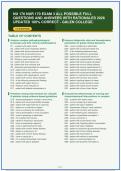
NU 170 NUR 170 EXAM 3 ALL POSSIBLE FULL
QUESTIONS AND ANSWERS WITH RATIONALES 2026
UPDATED 100% CORRECT - GALEN COLLEGE.
170 QUESTIONS
TABLE OF CONTENTS
Analyze complex pathophysiological Interpret diagnostic data and hemodynamic
processes and their clinical manifestations parameters to guide clinical decisions
Q1 - a patient with septic shock Q35 - nurse is preparing to administer
Q2 - patient with acute respiratory distress Q36 - patient with acute pancreatitis has
Q3 - patient with severe traumatic brain Q37 - of the following statements best
Q4 - patient with acute kidney injury Q38 - patient with asthma is prescribed
Q5 - patient in the post-anesthesia care Q39 - patient with rheumatoid arthritis is
Q6 - finding is most consistent with Q40 - patient with hypothyroidism is taking
Q7 - patient with heart failure has Q41 - patient with severe sepsis develops
Q8 - patient with liver cirrhosis and Q42 - patient with chronic kidney disease
Q9 - statement best describes the mechanism Q43 - patient with severe hyperkalemia (K+
Q10 - patient with a severe burn Q44 - patient with diabetic ketoacidosis has
Q11 - patient receiving a continuous infusion Q45 - patient with acute pancreatitis develops
Q12 - a patient with hyperkalemia, which Q46 - patient on mechanical ventilation has
Q13 - patient with chronic kidney disease Q47 - patient with cirrhosis and ascites
Q14 - of the following assessment findings Q48 - patient receiving heparin for deep
Q15 - patient with septic shock is Q49 - patient with acute ischemic stroke
Q16 - finding is most indicative of Q50 - patient with septic shock remains
Q17 - patient with diabetic ketoacidosis is Q51 - patient with chronic heart failure
Prioritize nursing interventions for critically Evaluate the effectiveness of nursing and
ill patients using evidence-based guidelines interprofessional interventions in complex
Q18 - electrocardiographic change is most chara... Q52 - a patient with septic shock
Q19 - patient with acute pancreatitis develops Q53 - nurse is preparing to administer
Q20 - patient with hypernatremia is receiving Q54 - patient with type 2 diabetes
Q21 - patient on a continuous heparin Q55 - assessment finding is most indicative
Q22 - nurse is reviewing the medication Q56 - patient with cirrhosis and ascites
Q23 - clinical presentation is most consistent Q57 - of the following pain medications
Q24 - nurse is preparing to administer Q58 - patient is prescribed enoxaparin 1
Q25 - For a patient with severe Q59 - nurse is caring for a
Q26 - patient is receiving a transfusion Q60 - patient with acute kidney injury
Q27 - nurse is evaluating a patient's Q61 - patient with hyperthyroidism is prescribed
Q28 - nurse is administering IV fluids Q62 - patient with type 2 diabetes
Q29 - patient with chronic kidney disease Q63 - patient on long-term glucocorticoid therapy
Q30 - patient is receiving an IV Q64 - patient with chronic kidney disease
Q31 - patient with chronic kidney disease Q65 - patient with heart failure is
Q32 - nurse is caring for a Q66 - patient with asthma is prescribed
Q33 - For a patient prescribed rivaroxaban Q67 - patient is receiving heparin by
Q34 - patient with type 2 diabetes Q68 - patient with bacterial meningitis is
Page 1
,NU 170 NUR 170 Exam 3 All Possible Full Foundations of Medical-Surgical Nursing:
Questions and Answers with Rationales Complex Care
Q69 - patient with cancer is receiving Q103 - patient with type 2 diabetes
Q70 - patient with tuberculosis is started Q104 - a patient with decompensated heart
Q71 - patient with heart failure and Q105 - patient on warfarin for mechanical
Q72 - a patient with acute respiratory Q106 - finding is most consistent with
Q73 - finding best distinguishes prerenal acute Q107 - patient with osteoporosis is prescribed
Q74 - patient with type 2 diabetes Q108 - patient with severe asthma exacerbation
Q75 - patient with septic shock and Q109 - patient is prescribed a potassium-sparing
Q76 - electrocardiographic change is most indic... Q110 - patient with hyperthyroidism is prescribed
Q77 - patient with cirrhosis and ascites Q111 - patient on a continuous heparin
Q78 - patient on a continuous heparin Q112 - patient with chronic kidney disease
Q79 - assessment finding is the earliest Q113 - patient receiving IV potassium chloride
Q80 - patient with acute pancreatitis has Q114 - assessment finding in a patient
Q81 - evaluating the effectiveness of a Q115 - patient is receiving an IV
Q82 - combination of findings most strongly Q116 - patient with a history of
Q83 - patient with acute respiratory distress Q117 - patient is receiving a transfusion
Q84 - patient with severe hyperkalemia (K+ Q118 - nurse is caring for a
Q85 - finding is most indicative of Q119 - patient with a serum potassium
Galen College. Applied Medical-Surgical Nursing: Complex
Q86 - a patient with suspected acute Care
Q87 - parameter is most important for Q120 - patient is receiving an IV
Q88 - patient with fulminant hepatic failure Q121 - client with chronic kidney disease
Q89 - of the following is the Q122 - a patient receiving a continuous
Q90 - patient with chronic kidney disease Q123 - patient with heart failure is
Q91 - a patient with septic shock Q124 - electrocardiogram change is most indicative
Q92 - patient on pressure-controlled ventilatio... Q125 - client on a mechanical ventilator
Q93 - patient with acute kidney injury Q126 - patient is receiving an intravenous
Q94 - patient in the ICU is Q127 - finding in a patient receiving
Q95 - patient with a pulmonary artery Q128 - patient with chronic kidney disease
Q96 - nurse is caring for a Q129 - patient is prescribed spironolactone. Which
Q97 - patient with acute pancreatitis develops Q130 - of the following is a
Q98 - patient is receiving a heparin Q131 - the context of the SQ3R
Q99 - patient with a traumatic brain Q132 - patient is prescribed a medication
Q100 - patient in the ICU develops Q133 - patient with chronic kidney disease
Q101 - patient with chronic kidney disease Q134 - nurse is providing discharge teaching
Q102 - patient is receiving a continuous Q135 - physiological mechanism best explains why
Q136 - patient with type 2 diabetes
Page 2
,Advanced Medical-Surgical Nursing:
Complex Care
Q137 - patient is receiving a continuous
Q138 - assessment finding in a post-operative
Q139 - patient with cirrhosis and ascites
Q140 - patient with acute pancreatitis is
Q141 - a patient with severe sepsis,
Q142 - pathophysiological mechanism best explain...
Q143 - provider prescribes 500 mg of
Q144 - finding most clearly distinguishes acute
Q145 - patient with chronic kidney disease
Q146 - patient with type 2 diabetes
Q147 - patient with acute pancreatitis develops
Q148 - critically ill patient with septic
Q149 - patient with chronic obstructive pulmonary
Q150 - patient with liver cirrhosis and
Q151 - a patient with severe sepsis
Q152 - patient with chronic heart failure
Q153 - pathophysiological mechanism best explain...
Medical-Surgical Nursing: Complex Care
Review
Q154 - patient with suspected pulmonary embolism
Q155 - patient with acute pancreatitis is
Q156 - patient on a continuous heparin
Q157 - assessment finding is most indicative
Q158 - patient with chronic kidney disease
Q159 - patient with type 1 diabetes
Q160 - patient with cirrhosis and ascites
Q161 - patient with acute decompensated heart
Q162 - hemodynamic profile is most consistent
Q163 - patient on a heparin drip
Q164 - patient with a history of
Q165 - intervention is most appropriate for
Q166 - patient with chronic kidney disease
Q167 - patient with severe sepsis and
Q168 - patient with a pulmonary embolism
Q169 - electrocardiographic change is most indic...
Q170 - patient with heart failure is
Page 3
, Q1 ANALYZE COMPLEX PATHOPHYSIOLOGICAL PROCESSES AND THEIR CLINICAL
MANIFESTATIONS
In a patient with septic shock on norepinephrine, the mean arterial pressure (MAP)
remains 60 mm Hg despite escalating doses. Which additional intervention is most
likely to improve tissue perfusion and reduce mortality?
A. Add vasopressin as a second-line agent
B. Initiate low-dose corticosteroids CORRECT
C. Increase IV fluid boluses to achieve central venous pressure (CVP) >12 mm Hg
D. Switch to dopamine as the primary vasopressor
RATIONALE: In septic shock refractory to norepinephrine, current Surviving Sepsis Campaign
guidelines recommend adding vasopressin (up to 0.03 U/min) or starting corticosteroids if the
patient is at high risk of adrenal insufficiency. Low-dose corticosteroids are indicated when MAP
remains low despite adequate fluids and vasopressors. Vasopressin is not typically added solely
for a MAP of 60; it is used as a second agent when norepinephrine dose is high. Fluid boluses
should not be continued if the patient is fluid-overloaded, and dopamine is no longer preferred
due to increased arrhythmias and mortality.
Q2 ANALYZE COMPLEX PATHOPHYSIOLOGICAL PROCESSES AND THEIR CLINICAL
MANIFESTATIONS
A patient with acute respiratory distress syndrome (ARDS) is on
volume-controlled ventilation with a tidal volume of 6 mL/kg ideal body weight.
The plateau pressure is 32 cm H2O. Which ventilator adjustment is most
appropriate?
A. Increase PEEP to improve oxygenation
B. Decrease tidal volume to 4 mL/kg CORRECT
C. Switch to pressure-controlled ventilation
D. Increase respiratory rate to maintain minute ventilation
RATIONALE: In ARDS, the goal is to maintain plateau pressure 30 cm H2O to prevent
ventilator-induced lung injury. With a plateau of 32 cm H2O, the tidal volume should be reduced
(e.g., to 4-5 mL/kg) to lower plateau pressure, even if it results in permissive hypercapnia.
Increasing PEEP may further increase plateau pressure. Switching modes does not directly
address the high plateau pressure. Increasing respiratory rate may worsen air trapping and is not
the primary intervention.
Page 4

