
Page 1 of 133
Virginia HVAC Master License Exam QUESTIONS
AND DETAILED SOLUTIONS JUST RELEASED
Virginia HVAC Master License Exam
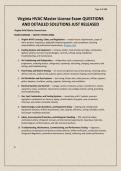
EXAM COVERAGE — MOSTLY TESTED AREAS
1. Virginia HVAC Licensing, Codes, and Regulations — master-license requirements, scope of
work, permits, inspections, applicable Virginia regulations, code compliance, licensing
responsibilities, and professional requirements. (Virginia Law)
2. Heating Systems and Equipment — furnaces, boilers, heat-transfer principles, combustion,
ignition systems, burners, heat exchangers, controls, venting, sizing, installation,
troubleshooting, and maintenance.
3. Air Conditioning and Refrigeration — refrigeration cycle, compressors, condensers,
evaporators, metering devices, refrigerants, superheat, subcooling, charging, evacuation, leak
testing, and troubleshooting.
4. Heat Pumps and Electric Heating — air-source and ground-source heat pumps, reversing valves,
defrost controls, auxiliary heat, balance points, electric resistance heating, and troubleshooting.
5. Air Distribution and Duct Systems — duct sizing, friction loss, static pressure, airflow, registers,
grilles, dampers, insulation, sealing, supports, balancing, and ventilation.
6. Electrical Systems and Controls — voltage, current, resistance, power, transformers, motors,
capacitors, relays, contactors, disconnects, breakers, low-voltage controls, wiring, grounding,
and troubleshooting.
7. Gas, Fuel, Combustion, and Venting Systems — natural gas and LP systems, pressure
regulation, combustion air, burners, piping, shutoff valves, flue gases, vent connectors,
chimneys, and carbon-monoxide hazards.
8. System Design, Load Calculations, and Equipment Sizing — heating and cooling loads,
equipment selection, airflow requirements, duct capacity, efficiency, zoning, humidity control,
and proper installation practices.
9. Safety, Environmental Protection, and Refrigerant Handling — PPE, electrical safety,
combustion safety, refrigerant recovery, environmental requirements, hazardous materials,
lockout/tagout, confined spaces, and safe service procedures.
10. Troubleshooting, Maintenance, Commissioning, and Performance Testing — diagnostic
procedures, temperature and pressure measurements, airflow verification, combustion analysis,
refrigerant diagnostics, preventive maintenance, startup, balancing, and system performance.
1.
, Page 2 of 133
When diagnosing a residential split air-conditioning system that has high suction pressure and low
superheat, which condition should a technician investigate first?
A. A restricted liquid-line filter-drier
B. An overfeeding metering device
C. A severely undercharged system
D. A completely blocked condenser coil
Answer: B
Rationale: High suction pressure combined with low superheat commonly indicates that the evaporator
is receiving too much refrigerant.
2.
Before a Virginia HVAC master begins work requiring a permit, which action is generally most
appropriate to ensure the project complies with applicable requirements?
A. Begin installation and request inspection after completion
B. Verify applicable permit, code, and inspection requirements before work starts
C. Allow the equipment manufacturer to obtain every required permit
D. Complete only the electrical portion before contacting the authority
Answer: B
, Page 3 of 133
Rationale: Proper planning requires determining applicable permits, codes, and inspection requirements
before covered work begins.
3.
A furnace operates normally for several minutes but repeatedly shuts down because the high-limit
control opens. Which condition should be investigated first?
A. Excessive supply-air temperature caused by inadequate airflow
B. An oversized thermostat wire
C. Excessive refrigerant charge
D. A failed condenser fan motor
Answer: A
Rationale: Restricted airflow can cause excessive heat buildup in the furnace heat exchanger and supply
air, opening the high-limit control.
4.
What measurement is most useful when determining whether an air-conditioning evaporator is
receiving adequate refrigerant after the system has stabilized?
A. Outdoor relative humidity only
B. Compressor oil level only
, Page 4 of 133
C. Evaporator superheat together with operating pressures and conditions
D. Condenser cabinet temperature only
Answer: C
Rationale: Superheat, pressures, indoor conditions, and outdoor conditions together provide useful
information about evaporator refrigerant feed.
5.
When a blower motor produces a humming sound but fails to start on a PSC blower assembly, which
component should be checked early in the diagnosis?
A. Flame sensor
B. Run capacitor
C. Refrigerant receiver
D. Gas regulator
Answer: B
Rationale: A weak or failed run capacitor can prevent a PSC motor from developing sufficient starting
torque.
6.

