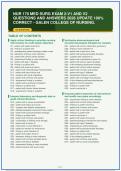
NUR 170 MED SURG EXAM 2-V1 AND V2
QUESTIONS AND ANSWERS 2026 UPDATE 100%
CORRECT - GALEN COLLEGE OF NURSING.
189 QUESTIONS
TABLE OF CONTENTS
Apply critical thinking to prioritize nursing Synthesize pharmacological and
interventions for multi-system disorders non-pharmacological therapies for complex
Q1 - patient with septic shock and Q37 - patient with chronic obstructive pulmonary
Q2 - finding in a patient with Q38 - finding is most indicative of
Q3 - postoperative patient develops sudden onset Q39 - patient with major burns over
Q4 - laboratory finding is most indicative Q40 - patient with acute pancreatitis develops
Q5 - patient with chronic kidney disease Q41 - a patient with syndrome of
Q6 - assessment finding is most concerning Q42 - patient with hyperkalemia (serum K+
Q7 - patient with type 1 diabetes Q43 - patient with severe sepsis develops
Q8 - finding in a patient with Q44 - of the following assessment findings
Q9 - patient with acute liver failure Q45 - patient with chronic kidney disease
Q10 - patient with chemotherapy-induced febrile... Q46 - patient with cirrhosis and ascites
Q11 - patient with heart failure and Q47 - patient with type 2 diabetes
Q12 - a patient with acute respiratory Q48 - assessment finding in a patient
Q13 - patient with cirrhosis and ascites Q49 - patient with end-stage renal disease
Q14 - assessment finding in a patient Q50 - of the following acid-base disturbances
Q15 - patient with a pulmonary embolism Q51 - patient in the ICU presents
Q16 - finding in a patient with Q52 - finding in a patient with
Q17 - patient with chronic kidney disease Q53 - nurse is caring for a
Q18 - assessment finding in a patient
Evaluate patient responses to interventions
Interpret laboratory and diagnostic data to and modify care plans accordingly
guide clinical decisions Q54 - assessment finding is most indicative
Q19 - patient with a severe exacerbation Q55 - patient with chronic kidney disease
Q20 - patient with sepsis and acute Q56 - finding in a patient receiving
Q21 - a patient with diabetic ketoacidosis Q57 - patient with cirrhosis and ascites
Q22 - pathophysiological mechanism best explain... Q58 - patient with a traumatic brain
Q23 - patient with acute pancreatitis develops Q59 - finding in a patient with
Q24 - finding in a patient with Q60 - nurse is caring for a
Q25 - patient with cirrhosis and ascites Q61 - patient with sepsis and acute
Q26 - combination of findings most strongly Q62 - pathophysiological mechanism best explain...
Q27 - patient with a history of Q63 - patient with type 2 diabetes
Q28 - intervention is most effective in Q64 - interpreting an arterial blood gas,
Q29 - patient on warfarin for mechanical Q65 - patient with acute pancreatitis develops
Q30 - finding is most indicative of Q66 - finding in a patient with
Q31 - patient with septic shock is Q67 - patient with chronic kidney disease
Q32 - laboratory finding is most indicative Q68 - of the following patients is
Q33 - patient with cirrhosis develops tense Q69 - patient with cirrhosis and ascites
Q34 - patient with type 2 diabetes Q70 - patient with an acute exacerbation
Q35 - assessment finding is most consistent
Q36 - patient presents with acute onset
Page 1
,NUR 170 Med Surg Exam 2 Galen College of Nursing.
Q71 - patient with acute pancreatitis develops Q105 - strategy is most effective in
Q72 - patient with cirrhosis and ascites Q106 - patient with a traumatic brain
Q73 - patient with chronic kidney disease Q107 - finding differentiates neurogenic shock from
Q74 - patient with type 2 diabetes Q108 - patient with acute pancreatitis develops
Q75 - patient with septic shock has Q109 - action is most appropriate for
Q76 - patient with heart failure with Q110 - assessment finding requires immediate int...
Q77 - patient with chronic obstructive pulmonary Q111 - patient with sepsis develops acute
Q78 - patient with acute kidney injury Q112 - patient with chronic kidney disease
Q79 - patient with sepsis is prescribed Q113 - patient with cirrhosis develops asterixis
Q80 - patient with cirrhosis and ascites Q114 - patient with a history of
Q81 - a patient with acute pancreatitis, Q115 - patient with acute pancreatitis develops
Q82 - patient with cirrhosis and ascites Q116 - patient with type 2 diabetes
Q83 - electrocardiographic change is most indic... Q117 - patient with COPD is receiving
Q84 - patient with septic shock remains Q118 - patient with acute coronary syndrome
Q85 - serum biomarker is most useful Q119 - patient with chronic kidney disease
Q86 - patient with chronic obstructive pulmonary Q120 - patient with septic shock and
Q87 - medication requires dose adjustment in Q121 - finding in a patient with
V1 and V2 Questions and Answers 2026 Foundations of Medical-Surgical Nursing
Update 100% Correct Q122 - patient with cirrhosis and ascites
Q88 - patient with acute respiratory distress Q123 - patient with acute pancreatitis has
Q89 - finding is most consistent with Q124 - patient with a traumatic brain
Q90 - For a patient with diabetic Q125 - patient on continuous renal replacement
Q91 - patient with a serum potassium Q126 - patient with a large pulmonary
Q92 - a patient with syndrome of Q127 - patient with acute respiratory failure
Q93 - patient with chronic kidney disease Q128 - patient with acute coronary syndrome
Q94 - patient with acute pancreatitis develops Q129 - patient with chronic kidney disease
Q95 - assessment finding is most indicative Q130 - patient with acute pancreatitis develops
Q96 - patient with a new colostomy Q131 - patient with cirrhosis and refractory
Q97 - patient with cirrhosis and ascites Q132 - patient on a continuous heparin
Q98 - patient with type 1 diabetes Q133 - patient with acute kidney injury
Q99 - assessment finding is most consistent Q134 - patient with COPD and chronic
Q100 - patient with a new diagnosis Q135 - patient with type 2 diabetes
Q101 - a patient with acute decompensated Q136 - patient with sepsis is receiving
Q102 - patient with chronic obstructive pulmonary Q137 - patient with a history of
Q103 - finding is most indicative of Q138 - patient with chronic kidney disease
Q104 - patient with type 2 diabetes
Page 2
,Applied Medical-Surgical Nursing Medical-Surgical Nursing Review
Q139 - patient with asthma develops progressive Q173 - patient with type 2 diabetes
Q140 - patient with severe sepsis develops Q174 - patient with a pulmonary embolism
Q141 - patient with diabetic ketoacidosis has Q175 - patient with chronic obstructive pulmonary
Q142 - electrocardiographic change is most indic... Q176 - patient with severe acute pancreatitis
Q143 - postoperative patient develops sudden dys... Q177 - patient with acute kidney injury
Q144 - patient with cirrhosis and ascites Q178 - patient with chronic liver disease
Q145 - assessment finding most reliably indicates Q179 - patient with diabetic ketoacidosis (DKA)
Q146 - patient with chronic kidney disease Q180 - patient with acute decompensated heart
Q147 - patient with acute pancreatitis has Q181 - a patient with septic shock,
Q148 - nurse is caring for a Q182 - patient with chronic kidney disease
Q149 - patient with acute kidney injury Q183 - patient is receiving a continuous
Q150 - patient with septic shock is Q184 - patient with acute pancreatitis has
Q151 - postoperative patient develops sudden dys... Q185 - patient with type 1 diabetes
Q152 - a patient with acute liver Q186 - patient is receiving a blood
Q153 - patient on continuous renal replacement Q187 - patient with cirrhosis and ascites
Q154 - patient with hypercalcemia secondary to Q188 - patient with COPD is receiving
Q155 - patient with acute respiratory distress Q189 - patient with a tracheostomy has
Advanced Medical-Surgical Nursing
Q156 - patient with diabetic ketoacidosis is
Q157 - patient in the intensive care
Q158 - nurse is caring for a
Q159 - patient with chronic kidney disease
Q160 - a patient with acute decompensated
Q161 - patient with chronic obstructive pulmonary
Q162 - laboratory finding is most consistent
Q163 - patient with type 2 diabetes
Q164 - a patient with acute pancreatitis,
Q165 - assessment finding is most critical
Q166 - patient with chronic kidney disease
Q167 - combination of findings is most
Q168 - intervention is most appropriate for
Q169 - patient with cirrhosis and ascites
Q170 - a patient with acute decompensated
Q171 - patient with sepsis and acute
Q172 - patient with cirrhosis and ascites
Page 3
, Q1 APPLY CRITICAL THINKING TO PRIORITIZE NURSING INTERVENTIONS FOR
MULTI-SYSTEM DISORDERS
A patient with septic shock and acute respiratory distress syndrome (ARDS) has a
pulmonary artery catheter in place. The nurse notes a cardiac index (CI) of 1.8
L/min/m², a pulmonary capillary wedge pressure (PCWP) of 18 mm Hg, and a
systemic vascular resistance (SVR) of 800 dynes/sec/cm. Which intervention
should the nurse anticipate first?
A. Administer a fluid bolus of 500 mL normal saline
B. Start a continuous infusion of norepinephrine
C. Initiate dobutamine infusion CORRECT
D. Prepare for intra-aortic balloon pump insertion
RATIONALE: The low CI with elevated PCWP indicates left ventricular dysfunction despite
adequate preload, so an inotrope (dobutamine) is indicated. Fluid bolus would worsen pulmonary
edema; norepinephrine would increase afterload further; IABP is not first-line for septic
cardiomyopathy.
Q2 APPLY CRITICAL THINKING TO PRIORITIZE NURSING INTERVENTIONS FOR
MULTI-SYSTEM DISORDERS
Which finding in a patient with acute pancreatitis indicates the development of a
systemic complication requiring immediate intervention?
A. Serum calcium of 8.2 mg/dL
B. Cullen's sign
C. PaO of 70 mm Hg on room air CORRECT
D. Elevated serum lipase
RATIONALE: Hypoxemia suggests ARDS, a serious systemic complication of pancreatitis.
Hypocalcemia (8.2) may be mild and not immediately critical; Cullen's sign indicates
retroperitoneal hemorrhage but is not an acute systemic complication; elevated lipase confirms
diagnosis but is not a complication.
Page 4