
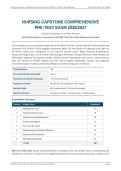
Nursing Capstone Comprehensive Pre-Test Exam 2026/2027 | NCLEX-RN Readiness 180 Verified Q&A | A+ Graded
NURSING CAPSTONE COMPREHENSIVE
PRE-TEST EXAM 2026/2027
Complete Questions & Verified Answers
NCLEX-RN Readiness Assessment | NCSBN Test Plan & NGN Measurement Model
This comprehensive pre-test examination aligns with the NCSBN NCLEX-RN Test Plan (2026/2027 Edition) and the Next
Generation NCLEX (NGN) Clinical Judgment Measurement Model. The 180 questions are organized across eight core
NCLEX-RN content areas: Management of Care, Safety & Infection Control, Health Promotion & Maintenance,
Psychosocial Integrity, Basic Care & Comfort, Pharmacological & Parenteral Therapies, Reduction of Risk Potential, and
Physiological Adaptation. Each question includes a detailed rationale explaining the correct answer, common distractor
traps, and references to NCSBN standards and NGN clinical judgment methodology. Question style emphasizes
scenario-based clinical reasoning, prioritization, delegation, and pharmacology across the lifespan.
Total Questions 180
Time Allotted (Recommended) 3 hours
Passing Score (NCLEX Standard) ~70% (126/180 correct)
Cognitive Level Mix 20% Recall / 40% Application / 40% Analysis
Question Style 80% Scenario-Based / 20% Direct Knowledge
Special Inclusions 20 NGN Case Studies / 25 Prioritization / 25 Pharmacology
Examination Structure
Section Subject Area Questions
1 Management of Care 25
2 Safety & Infection Control 20
3 Health Promotion & Maintenance 20
4 Psychosocial Integrity 15
5 Basic Care & Comfort 20
6 Pharmacological & Parenteral Therapies 25
7 Reduction of Risk Potential 25
8 Physiological Adaptation 30
TOTAL 180
How to Use This Exam: Attempt each question before reviewing the answer and rationale. Focus on understanding why
the distractors are incorrect - NCLEX writers frequently build distractors from plausible nursing actions, common clinical
NCSBN NCLEX-RN Test Plan & NGN Measurement Model Page 1
,Nursing Capstone Comprehensive Pre-Test Exam 2026/2027 | NCLEX-RN Readiness 180 Verified Q&A | A+ Graded
errors, and prioritization traps. A score of 126/180 (70%) or higher indicates readiness for the NCLEX-RN examination.
The NGN Clinical Judgment Measurement Model (Recognize Cues, Analyze Cues, Prioritize Hypotheses, Generate
Solutions, Take Action, Evaluate Outcomes) is embedded throughout the scenarios.
NCSBN NCLEX-RN Test Plan & NGN Measurement Model Page 2
,Nursing Capstone Comprehensive Pre-Test Exam 2026/2027 | NCLEX-RN Readiness 180 Verified Q&A | A+ Graded
Section 1: Management of Care
Q1: An RN on a medical-surgical unit is caring for four clients. Which client should the RN assess FIRST?
A. A client 2 days postop total knee replacement reporting incisional pain at 6/10
B. A client with chronic heart failure reporting new-onset shortness of breath and a 3 lb weight gain since
yesterday *[CORRECT]*
C. A client with Type 2 diabetes mellitus whose fasting glucose is 142 mg/dL
D. A client receiving IV antibiotics for cellulitis whose temperature decreased from 101.2°F to 99.8°F
Correct Answer: B
Rationale: Using the ABC (Airway-Breathing-Circulation) priority framework and Maslow's hierarchy, the client with new-onset
shortness of breath and weight gain likely has acute decompensated heart failure with pulmonary edema, requiring immediate
assessment. The postop pain (A), elevated glucose (C), and improving cellulitis (D) are non-emergent. NCSBN priority-setting
uses ABC, acute vs. chronic, and actual vs. potential risk to determine highest-priority clients.
Q2: An RN is delegating care for four clients to a licensed practical nurse (LPN) and a UAP. Which task is
MOST appropriate to assign to the LPN?
A. Ambulating a client 2 days postop for the first time after total hip replacement
B. Administering oral furosemide 40 mg to a client with chronic heart failure and recording intake/output
*[CORRECT]*
C. Reinforcing teaching for a newly diagnosed Type 1 diabetic client on insulin injection technique
D. Performing an initial admission assessment for a client transferred from the ICU
Correct Answer: B
Rationale: The LPN scope of practice includes administering oral medications and monitoring I&O for stable clients;
furosemide administration and I&O tracking fit within LPN scope. First-time postop ambulation (A) requires RN assessment and
presence; new diagnosis teaching (C) requires RN initial education; admission assessments (D) are an RN responsibility per
NCSBN's Five Rights of Delegation (right task, right circumstances, right person, right direction/communication, right
supervision).
Q3: A 78-year-old client with a terminal diagnosis asks the nurse, 'I don't want CPR if my heart stops.' Which
action is MOST appropriate?
A. Notify the provider to obtain a DNR order and facilitate completion of an advance directive if not already in
place *[CORRECT]*
B. Document the client's statement but take no further action until the family is consulted
C. Place the client on a no-CPR list per hospital policy without provider input
D. Inform the client that the hospital cannot honor DNR requests
Correct Answer: A
Rationale: Under the Patient Self-Determination Act (PSDA), clients have the right to make advance care planning decisions;
the nurse's role is to advocate, communicate the client's wishes to the provider, and facilitate completion of an advance directive
or POLST/MOLST form. Option B delays action; the client's wishes should be respected regardless of family input. Option C
bypasses the required provider order. Option D violates the client's autonomy and the PSDA.
NCSBN NCLEX-RN Test Plan & NGN Measurement Model Page 3
, Nursing Capstone Comprehensive Pre-Test Exam 2026/2027 | NCLEX-RN Readiness 180 Verified Q&A | A+ Graded
Q4: A client is scheduled for an elective cholecystectomy. The nurse is preparing to witness the informed
consent. Which finding requires the nurse to STOP the consent process?
A. The client asks the nurse to explain the surgical procedure in more detail
B. The client received midazolam (Versed) 2 mg IV for anxiety 15 minutes ago *[CORRECT]*
C. The client speaks English fluently and the consent form is in English
D. The client's spouse is present during the consent discussion
Correct Answer: B
Rationale: Informed consent requires the client to have capacity, which includes being free from mind-altering substances;
midazolam (a benzodiazepine) impairs cognition and invalidates consent. Option A indicates the nurse should refer the question
back to the provider but does not necessarily stop the process. Option C is appropriate. Option D is permitted as long as the
client consents. The nurse's role is to witness the signature and verify capacity, voluntariness, and that the provider obtained
consent.
Q5: An RN is caring for four clients. Using the SBAR communication tool, which scenario demonstrates the
most APPROPRIATE handoff to the oncoming RN?
A. 'Mr. Smith in room 4 is doing okay, just keep an eye on him.'
B. 'Situation: Mr. Jones, 68, admitted with pneumonia. Background: COPD, on 2L NC. Assessment: RR 24,
SpO2 92%, productive cough. Recommendation: repeat chest x-ray in the morning and consider respiratory
consult.' *[CORRECT]*
C. 'Room 5 patient has a fever, you might want to check on them.'
D. 'The client in 6 needs a new IV, just call the IV team.'
Correct Answer: B
Rationale: SBAR (Situation-Background-Assessment-Recommendation) provides structured, comprehensive handoff
communication that improves patient safety by reducing errors. Option B follows SBAR format precisely. Options A, C, and D
lack specific client identifiers, clinical data, and recommendations. The Joint Commission requires standardized handoff
communication to prevent sentinel events.
Q6: A nurse manager notices a staff nurse documenting medications as given before actually administering
them. Which action by the nurse manager is MOST appropriate?
A. Confront the nurse privately, document the incident, and report to the state board of nursing per mandatory
reporting laws *[CORRECT]*
B. Ignore the behavior since no harm came to the patient
C. Reassign the nurse to non-medication duties without documentation
D. Wait to see if the behavior recurs before taking action
Correct Answer: A
Rationale: Documenting medications as given before administration is falsification of medical records and violates the ANA
Code of Ethics and state Nurse Practice Acts; the nurse manager must confront, document, and report to the state board of
nursing as required by mandatory reporting laws. Option B ignores a serious patient safety risk. Option C fails to address the
violation. Option D allows ongoing unsafe practice. NCSBN emphasizes the nurse's duty to report unsafe practice.
NCSBN NCLEX-RN Test Plan & NGN Measurement Model Page 4
NURSING CAPSTONE COMPREHENSIVE
PRE-TEST EXAM 2026/2027
Complete Questions & Verified Answers
NCLEX-RN Readiness Assessment | NCSBN Test Plan & NGN Measurement Model
This comprehensive pre-test examination aligns with the NCSBN NCLEX-RN Test Plan (2026/2027 Edition) and the Next
Generation NCLEX (NGN) Clinical Judgment Measurement Model. The 180 questions are organized across eight core
NCLEX-RN content areas: Management of Care, Safety & Infection Control, Health Promotion & Maintenance,
Psychosocial Integrity, Basic Care & Comfort, Pharmacological & Parenteral Therapies, Reduction of Risk Potential, and
Physiological Adaptation. Each question includes a detailed rationale explaining the correct answer, common distractor
traps, and references to NCSBN standards and NGN clinical judgment methodology. Question style emphasizes
scenario-based clinical reasoning, prioritization, delegation, and pharmacology across the lifespan.
Total Questions 180
Time Allotted (Recommended) 3 hours
Passing Score (NCLEX Standard) ~70% (126/180 correct)
Cognitive Level Mix 20% Recall / 40% Application / 40% Analysis
Question Style 80% Scenario-Based / 20% Direct Knowledge
Special Inclusions 20 NGN Case Studies / 25 Prioritization / 25 Pharmacology
Examination Structure
Section Subject Area Questions
1 Management of Care 25
2 Safety & Infection Control 20
3 Health Promotion & Maintenance 20
4 Psychosocial Integrity 15
5 Basic Care & Comfort 20
6 Pharmacological & Parenteral Therapies 25
7 Reduction of Risk Potential 25
8 Physiological Adaptation 30
TOTAL 180
How to Use This Exam: Attempt each question before reviewing the answer and rationale. Focus on understanding why
the distractors are incorrect - NCLEX writers frequently build distractors from plausible nursing actions, common clinical
NCSBN NCLEX-RN Test Plan & NGN Measurement Model Page 1
,Nursing Capstone Comprehensive Pre-Test Exam 2026/2027 | NCLEX-RN Readiness 180 Verified Q&A | A+ Graded
errors, and prioritization traps. A score of 126/180 (70%) or higher indicates readiness for the NCLEX-RN examination.
The NGN Clinical Judgment Measurement Model (Recognize Cues, Analyze Cues, Prioritize Hypotheses, Generate
Solutions, Take Action, Evaluate Outcomes) is embedded throughout the scenarios.
NCSBN NCLEX-RN Test Plan & NGN Measurement Model Page 2
,Nursing Capstone Comprehensive Pre-Test Exam 2026/2027 | NCLEX-RN Readiness 180 Verified Q&A | A+ Graded
Section 1: Management of Care
Q1: An RN on a medical-surgical unit is caring for four clients. Which client should the RN assess FIRST?
A. A client 2 days postop total knee replacement reporting incisional pain at 6/10
B. A client with chronic heart failure reporting new-onset shortness of breath and a 3 lb weight gain since
yesterday *[CORRECT]*
C. A client with Type 2 diabetes mellitus whose fasting glucose is 142 mg/dL
D. A client receiving IV antibiotics for cellulitis whose temperature decreased from 101.2°F to 99.8°F
Correct Answer: B
Rationale: Using the ABC (Airway-Breathing-Circulation) priority framework and Maslow's hierarchy, the client with new-onset
shortness of breath and weight gain likely has acute decompensated heart failure with pulmonary edema, requiring immediate
assessment. The postop pain (A), elevated glucose (C), and improving cellulitis (D) are non-emergent. NCSBN priority-setting
uses ABC, acute vs. chronic, and actual vs. potential risk to determine highest-priority clients.
Q2: An RN is delegating care for four clients to a licensed practical nurse (LPN) and a UAP. Which task is
MOST appropriate to assign to the LPN?
A. Ambulating a client 2 days postop for the first time after total hip replacement
B. Administering oral furosemide 40 mg to a client with chronic heart failure and recording intake/output
*[CORRECT]*
C. Reinforcing teaching for a newly diagnosed Type 1 diabetic client on insulin injection technique
D. Performing an initial admission assessment for a client transferred from the ICU
Correct Answer: B
Rationale: The LPN scope of practice includes administering oral medications and monitoring I&O for stable clients;
furosemide administration and I&O tracking fit within LPN scope. First-time postop ambulation (A) requires RN assessment and
presence; new diagnosis teaching (C) requires RN initial education; admission assessments (D) are an RN responsibility per
NCSBN's Five Rights of Delegation (right task, right circumstances, right person, right direction/communication, right
supervision).
Q3: A 78-year-old client with a terminal diagnosis asks the nurse, 'I don't want CPR if my heart stops.' Which
action is MOST appropriate?
A. Notify the provider to obtain a DNR order and facilitate completion of an advance directive if not already in
place *[CORRECT]*
B. Document the client's statement but take no further action until the family is consulted
C. Place the client on a no-CPR list per hospital policy without provider input
D. Inform the client that the hospital cannot honor DNR requests
Correct Answer: A
Rationale: Under the Patient Self-Determination Act (PSDA), clients have the right to make advance care planning decisions;
the nurse's role is to advocate, communicate the client's wishes to the provider, and facilitate completion of an advance directive
or POLST/MOLST form. Option B delays action; the client's wishes should be respected regardless of family input. Option C
bypasses the required provider order. Option D violates the client's autonomy and the PSDA.
NCSBN NCLEX-RN Test Plan & NGN Measurement Model Page 3
, Nursing Capstone Comprehensive Pre-Test Exam 2026/2027 | NCLEX-RN Readiness 180 Verified Q&A | A+ Graded
Q4: A client is scheduled for an elective cholecystectomy. The nurse is preparing to witness the informed
consent. Which finding requires the nurse to STOP the consent process?
A. The client asks the nurse to explain the surgical procedure in more detail
B. The client received midazolam (Versed) 2 mg IV for anxiety 15 minutes ago *[CORRECT]*
C. The client speaks English fluently and the consent form is in English
D. The client's spouse is present during the consent discussion
Correct Answer: B
Rationale: Informed consent requires the client to have capacity, which includes being free from mind-altering substances;
midazolam (a benzodiazepine) impairs cognition and invalidates consent. Option A indicates the nurse should refer the question
back to the provider but does not necessarily stop the process. Option C is appropriate. Option D is permitted as long as the
client consents. The nurse's role is to witness the signature and verify capacity, voluntariness, and that the provider obtained
consent.
Q5: An RN is caring for four clients. Using the SBAR communication tool, which scenario demonstrates the
most APPROPRIATE handoff to the oncoming RN?
A. 'Mr. Smith in room 4 is doing okay, just keep an eye on him.'
B. 'Situation: Mr. Jones, 68, admitted with pneumonia. Background: COPD, on 2L NC. Assessment: RR 24,
SpO2 92%, productive cough. Recommendation: repeat chest x-ray in the morning and consider respiratory
consult.' *[CORRECT]*
C. 'Room 5 patient has a fever, you might want to check on them.'
D. 'The client in 6 needs a new IV, just call the IV team.'
Correct Answer: B
Rationale: SBAR (Situation-Background-Assessment-Recommendation) provides structured, comprehensive handoff
communication that improves patient safety by reducing errors. Option B follows SBAR format precisely. Options A, C, and D
lack specific client identifiers, clinical data, and recommendations. The Joint Commission requires standardized handoff
communication to prevent sentinel events.
Q6: A nurse manager notices a staff nurse documenting medications as given before actually administering
them. Which action by the nurse manager is MOST appropriate?
A. Confront the nurse privately, document the incident, and report to the state board of nursing per mandatory
reporting laws *[CORRECT]*
B. Ignore the behavior since no harm came to the patient
C. Reassign the nurse to non-medication duties without documentation
D. Wait to see if the behavior recurs before taking action
Correct Answer: A
Rationale: Documenting medications as given before administration is falsification of medical records and violates the ANA
Code of Ethics and state Nurse Practice Acts; the nurse manager must confront, document, and report to the state board of
nursing as required by mandatory reporting laws. Option B ignores a serious patient safety risk. Option C fails to address the
violation. Option D allows ongoing unsafe practice. NCSBN emphasizes the nurse's duty to report unsafe practice.
NCSBN NCLEX-RN Test Plan & NGN Measurement Model Page 4

