
AHIP Final Exam Review 2026/2027 | CMS Medicare Standards Verified 50 Q&A | A+ Graded
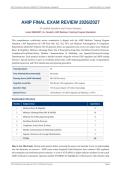
AHIP FINAL EXAM REVIEW 2026/2027
50 Verified Questions and Correct Answers
Latest 2026/2027 | A+ Graded | AHIP Medicare Training Program Standards
This comprehensive certification review examination is aligned with the AHIP Medicare Training Program
Standards, CMS Regulations (42 CFR Parts 406, 422, 423, 447), and Medicare Advantage/Part D Compliance
Requirements (2026/2027 Edition). The 50 questions below are organized across seven core subject areas: Medicare
Basics & Eligibility, Medicare Advantage Plans, Part D Prescription Drug Plans, Enrollment Periods & Processes,
Compliance/Fraud/Waste/Abuse, Member Communications & Marketing, and Appeals/Grievances/Coverage
Determinations. Each question includes a detailed rationale citing the relevant CMS regulation and AHIP training
reference. Special attention is given to enrollment period rules, CMS marketing guidelines (scope of appointment,
prohibited practices), and FWA identification and reporting procedures.
Total Questions 50
Time Allotted (Recommended) 90 minutes
Passing Score (AHIP Standard) 90% (45/50 correct)
Cognitive Level Mix 30% Recall / 50% Application / 20% Analysis
Question Style 75% Scenario-Based / 25% Direct Knowledge
Special Focus 10 Enrollment / 10 CMS Compliance & Marketing / 5 FWA
Examination Structure
Section Subject Area Questions
1 Medicare Basics & Eligibility 8
2 Medicare Advantage Plans (MA & MAPD) 10
3 Medicare Part D Prescription Drug Plans 8
4 Enrollment Periods & Processes 7
5 Compliance, Fraud, Waste, & Abuse 7
6 Member Communications & Marketing Guidelines 5
7 Appeals, Grievances, & Coverage Determinations 5
TOTAL 50
How to Use This Exam: Attempt each question before reviewing the answer and rationale. Focus on understanding
why the distractors are incorrect - AHIP exam writers frequently build distractors from common CMS regulation
misconceptions and enrollment period confusion. A score of 45/50 (90%) or higher indicates readiness for the actual
AHIP certification examination. Questions marked *[CORRECT]* highlight the verified answer with rationale citing
AHIP Medicare Advantage & Part D Certification Review Page 1
,AHIP Final Exam Review 2026/2027 | CMS Medicare Standards Verified 50 Q&A | A+ Graded
the relevant 42 CFR section, CMS Marketing Guideline, or AHIP training reference.
AHIP Medicare Advantage & Part D Certification Review Page 2
, AHIP Final Exam Review 2026/2027 | CMS Medicare Standards Verified 50 Q&A | A+ Graded
Section 1: Medicare Basics & Eligibility
Q1: A 65-year-old U.S. citizen has worked 40 quarters in Social Security-covered employment and is
ready to enroll in Medicare. Which statement about his eligibility and enrollment is CORRECT?
A. He must wait until he is 67 to enroll because of full retirement age rules
B. He is eligible for premium-free Part A and may enroll in Part B during his 7-month Initial Enrollment
Period that begins 3 months before his birth month *[CORRECT]*
C. He must pay a premium for Part A because he is no longer actively employed
D. He can only enroll in Part D, not Parts A or B, until he stops working
Correct Answer: B
Rationale: Under 42 CFR 406.6, a person age 65 with 40 quarters of Social Security-covered employment is entitled to
premium-free Part A; the 7-month IEP spans 3 months before, the month of, and 3 months after the birth month (or 65th
birthday month if born on the 1st). Option A is wrong - Medicare eligibility begins at 65 regardless of Social Security full
retirement age. Option C is wrong - 40 quarters entitle him to premium-free Part A. Option D is wrong - Parts A/B
enrollment is independent of active employment (SEP for active employment may apply, but enrollment is not blocked).
Q2: A beneficiary is hospitalized for 90 days in a single benefit period under Medicare Part A. Which
statement correctly describes Part A coverage in 2026?
A. All 90 days are fully covered after the deductible, with no coinsurance
B. Days 1-60 are covered after the deductible ($1,676 in 2026); days 61-90 require $419/day coinsurance;
days 91-150 use 60 lifetime reserve days at $838/day *[CORRECT]*
C. Days 1-90 require 20% coinsurance
D. Medicare Part A covers only the first 30 days of hospitalization
Correct Answer: B
Rationale: Per CMS 2026 Part A inpatient hospital benefit: after the $1,676 deductible (2026), days 1-60 are fully
covered, days 61-90 require $419/day coinsurance, and days 91-150 draw on 60 lifetime reserve days at $838/day. Option
A is wrong because coinsurance applies after day 60. Option C is wrong - Part A is not 20% coinsurance (that's Part B).
Option D is wrong - Part A covers up to 90 days plus 60 lifetime reserve days per benefit period.
Q3: Which of the following services is covered under Medicare Part B (Medical Insurance)?
A. Inpatient hospital stays
B. Skilled nursing facility care for the first 100 days after a 3-day hospital stay
C. Physician services, outpatient therapy, durable medical equipment (DME), and clinical diagnostic lab
tests (generally 80% of the Medicare-approved amount after the deductible) *[CORRECT]*
D. Long-term custodial nursing home care
Correct Answer: C
Rationale: Part B covers physician services, outpatient therapy, DME, and clinical lab tests, paying 80% of the
Medicare-approved amount after the annual deductible ($257 in 2026); the beneficiary pays 20% coinsurance. Option A
describes Part A coverage. Option B describes Part A SNF benefit (first 20 days fully covered, days 21-100 $209.50/day
coinsurance in 2026). Option D is wrong - Medicare does not cover long-term custodial care.
AHIP Medicare Advantage & Part D Certification Review Page 3
AHIP FINAL EXAM REVIEW 2026/2027
50 Verified Questions and Correct Answers
Latest 2026/2027 | A+ Graded | AHIP Medicare Training Program Standards
This comprehensive certification review examination is aligned with the AHIP Medicare Training Program
Standards, CMS Regulations (42 CFR Parts 406, 422, 423, 447), and Medicare Advantage/Part D Compliance
Requirements (2026/2027 Edition). The 50 questions below are organized across seven core subject areas: Medicare
Basics & Eligibility, Medicare Advantage Plans, Part D Prescription Drug Plans, Enrollment Periods & Processes,
Compliance/Fraud/Waste/Abuse, Member Communications & Marketing, and Appeals/Grievances/Coverage
Determinations. Each question includes a detailed rationale citing the relevant CMS regulation and AHIP training
reference. Special attention is given to enrollment period rules, CMS marketing guidelines (scope of appointment,
prohibited practices), and FWA identification and reporting procedures.
Total Questions 50
Time Allotted (Recommended) 90 minutes
Passing Score (AHIP Standard) 90% (45/50 correct)
Cognitive Level Mix 30% Recall / 50% Application / 20% Analysis
Question Style 75% Scenario-Based / 25% Direct Knowledge
Special Focus 10 Enrollment / 10 CMS Compliance & Marketing / 5 FWA
Examination Structure
Section Subject Area Questions
1 Medicare Basics & Eligibility 8
2 Medicare Advantage Plans (MA & MAPD) 10
3 Medicare Part D Prescription Drug Plans 8
4 Enrollment Periods & Processes 7
5 Compliance, Fraud, Waste, & Abuse 7
6 Member Communications & Marketing Guidelines 5
7 Appeals, Grievances, & Coverage Determinations 5
TOTAL 50
How to Use This Exam: Attempt each question before reviewing the answer and rationale. Focus on understanding
why the distractors are incorrect - AHIP exam writers frequently build distractors from common CMS regulation
misconceptions and enrollment period confusion. A score of 45/50 (90%) or higher indicates readiness for the actual
AHIP certification examination. Questions marked *[CORRECT]* highlight the verified answer with rationale citing
AHIP Medicare Advantage & Part D Certification Review Page 1
,AHIP Final Exam Review 2026/2027 | CMS Medicare Standards Verified 50 Q&A | A+ Graded
the relevant 42 CFR section, CMS Marketing Guideline, or AHIP training reference.
AHIP Medicare Advantage & Part D Certification Review Page 2
, AHIP Final Exam Review 2026/2027 | CMS Medicare Standards Verified 50 Q&A | A+ Graded
Section 1: Medicare Basics & Eligibility
Q1: A 65-year-old U.S. citizen has worked 40 quarters in Social Security-covered employment and is
ready to enroll in Medicare. Which statement about his eligibility and enrollment is CORRECT?
A. He must wait until he is 67 to enroll because of full retirement age rules
B. He is eligible for premium-free Part A and may enroll in Part B during his 7-month Initial Enrollment
Period that begins 3 months before his birth month *[CORRECT]*
C. He must pay a premium for Part A because he is no longer actively employed
D. He can only enroll in Part D, not Parts A or B, until he stops working
Correct Answer: B
Rationale: Under 42 CFR 406.6, a person age 65 with 40 quarters of Social Security-covered employment is entitled to
premium-free Part A; the 7-month IEP spans 3 months before, the month of, and 3 months after the birth month (or 65th
birthday month if born on the 1st). Option A is wrong - Medicare eligibility begins at 65 regardless of Social Security full
retirement age. Option C is wrong - 40 quarters entitle him to premium-free Part A. Option D is wrong - Parts A/B
enrollment is independent of active employment (SEP for active employment may apply, but enrollment is not blocked).
Q2: A beneficiary is hospitalized for 90 days in a single benefit period under Medicare Part A. Which
statement correctly describes Part A coverage in 2026?
A. All 90 days are fully covered after the deductible, with no coinsurance
B. Days 1-60 are covered after the deductible ($1,676 in 2026); days 61-90 require $419/day coinsurance;
days 91-150 use 60 lifetime reserve days at $838/day *[CORRECT]*
C. Days 1-90 require 20% coinsurance
D. Medicare Part A covers only the first 30 days of hospitalization
Correct Answer: B
Rationale: Per CMS 2026 Part A inpatient hospital benefit: after the $1,676 deductible (2026), days 1-60 are fully
covered, days 61-90 require $419/day coinsurance, and days 91-150 draw on 60 lifetime reserve days at $838/day. Option
A is wrong because coinsurance applies after day 60. Option C is wrong - Part A is not 20% coinsurance (that's Part B).
Option D is wrong - Part A covers up to 90 days plus 60 lifetime reserve days per benefit period.
Q3: Which of the following services is covered under Medicare Part B (Medical Insurance)?
A. Inpatient hospital stays
B. Skilled nursing facility care for the first 100 days after a 3-day hospital stay
C. Physician services, outpatient therapy, durable medical equipment (DME), and clinical diagnostic lab
tests (generally 80% of the Medicare-approved amount after the deductible) *[CORRECT]*
D. Long-term custodial nursing home care
Correct Answer: C
Rationale: Part B covers physician services, outpatient therapy, DME, and clinical lab tests, paying 80% of the
Medicare-approved amount after the annual deductible ($257 in 2026); the beneficiary pays 20% coinsurance. Option A
describes Part A coverage. Option B describes Part A SNF benefit (first 20 days fully covered, days 21-100 $209.50/day
coinsurance in 2026). Option D is wrong - Medicare does not cover long-term custodial care.
AHIP Medicare Advantage & Part D Certification Review Page 3

