

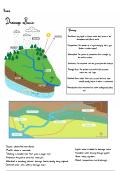
Rivers
·
=>
oth
urce
Tributary
Confluence
Watershed
Catchment
:
:
where the
where
:
:
:
a
the
a
are a
a
smaller
point at
boundary
: are a
river
river
river
starts
ends
that
which two
between
within a
joins
rivers
a
drainage
drainage
larger
join
basins
basin
river
, usually along highland
Inputs
Transfers
Store :
:
Output evaporation ,
:
water i s added to
: water
lakes , aquifers s ...
drainage
flowing through system
river discharg
e...
basin
, River Processes: Transportation & Deposition
Competence: The Maximum size of material that a river can
carry
Capacity: the Maximum/ total amount of old that a river can
carry
Conditions that lead to a river’s competence dropping:
• Low discharge (follows a period of low precipicetation
• Velocity decreases, when a river meets a lake, sea…
• Shallow water occurs on the inside of a meander
• Capacity is reacher, load suddenly increased (landslides)
• River over-flows its banks, velocity outside channel is
The Bradshaw Model reduced
r - Wi ENY
↑
vo ..
388 8
17
~
Hydraulic action: Abrasion: Attrition: Solution:
Water forces its ways into cracks Pieces of rock are pulled along Process that smoothes rocks Lots of rocks like
and breaks off big chunks of rock the river bed scraping away carried by river as rocks bang into limestone dissolve in
other pieces of rock each other and sharp edges are water
knocked off
• Cliffs might collapse over time because of vertical and
Vertical erosion: lateral erosion. This creates caves and eventually there
(stronger) is nothing or too little holding the cliffs; they collapse
Lateral erosion:
·
m·mmmmmmm
Suspension: fine material such as clay
carried by river, makes water cloudy
&
Solution: materials like salts
are dissolved in the river
·
Traction: large stones moved
Saltation: movement of smaller rocks/ pebbles along the bed of the river
that are picked up & dropped again
·
"
·
·
①
·
=>
oth
urce
Tributary
Confluence
Watershed
Catchment
:
:
where the
where
:
:
:
a
the
a
are a
a
smaller
point at
boundary
: are a
river
river
river
starts
ends
that
which two
between
within a
joins
rivers
a
drainage
drainage
larger
join
basins
basin
river
, usually along highland
Inputs
Transfers
Store :
:
Output evaporation ,
:
water i s added to
: water
lakes , aquifers s ...
drainage
flowing through system
river discharg
e...
basin
, River Processes: Transportation & Deposition
Competence: The Maximum size of material that a river can
carry
Capacity: the Maximum/ total amount of old that a river can
carry
Conditions that lead to a river’s competence dropping:
• Low discharge (follows a period of low precipicetation
• Velocity decreases, when a river meets a lake, sea…
• Shallow water occurs on the inside of a meander
• Capacity is reacher, load suddenly increased (landslides)
• River over-flows its banks, velocity outside channel is
The Bradshaw Model reduced
r - Wi ENY
↑
vo ..
388 8
17
~
Hydraulic action: Abrasion: Attrition: Solution:
Water forces its ways into cracks Pieces of rock are pulled along Process that smoothes rocks Lots of rocks like
and breaks off big chunks of rock the river bed scraping away carried by river as rocks bang into limestone dissolve in
other pieces of rock each other and sharp edges are water
knocked off
• Cliffs might collapse over time because of vertical and
Vertical erosion: lateral erosion. This creates caves and eventually there
(stronger) is nothing or too little holding the cliffs; they collapse
Lateral erosion:
·
m·mmmmmmm
Suspension: fine material such as clay
carried by river, makes water cloudy
&
Solution: materials like salts
are dissolved in the river
·
Traction: large stones moved
Saltation: movement of smaller rocks/ pebbles along the bed of the river
that are picked up & dropped again
·
"
·
·
①

