
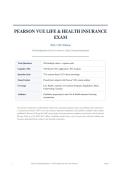
PEARSON VUE LIFE & HEALTH INSURANCE
EXAM
Edition
Verified Questions & Correct Answers | State Licensing Preparation
Total Questions 200 (multiple choice, 4 options each)
Cognitive Mix 30% Recall | 50% Application | 20% Analysis
Question Style 75% scenario-based | 25% direct knowledge
Exam Format Closed-book; aligned with Pearson VUE content outlines
Coverage Life, Health, Annuities, Government Programs, Regulations, Ethics,
Underwriting, Taxation
Audience Candidates preparing for state Life & Health insurance licensing
examinations
This practice examination is independently authored for educational purposes and is not affiliated with, endorsed by,
or sponsored by Pearson VUE or any state insurance department. Questions reflect publicly available content outlines
published by Pearson VUE and the NAIC, current federal and state insurance regulatory frameworks, and the Internal
Revenue Code as of the 2026–2027 edition. Candidates should always verify current rules with their resident state
insurance department before sitting for the licensing examination.
1 State Licensing Preparation | Verified Questions & Correct Answers Page 1
,Pearson VUE Life & Health Insurance Exam — 2026/2027 Edition
Table of Contents
Section Topic # Qs
Section 1 Life Insurance Basics & Policy Types 30
Section 2 Life Insurance Provisions, Riders, & Options 25
Section 3 Health Insurance Fundamentals & Policy Types 30
Section 4 Health Insurance Provisions & Benefits 25
Section 5 Annuities & Retirement Planning 20
Section 6 Social Security, Medicare, & Government Programs 15
Section 7 Insurance Law, Regulations, & Ethics 25
Section 8 Underwriting, Risk Classification, & Policy Issuance 15
Section 9 Taxation of Insurance Products 15
TOTAL All Sections Combined 200
Each question presents one correct answer (marked *[CORRECT]*) and includes a 2–3 sentence rationale citing the relevant
Pearson VUE content outline domain and federal/state regulatory or statutory authority. Page numbers are automatically
maintained by the running header.
2 State Licensing Preparation | Verified Questions & Correct Answers Page 2
,Pearson VUE Life & Health Insurance Exam — 2026/2027 Edition
Section 1: Life Insurance Basics & Policy Types
Term, whole life, universal life, variable life, survivorship life — 30 questions
Q1: A 35-year-old client tells you he wants the lowest possible premium for the largest death benefit
while his children (ages 4 and 6) are dependent. He expects his income need to drop dramatically in 20
years. Which policy is MOST suitable?
A. Whole life insurance, because premiums remain level for life and cash value accumulates.
B. 20-year level term insurance, because it provides a level death benefit with the lowest premium for
the stated period. *[CORRECT]*
C. Universal life insurance with Option B, because the death benefit can grow tax-free.
D. Single-premium whole life, because one payment guarantees lifetime coverage.
Correct Answer: B
Rationale: Level term provides the highest death benefit per premium dollar for a defined period, matching the client's
20-year dependency window. Whole life and universal life carry higher premiums to fund cash value, and
single-premium whole life requires a large lump sum inconsistent with the client's premium-sensitivity objective (Pearson
VUE Life Insurance Basics: Term vs. Permanent).
Q2: A policyowner of a traditional whole life policy decides she no longer wants to pay premiums but
wants to keep some death benefit in force. Which nonforfeiture option will provide paid-up insurance
for the SAME face amount as the original policy but only for a limited, reduced period?
A. Cash surrender value
B. Reduced paid-up insurance
C. Extended term insurance *[CORRECT]*
D. Accumulation at interest
Correct Answer: C
Rationale: Extended term uses the cash value to buy term insurance for the ORIGINAL face amount, but only for as
long as the cash value will last. Reduced paid-up buys a smaller permanent death benefit (not the same face amount),
cash surrender ends the contract, and accumulation at interest is a dividend option, not a nonforfeiture option (Pearson
VUE: Nonforfeiture Options).
3 State Licensing Preparation | Verified Questions & Correct Answers Page 3
, Pearson VUE Life & Health Insurance Exam — 2026/2027 Edition
Q3: An insured owns a participating whole life policy and elects the 'paid-up additions' dividend
option. Which statement BEST describes the tax treatment when a paid-up addition is added to the
policy?
A. The dividend is taxable as ordinary income in the year received.
B. The dividend is taxable only when cumulative dividends exceed the policy's cost basis.
C. The dividend used to purchase paid-up additions is treated as a return of premium and is NOT
taxable, but interest earned on dividends IS taxable. *[CORRECT]*
D. The paid-up additions are taxable as a constructive dividend under IRC § 301.
Correct Answer: C
Rationale: Dividends are generally considered a return of unused premium and are not taxable when received or used to
purchase paid-up additions. However, interest earned on dividends left with the insurer is taxable as ordinary income
(Pearson VUE: Dividend Options; IRC § 7702).
Q4: A client purchases a universal life policy with Option B (increasing death benefit). As the cash
value grows over time, what happens to the TOTAL death benefit payable to the beneficiary?
A. It remains level at the original face amount for the life of the contract.
B. It increases because the insurer pays the face amount PLUS the cash value. *[CORRECT]*
C. It decreases because the cash value offsets the face amount.
D. It is recalculated annually based on the consumer price index.
Correct Answer: B
Rationale: Under Option B, the death benefit equals the face amount PLUS the accumulating cash value, so the total
payable grows over time. Option A (level) pays the face amount only; the cash value does not offset it (Pearson VUE:
Universal Life Death Benefit Options).
Q5: Which of the following is a defining characteristic of variable life insurance that distinguishes it
from whole life?
A. Variable life guarantees both a minimum cash value and a minimum death benefit equal to face amount.
B. The cash value is not guaranteed and fluctuates based on the performance of separate investment
accounts selected by the policyowner. *[CORRECT]*
C. Variable life premiums are flexible and may be skipped without policy lapse.
D. Variable life is issued only as group insurance through an employer.
Correct Answer: B
Rationale: Variable life cash value is held in separate accounts and varies with investment performance, with no
guaranteed cash value. A minimum death benefit is guaranteed, but premiums are fixed (not flexible like universal life),
and the product is sold individually with a prospectus (Pearson VUE: Variable Life; SEC/FINRA registration required).
4 State Licensing Preparation | Verified Questions & Correct Answers Page 4
EXAM
Edition
Verified Questions & Correct Answers | State Licensing Preparation
Total Questions 200 (multiple choice, 4 options each)
Cognitive Mix 30% Recall | 50% Application | 20% Analysis
Question Style 75% scenario-based | 25% direct knowledge
Exam Format Closed-book; aligned with Pearson VUE content outlines
Coverage Life, Health, Annuities, Government Programs, Regulations, Ethics,
Underwriting, Taxation
Audience Candidates preparing for state Life & Health insurance licensing
examinations
This practice examination is independently authored for educational purposes and is not affiliated with, endorsed by,
or sponsored by Pearson VUE or any state insurance department. Questions reflect publicly available content outlines
published by Pearson VUE and the NAIC, current federal and state insurance regulatory frameworks, and the Internal
Revenue Code as of the 2026–2027 edition. Candidates should always verify current rules with their resident state
insurance department before sitting for the licensing examination.
1 State Licensing Preparation | Verified Questions & Correct Answers Page 1
,Pearson VUE Life & Health Insurance Exam — 2026/2027 Edition
Table of Contents
Section Topic # Qs
Section 1 Life Insurance Basics & Policy Types 30
Section 2 Life Insurance Provisions, Riders, & Options 25
Section 3 Health Insurance Fundamentals & Policy Types 30
Section 4 Health Insurance Provisions & Benefits 25
Section 5 Annuities & Retirement Planning 20
Section 6 Social Security, Medicare, & Government Programs 15
Section 7 Insurance Law, Regulations, & Ethics 25
Section 8 Underwriting, Risk Classification, & Policy Issuance 15
Section 9 Taxation of Insurance Products 15
TOTAL All Sections Combined 200
Each question presents one correct answer (marked *[CORRECT]*) and includes a 2–3 sentence rationale citing the relevant
Pearson VUE content outline domain and federal/state regulatory or statutory authority. Page numbers are automatically
maintained by the running header.
2 State Licensing Preparation | Verified Questions & Correct Answers Page 2
,Pearson VUE Life & Health Insurance Exam — 2026/2027 Edition
Section 1: Life Insurance Basics & Policy Types
Term, whole life, universal life, variable life, survivorship life — 30 questions
Q1: A 35-year-old client tells you he wants the lowest possible premium for the largest death benefit
while his children (ages 4 and 6) are dependent. He expects his income need to drop dramatically in 20
years. Which policy is MOST suitable?
A. Whole life insurance, because premiums remain level for life and cash value accumulates.
B. 20-year level term insurance, because it provides a level death benefit with the lowest premium for
the stated period. *[CORRECT]*
C. Universal life insurance with Option B, because the death benefit can grow tax-free.
D. Single-premium whole life, because one payment guarantees lifetime coverage.
Correct Answer: B
Rationale: Level term provides the highest death benefit per premium dollar for a defined period, matching the client's
20-year dependency window. Whole life and universal life carry higher premiums to fund cash value, and
single-premium whole life requires a large lump sum inconsistent with the client's premium-sensitivity objective (Pearson
VUE Life Insurance Basics: Term vs. Permanent).
Q2: A policyowner of a traditional whole life policy decides she no longer wants to pay premiums but
wants to keep some death benefit in force. Which nonforfeiture option will provide paid-up insurance
for the SAME face amount as the original policy but only for a limited, reduced period?
A. Cash surrender value
B. Reduced paid-up insurance
C. Extended term insurance *[CORRECT]*
D. Accumulation at interest
Correct Answer: C
Rationale: Extended term uses the cash value to buy term insurance for the ORIGINAL face amount, but only for as
long as the cash value will last. Reduced paid-up buys a smaller permanent death benefit (not the same face amount),
cash surrender ends the contract, and accumulation at interest is a dividend option, not a nonforfeiture option (Pearson
VUE: Nonforfeiture Options).
3 State Licensing Preparation | Verified Questions & Correct Answers Page 3
, Pearson VUE Life & Health Insurance Exam — 2026/2027 Edition
Q3: An insured owns a participating whole life policy and elects the 'paid-up additions' dividend
option. Which statement BEST describes the tax treatment when a paid-up addition is added to the
policy?
A. The dividend is taxable as ordinary income in the year received.
B. The dividend is taxable only when cumulative dividends exceed the policy's cost basis.
C. The dividend used to purchase paid-up additions is treated as a return of premium and is NOT
taxable, but interest earned on dividends IS taxable. *[CORRECT]*
D. The paid-up additions are taxable as a constructive dividend under IRC § 301.
Correct Answer: C
Rationale: Dividends are generally considered a return of unused premium and are not taxable when received or used to
purchase paid-up additions. However, interest earned on dividends left with the insurer is taxable as ordinary income
(Pearson VUE: Dividend Options; IRC § 7702).
Q4: A client purchases a universal life policy with Option B (increasing death benefit). As the cash
value grows over time, what happens to the TOTAL death benefit payable to the beneficiary?
A. It remains level at the original face amount for the life of the contract.
B. It increases because the insurer pays the face amount PLUS the cash value. *[CORRECT]*
C. It decreases because the cash value offsets the face amount.
D. It is recalculated annually based on the consumer price index.
Correct Answer: B
Rationale: Under Option B, the death benefit equals the face amount PLUS the accumulating cash value, so the total
payable grows over time. Option A (level) pays the face amount only; the cash value does not offset it (Pearson VUE:
Universal Life Death Benefit Options).
Q5: Which of the following is a defining characteristic of variable life insurance that distinguishes it
from whole life?
A. Variable life guarantees both a minimum cash value and a minimum death benefit equal to face amount.
B. The cash value is not guaranteed and fluctuates based on the performance of separate investment
accounts selected by the policyowner. *[CORRECT]*
C. Variable life premiums are flexible and may be skipped without policy lapse.
D. Variable life is issued only as group insurance through an employer.
Correct Answer: B
Rationale: Variable life cash value is held in separate accounts and varies with investment performance, with no
guaranteed cash value. A minimum death benefit is guaranteed, but premiums are fixed (not flexible like universal life),
and the product is sold individually with a prospectus (Pearson VUE: Variable Life; SEC/FINRA registration required).
4 State Licensing Preparation | Verified Questions & Correct Answers Page 4

