
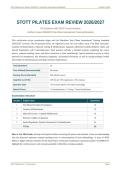
Stott Pilates Exam Review 2026/2027 | Merrithew International Standards Verified 50 Q&A
STOTT PILATES EXAM REVIEW 2026/2027
50 Questions with 100% Correct Answers
Verified | Latest 2026/2027 | Merrithew International Training Standards
This certification review examination aligns with the Merrithew Stott Pilates International Training Standards
(2026/2027 revision). The 50 questions below are organized across five core subject areas: Five Basic Principles,
Anatomy & Biomechanics, Matwork Cueing & Modifications, Apparatus (Reformer/Cadillac/Stability Chair), and
Special Populations with Contraindications. Each question includes a detailed rationale explaining the correct
answer, common teaching errors, and direct references to Stott methodology. Special attention is given to safety
protocols for osteoporosis, disc herniation, pregnancy, and postural deviations, as well as cueing technique (verbal
and tactile) for identifying and correcting common compensations.
Total Questions 50
Time Allotted (Recommended) 60 minutes
Passing Score (Standard) 80% (40/50 correct)
Cognitive Level Mix 30% Recall / 50% Application / 20% Analysis
Question Style 75% Scenario-Based / 25% Direct Knowledge
Special Focus 5 Contraindications / 5 Cueing / 5 Form Identification
Examination Structure
Section Subject Area Questions
1 Stott Pilates Principles & Foundations 10
2 Anatomy & Biomechanics 10
3 Matwork Exercises - Cueing & Modifications 10
4 Reformer, Cadillac, & Apparatus 10
5 Special Populations, Postural Assessment, & Contraindications 10
TOTAL 50
How to Use This Exam: Attempt each question before reviewing the answer and rationale. Focus on understanding
why the distractors represent common teaching errors or misconceptions of Stott methodology. A score of 40/50
(80%) or higher indicates readiness for the Stott Pilates certification examination. Questions marked *[CORRECT]*
highlight the verified answer with rationale grounded in Merrithew training standards.
Stott Pilates Exam - 50 Questions Page 1
,Stott Pilates Exam Review 2026/2027 | Merrithew International Standards Verified 50 Q&A
Section 1: Stott Pilates Principles & Foundations
Q1: A new client asks why Stott Pilates places such emphasis on the Five Basic Principles before
introducing complex exercises. The MOST accurate instructor response is that these principles:
A. Were developed by Joseph Pilates in 1923 and remain unchanged today
B. Establish optimal biomechanical alignment that enhances safety, muscle recruitment, and movement
efficiency across every exercise *[CORRECT]*
C. Are designed exclusively for rehabilitation clients and do not apply to fitness populations
D. Replace the need for individualized cueing and program design
Correct Answer: B
Rationale: Merrithew Stott Pilates uses the Five Basic Principles (Breathing, Pelvic Placement, Rib Cage Placement,
Scapular Movement, Head & Cervical Placement) as the biomechanical foundation that supports every exercise, ensuring
safety and proper muscle activation. Option A is incorrect - Stott Pilates was co-developed by Lindsay and Moira
Merrithew in the 1980s-90s as an evolution of Joseph Pilates' original work; the principles are contemporary, not original
1923. Option C is incorrect because the principles apply across all populations, not exclusively rehab. Option D is
incorrect because cueing and program design remain essential individualized layers built atop these principles.
Q2: During a beginner Matwork class, an instructor cues a client to breathe in through the nose and out
through the mouth with a slight engagement of the transversus abdominis on the exhale. Which Stott
principle is being applied, and what is its primary purpose?
A. Pelvic Placement; to maintain neutral spine
B. Breathing; to facilitate relaxation of the abdominal wall and stabilize the rib cage on the exhale
*[CORRECT]*
C. Scapular Movement; to depress the shoulder blades
D. Head & Cervical Placement; to lengthen the neck
Correct Answer: B
Rationale: The Stott Breathing Principle uses lateral thoracic breathing (in through nose, out through mouth) to maintain
abdominal engagement without rib cage elevation, while the exhale on effort promotes core stabilization. Option A
describes Pelvic Placement, a separate principle; Option C describes Scapular Movement; Option D describes Head &
Cervical Placement - all distinct principles in the Stott framework.
Q3: A client lying supine demonstrates a lumbar curve off the mat with ASIS and pubic bone in a
horizontal plane. In Stott terminology this pelvic placement is called:
A. Imprint
B. Neutral spine *[CORRECT]*
C. Posterior pelvic tilt
D. Anterior pelvic tilt (not neutral)
Correct Answer: B
Rationale: Stott defines neutral pelvis (in supine) as ASIS and pubic bone on the same horizontal plane with a natural
lumbar curve. Imprint (A) is a slight posterior tilt drawing the lower back gently toward the mat, used when stabilizing
against heavy loads or with weakened abdominals. Posterior pelvic tilt (C) and anterior pelvic tilt (D) are excessive
Stott Pilates Exam - 50 Questions Page 2
, Stott Pilates Exam Review 2026/2027 | Merrithew International Standards Verified 50 Q&A
versions of motion, not the neutral Stott position.
Q4: Which client would benefit MOST from cueing to an imprinted spine during supine Matwork,
according to Stott guidelines?
A. A fit athlete performing the Hundreds at an advanced level
B. A client with weakened abdominal muscles and a lordotic posture who cannot maintain neutral spine
during loaded leg circles *[CORRECT]*
C. A prenatal client in the third trimester
D. A client with osteoporosis performing spinal flexion
Correct Answer: B
Rationale: Stott teaches imprint as a stabilizing modification when neutral spine cannot be maintained against load,
particularly for clients with weak abdominals or lordosis. Option A is incorrect - a fit athlete can typically hold neutral;
Option C is incorrect - prenatal clients generally avoid imprint supine due to fetal positioning concerns and instead favor
side-lying or neutral; Option D is incorrect - osteoporosis contraindicates spinal flexion regardless of imprint.
Q5: The Stott principle of Scapular Movement emphasizes:
A. Keeping the shoulder blades pinned down and back at all times
B. Allowing the scapulae to glide freely through elevation, depression, abduction, adduction, and
upward/downward rotation without excessive protraction during loaded movement *[CORRECT]*
C. Forcing the scapulae into retraction during every arm movement
D. Locking the scapulae in depression to stabilize the neck
Correct Answer: B
Rationale: Stott Pilates trains the scapulae to move dynamically through their full range (elevation, depression,
abduction/protraction, adduction/retraction, upward and downward rotation) to support shoulder girdle stability and
avoid rigidity. Option A is incorrect - the scapulae must not be 'pinned'; Option C is incorrect - forced retraction during
every movement is non-functional; Option D is incorrect - locked depression creates neck tension, not stability.
Q6: When cueing Head & Cervical Placement during abdominal curl-ups, the instructor should
emphasize:
A. Lifting the chin toward the ceiling to lengthen the back of the neck
B. Maintaining a natural cervical curve with the head aligned over the thoracic spine, lengthening
through the back of the neck on flexion *[CORRECT]*
C. Forcing the chin to the chest to maximize abdominal contraction
D. Keeping the head flat on the mat at all times
Correct Answer: B
Rationale: Stott cueing emphasizes cervical spine lengthening through the back of the neck during flexion, maintaining the
natural curve and preventing jutting the chin forward. Option A creates cervical compression; Option C forces excessive
flexion and strain; Option D would prevent the curl-up entirely, contradicting the exercise.
Stott Pilates Exam - 50 Questions Page 3
STOTT PILATES EXAM REVIEW 2026/2027
50 Questions with 100% Correct Answers
Verified | Latest 2026/2027 | Merrithew International Training Standards
This certification review examination aligns with the Merrithew Stott Pilates International Training Standards
(2026/2027 revision). The 50 questions below are organized across five core subject areas: Five Basic Principles,
Anatomy & Biomechanics, Matwork Cueing & Modifications, Apparatus (Reformer/Cadillac/Stability Chair), and
Special Populations with Contraindications. Each question includes a detailed rationale explaining the correct
answer, common teaching errors, and direct references to Stott methodology. Special attention is given to safety
protocols for osteoporosis, disc herniation, pregnancy, and postural deviations, as well as cueing technique (verbal
and tactile) for identifying and correcting common compensations.
Total Questions 50
Time Allotted (Recommended) 60 minutes
Passing Score (Standard) 80% (40/50 correct)
Cognitive Level Mix 30% Recall / 50% Application / 20% Analysis
Question Style 75% Scenario-Based / 25% Direct Knowledge
Special Focus 5 Contraindications / 5 Cueing / 5 Form Identification
Examination Structure
Section Subject Area Questions
1 Stott Pilates Principles & Foundations 10
2 Anatomy & Biomechanics 10
3 Matwork Exercises - Cueing & Modifications 10
4 Reformer, Cadillac, & Apparatus 10
5 Special Populations, Postural Assessment, & Contraindications 10
TOTAL 50
How to Use This Exam: Attempt each question before reviewing the answer and rationale. Focus on understanding
why the distractors represent common teaching errors or misconceptions of Stott methodology. A score of 40/50
(80%) or higher indicates readiness for the Stott Pilates certification examination. Questions marked *[CORRECT]*
highlight the verified answer with rationale grounded in Merrithew training standards.
Stott Pilates Exam - 50 Questions Page 1
,Stott Pilates Exam Review 2026/2027 | Merrithew International Standards Verified 50 Q&A
Section 1: Stott Pilates Principles & Foundations
Q1: A new client asks why Stott Pilates places such emphasis on the Five Basic Principles before
introducing complex exercises. The MOST accurate instructor response is that these principles:
A. Were developed by Joseph Pilates in 1923 and remain unchanged today
B. Establish optimal biomechanical alignment that enhances safety, muscle recruitment, and movement
efficiency across every exercise *[CORRECT]*
C. Are designed exclusively for rehabilitation clients and do not apply to fitness populations
D. Replace the need for individualized cueing and program design
Correct Answer: B
Rationale: Merrithew Stott Pilates uses the Five Basic Principles (Breathing, Pelvic Placement, Rib Cage Placement,
Scapular Movement, Head & Cervical Placement) as the biomechanical foundation that supports every exercise, ensuring
safety and proper muscle activation. Option A is incorrect - Stott Pilates was co-developed by Lindsay and Moira
Merrithew in the 1980s-90s as an evolution of Joseph Pilates' original work; the principles are contemporary, not original
1923. Option C is incorrect because the principles apply across all populations, not exclusively rehab. Option D is
incorrect because cueing and program design remain essential individualized layers built atop these principles.
Q2: During a beginner Matwork class, an instructor cues a client to breathe in through the nose and out
through the mouth with a slight engagement of the transversus abdominis on the exhale. Which Stott
principle is being applied, and what is its primary purpose?
A. Pelvic Placement; to maintain neutral spine
B. Breathing; to facilitate relaxation of the abdominal wall and stabilize the rib cage on the exhale
*[CORRECT]*
C. Scapular Movement; to depress the shoulder blades
D. Head & Cervical Placement; to lengthen the neck
Correct Answer: B
Rationale: The Stott Breathing Principle uses lateral thoracic breathing (in through nose, out through mouth) to maintain
abdominal engagement without rib cage elevation, while the exhale on effort promotes core stabilization. Option A
describes Pelvic Placement, a separate principle; Option C describes Scapular Movement; Option D describes Head &
Cervical Placement - all distinct principles in the Stott framework.
Q3: A client lying supine demonstrates a lumbar curve off the mat with ASIS and pubic bone in a
horizontal plane. In Stott terminology this pelvic placement is called:
A. Imprint
B. Neutral spine *[CORRECT]*
C. Posterior pelvic tilt
D. Anterior pelvic tilt (not neutral)
Correct Answer: B
Rationale: Stott defines neutral pelvis (in supine) as ASIS and pubic bone on the same horizontal plane with a natural
lumbar curve. Imprint (A) is a slight posterior tilt drawing the lower back gently toward the mat, used when stabilizing
against heavy loads or with weakened abdominals. Posterior pelvic tilt (C) and anterior pelvic tilt (D) are excessive
Stott Pilates Exam - 50 Questions Page 2
, Stott Pilates Exam Review 2026/2027 | Merrithew International Standards Verified 50 Q&A
versions of motion, not the neutral Stott position.
Q4: Which client would benefit MOST from cueing to an imprinted spine during supine Matwork,
according to Stott guidelines?
A. A fit athlete performing the Hundreds at an advanced level
B. A client with weakened abdominal muscles and a lordotic posture who cannot maintain neutral spine
during loaded leg circles *[CORRECT]*
C. A prenatal client in the third trimester
D. A client with osteoporosis performing spinal flexion
Correct Answer: B
Rationale: Stott teaches imprint as a stabilizing modification when neutral spine cannot be maintained against load,
particularly for clients with weak abdominals or lordosis. Option A is incorrect - a fit athlete can typically hold neutral;
Option C is incorrect - prenatal clients generally avoid imprint supine due to fetal positioning concerns and instead favor
side-lying or neutral; Option D is incorrect - osteoporosis contraindicates spinal flexion regardless of imprint.
Q5: The Stott principle of Scapular Movement emphasizes:
A. Keeping the shoulder blades pinned down and back at all times
B. Allowing the scapulae to glide freely through elevation, depression, abduction, adduction, and
upward/downward rotation without excessive protraction during loaded movement *[CORRECT]*
C. Forcing the scapulae into retraction during every arm movement
D. Locking the scapulae in depression to stabilize the neck
Correct Answer: B
Rationale: Stott Pilates trains the scapulae to move dynamically through their full range (elevation, depression,
abduction/protraction, adduction/retraction, upward and downward rotation) to support shoulder girdle stability and
avoid rigidity. Option A is incorrect - the scapulae must not be 'pinned'; Option C is incorrect - forced retraction during
every movement is non-functional; Option D is incorrect - locked depression creates neck tension, not stability.
Q6: When cueing Head & Cervical Placement during abdominal curl-ups, the instructor should
emphasize:
A. Lifting the chin toward the ceiling to lengthen the back of the neck
B. Maintaining a natural cervical curve with the head aligned over the thoracic spine, lengthening
through the back of the neck on flexion *[CORRECT]*
C. Forcing the chin to the chest to maximize abdominal contraction
D. Keeping the head flat on the mat at all times
Correct Answer: B
Rationale: Stott cueing emphasizes cervical spine lengthening through the back of the neck during flexion, maintaining the
natural curve and preventing jutting the chin forward. Option A creates cervical compression; Option C forces excessive
flexion and strain; Option D would prevent the curl-up entirely, contradicting the exercise.
Stott Pilates Exam - 50 Questions Page 3

