NR 602: ADVANCED CLINICAL PRACTICE
Tommy Acker iHuman Case Study:
Pediatric Trauma, SIRS & Child Abuse
2026-2027 CLINICAL UPDATE & TEST BANK
CLINICAL BLUEPRINT & REFERENCE CORE:
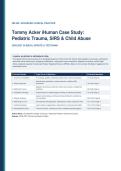
This typeset clinical learning resource is developed based on the 26-month-old Tommy Acker pediatric case study, synthesizing
advanced clinical reasoning in emergency stabilization, multisystem trauma evaluation, diagnostic screening, and the legal
ethical standards required of Advanced Practice Registered Nurses (APRNs). Below is the curricular distribution mapping for this
examination series.
Curricular Domain Topic Focus & Objectives Evaluated Questions
1. Growth & Comorbidities FTT etiology, pediatric congenital cardiac limits in shock resuscitation. Q1 & Q2 (Page 2)
Hemodynamic parameters, systemic perfusion, capillary refills,
2. Shock Diagnostics tachycardia. Q3 & Q4 (Page 3)
Epigastric ecchymosis, peritonitis, hollow viscus injuries, compartment
3. Abdominal Trauma syndrome. Q5 & Q6 (Page 4)
4. Orthopedic Pathology Dating fractures in multiple stages of healing, rib elasticity thresholds. Q7 & Q8 (Page 5)
Ligature wrist markings, soft tissue bruising distribution, accidental vs.
5. Physical Violations non-accidental. Q9 & Q10 (Page 6)
6. Nephrology & Lysis Post-traumatic AKI diagnostics, hyperkalemia, cardiac conduction limits. Q11 & Q12 (Page 7)
7. Acid-Base Systems Lactic acidosis, hypoperfusion, hypocalcemia in traumatic pancreatitis. Q13 & Q14 (Page 8)
8. Resuscitation & Ethics Trauma fluid bolus, maintenance fluids, mandated reporting legalities. Q15 & Q16 (Page 9)
Author Block: Chamberlain College of Nursing / Advanced Pediatric Assessment Series
Release: 2026-2027 Clinical Examination Edition
, NR 602: PEDIATRIC TRAUMA & CHILD ABUSE CLINICAL HANDBOOK 2026-2027 CLINICAL UPDATE & TEST BANK
SECTION 1: GROWTH FAILURE & NUTRITIONAL NEGLECT
Learning Objective: Evaluate growth parameters in a 26-month-old toddler to identify failure to thrive (FTT) and nutritional neglect
in child abuse cases.
Question 1: A 26-month-old male is brought to the clinic presenting with abdominal pain. The clinician plots his physical
metrics: height of 28 inches and weight of 22 pounds (10 kg), both falling significantly below the 5th percentile on
standardized growth charts. What is the correct clinical interpretation of these findings?
A. Normal physiological growth pattern for a toddler with Down syndrome.
B. Severe failure to thrive (FTT) that raises immediate concern for chronic nutritional neglect and systemic physical abuse.
C. Constitutional growth delay requiring simple dietary changes and outpatient close follow-up in three months.
D. Idiopathic growth hormone deficiency that requires immediate referral to a pediatric endocrinologist.
ANSWER ■: B — Severe failure to thrive (FTT) that raises immediate concern for chronic nutritional neglect and
systemic physical abuse.
Explanation: Plotting growth parameters is a fundamental component of the physical assessment. A 26-month-old toddler
presenting with height and weight both significantly below the 5th percentile meets criteria for failure to thrive (FTT). In the context
of suspected non-accidental trauma, chronic growth failure is a major indicator of physical and nutritional neglect (acts of
omission). Option A is incorrect because while Down syndrome can affect growth, parameters below the 5th percentile still require
investigation and cannot be assumed to be 'normal' without ruling out neglect. Option C is clinically inappropriate because the
severity of FTT and comorbidities demands immediate intervention rather than long-interval follow-up. Option D is incorrect
because endocrine causes are rare and should not overshadow environmental neglect screening in suspected abuse.
SECTION 2: CONGENITAL CARDIAC LESIONS IN TRAUMA RESUSCITATION
Learning Objective: Analyze the physiological impact of repaired Atrial Septal Defect (ASD) and active Congestive Heart Failure
(CHF) during volume resuscitation in pediatric trauma.
Question 2: The patient's past medical history (PMH) is pertinent for Down syndrome, a repaired Atrial Septal Defect
(ASD), and Congestive Heart Failure (CHF). As the team prepares for fluid resuscitation due to hypovolemic/traumatic
shock, which physiological risk must be prioritized?
A. Rapid development of hypernatremic dehydration from crystalloid administration.
B. Acute volume overload and pulmonary edema due to impaired left ventricular compliance and pre-existing myocardial
dysfunction.
C. A sudden right-to-left shunt reversal causing severe refractory hypoxemia.
D. Complete atrioventricular (AV) nodal block from mechanical catheter-induced trauma during peripheral IV insertion.
ANSWER ■: B — Acute volume overload and pulmonary edema due to impaired left ventricular compliance and
pre-existing myocardial dysfunction.
Explanation: A child with a history of CHF and congenital cardiac anomalies has significantly reduced myocardial compliance and
baseline cardiac reserves. During rapid crystalloid fluid resuscitation (such as 20 mL/kg boluses), these children are at high risk for
fluid overload, elevated left atrial pressures, and acute pulmonary edema. While volume resuscitation is vital for shock, fluid
administration must be carefully titrated and monitored. Option A is incorrect because crystalloids do not cause hypernatremic
dehydration. Option C is incorrect because a repaired ASD eliminates the interatrial communication, preventing shunt reversal.
Option D is incorrect because peripheral IV insertion does not involve central cardiac catheters that can touch the AV node.
iHuman Case Study (Tommy Acker) — Pediatric Clinical Practice Guidelines Page 2 of 10
Tommy Acker iHuman Case Study:
Pediatric Trauma, SIRS & Child Abuse
2026-2027 CLINICAL UPDATE & TEST BANK
CLINICAL BLUEPRINT & REFERENCE CORE:
This typeset clinical learning resource is developed based on the 26-month-old Tommy Acker pediatric case study, synthesizing
advanced clinical reasoning in emergency stabilization, multisystem trauma evaluation, diagnostic screening, and the legal
ethical standards required of Advanced Practice Registered Nurses (APRNs). Below is the curricular distribution mapping for this
examination series.
Curricular Domain Topic Focus & Objectives Evaluated Questions
1. Growth & Comorbidities FTT etiology, pediatric congenital cardiac limits in shock resuscitation. Q1 & Q2 (Page 2)
Hemodynamic parameters, systemic perfusion, capillary refills,
2. Shock Diagnostics tachycardia. Q3 & Q4 (Page 3)
Epigastric ecchymosis, peritonitis, hollow viscus injuries, compartment
3. Abdominal Trauma syndrome. Q5 & Q6 (Page 4)
4. Orthopedic Pathology Dating fractures in multiple stages of healing, rib elasticity thresholds. Q7 & Q8 (Page 5)
Ligature wrist markings, soft tissue bruising distribution, accidental vs.
5. Physical Violations non-accidental. Q9 & Q10 (Page 6)
6. Nephrology & Lysis Post-traumatic AKI diagnostics, hyperkalemia, cardiac conduction limits. Q11 & Q12 (Page 7)
7. Acid-Base Systems Lactic acidosis, hypoperfusion, hypocalcemia in traumatic pancreatitis. Q13 & Q14 (Page 8)
8. Resuscitation & Ethics Trauma fluid bolus, maintenance fluids, mandated reporting legalities. Q15 & Q16 (Page 9)
Author Block: Chamberlain College of Nursing / Advanced Pediatric Assessment Series
Release: 2026-2027 Clinical Examination Edition
, NR 602: PEDIATRIC TRAUMA & CHILD ABUSE CLINICAL HANDBOOK 2026-2027 CLINICAL UPDATE & TEST BANK
SECTION 1: GROWTH FAILURE & NUTRITIONAL NEGLECT
Learning Objective: Evaluate growth parameters in a 26-month-old toddler to identify failure to thrive (FTT) and nutritional neglect
in child abuse cases.
Question 1: A 26-month-old male is brought to the clinic presenting with abdominal pain. The clinician plots his physical
metrics: height of 28 inches and weight of 22 pounds (10 kg), both falling significantly below the 5th percentile on
standardized growth charts. What is the correct clinical interpretation of these findings?
A. Normal physiological growth pattern for a toddler with Down syndrome.
B. Severe failure to thrive (FTT) that raises immediate concern for chronic nutritional neglect and systemic physical abuse.
C. Constitutional growth delay requiring simple dietary changes and outpatient close follow-up in three months.
D. Idiopathic growth hormone deficiency that requires immediate referral to a pediatric endocrinologist.
ANSWER ■: B — Severe failure to thrive (FTT) that raises immediate concern for chronic nutritional neglect and
systemic physical abuse.
Explanation: Plotting growth parameters is a fundamental component of the physical assessment. A 26-month-old toddler
presenting with height and weight both significantly below the 5th percentile meets criteria for failure to thrive (FTT). In the context
of suspected non-accidental trauma, chronic growth failure is a major indicator of physical and nutritional neglect (acts of
omission). Option A is incorrect because while Down syndrome can affect growth, parameters below the 5th percentile still require
investigation and cannot be assumed to be 'normal' without ruling out neglect. Option C is clinically inappropriate because the
severity of FTT and comorbidities demands immediate intervention rather than long-interval follow-up. Option D is incorrect
because endocrine causes are rare and should not overshadow environmental neglect screening in suspected abuse.
SECTION 2: CONGENITAL CARDIAC LESIONS IN TRAUMA RESUSCITATION
Learning Objective: Analyze the physiological impact of repaired Atrial Septal Defect (ASD) and active Congestive Heart Failure
(CHF) during volume resuscitation in pediatric trauma.
Question 2: The patient's past medical history (PMH) is pertinent for Down syndrome, a repaired Atrial Septal Defect
(ASD), and Congestive Heart Failure (CHF). As the team prepares for fluid resuscitation due to hypovolemic/traumatic
shock, which physiological risk must be prioritized?
A. Rapid development of hypernatremic dehydration from crystalloid administration.
B. Acute volume overload and pulmonary edema due to impaired left ventricular compliance and pre-existing myocardial
dysfunction.
C. A sudden right-to-left shunt reversal causing severe refractory hypoxemia.
D. Complete atrioventricular (AV) nodal block from mechanical catheter-induced trauma during peripheral IV insertion.
ANSWER ■: B — Acute volume overload and pulmonary edema due to impaired left ventricular compliance and
pre-existing myocardial dysfunction.
Explanation: A child with a history of CHF and congenital cardiac anomalies has significantly reduced myocardial compliance and
baseline cardiac reserves. During rapid crystalloid fluid resuscitation (such as 20 mL/kg boluses), these children are at high risk for
fluid overload, elevated left atrial pressures, and acute pulmonary edema. While volume resuscitation is vital for shock, fluid
administration must be carefully titrated and monitored. Option A is incorrect because crystalloids do not cause hypernatremic
dehydration. Option C is incorrect because a repaired ASD eliminates the interatrial communication, preventing shunt reversal.
Option D is incorrect because peripheral IV insertion does not involve central cardiac catheters that can touch the AV node.
iHuman Case Study (Tommy Acker) — Pediatric Clinical Practice Guidelines Page 2 of 10