Praxis 5005 (Elementary Science) Study Guide & Practice Questions
1. Which of the following is true about Earth's mantle?
● Convection currents occur in the mantle.
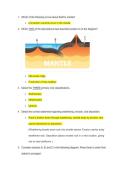
2. Which TWO of the descriptions best describe location A on the diagram?
● Mid-ocean ridge
● Production of new seafloor
3. Select the THREE primary rock classifications.
● Sedimentary
● Metamorphic
● Igneous
4. Select the correct statement regarding weathering, erosion, and deposition.
● Rock is broken down through weathering, carried away by erosion, and
placed elsewhere by deposition.
(Weathering breaks down rock into smaller pieces. Erosion carries away
weathered rock. Deposition places eroded rock in a new location, giving
rise to new landforms.)
5. Consider sections A, B, and C in the following diagram. Place them in order from
oldest to youngest.
Praxis 5005 (Elementary Science) Study Guide & Practice Questions
,Praxis 5005 (Elementary Science) Study Guide & Practice Questions
● (B,A,C) Layer B is the oldest layer, followed by layer A. Layer C cuts
through both layers and is deposited last.
6. Which of the following correctly describes the process of transpiration?
● Transpiration: Liquid water enters the gaseous phase from plant leaves.
7. Select the correct statement regarding Earth's atmosphere.
● Earth's atmosphere is primarily composed of nitrogen and oxygen and is
divided into distinct layers.
8. Climate is the average weather condition of an area over a long period of time.
As such, which TWO of the following scenarios describe climate?
● The western side of the Sierra Nevada is green and lush while the eastern
side is dry and barren.
● The doldrums trapped ancient ships because these regions have rising air
and little horizontal wind.
9. Describe what happens when a warm air mass meets a cold air mass.
Praxis 5005 (Elementary Science) Study Guide & Practice Questions
, Praxis 5005 (Elementary Science) Study Guide & Practice Questions
● The warm air rises over the cold air, shedding moisture as precipitation.
10. Which of the following best describes the Milky Way?
● A spiral shaped galaxy.
11. Which of the following correctly describes an asteroid?
● A piece of irregularly shaped rock orbiting the Sun; smaller than a dwarf
planet.
12. If there is a First or Third Quarter Moon in the sky, which of the following is true?
● The tides are moderate.
13. Which THREE of the following statements are true?
● All living things respond to their environment.
● All living things require a regular input of energy.
● All living things are made of a cell or cells.
14. Match the Label to the correct letter in the diagram?
Praxis 5005 (Elementary Science) Study Guide & Practice Questions
1. Which of the following is true about Earth's mantle?
● Convection currents occur in the mantle.
2. Which TWO of the descriptions best describe location A on the diagram?
● Mid-ocean ridge
● Production of new seafloor
3. Select the THREE primary rock classifications.
● Sedimentary
● Metamorphic
● Igneous
4. Select the correct statement regarding weathering, erosion, and deposition.
● Rock is broken down through weathering, carried away by erosion, and
placed elsewhere by deposition.
(Weathering breaks down rock into smaller pieces. Erosion carries away
weathered rock. Deposition places eroded rock in a new location, giving
rise to new landforms.)
5. Consider sections A, B, and C in the following diagram. Place them in order from
oldest to youngest.
Praxis 5005 (Elementary Science) Study Guide & Practice Questions
,Praxis 5005 (Elementary Science) Study Guide & Practice Questions
● (B,A,C) Layer B is the oldest layer, followed by layer A. Layer C cuts
through both layers and is deposited last.
6. Which of the following correctly describes the process of transpiration?
● Transpiration: Liquid water enters the gaseous phase from plant leaves.
7. Select the correct statement regarding Earth's atmosphere.
● Earth's atmosphere is primarily composed of nitrogen and oxygen and is
divided into distinct layers.
8. Climate is the average weather condition of an area over a long period of time.
As such, which TWO of the following scenarios describe climate?
● The western side of the Sierra Nevada is green and lush while the eastern
side is dry and barren.
● The doldrums trapped ancient ships because these regions have rising air
and little horizontal wind.
9. Describe what happens when a warm air mass meets a cold air mass.
Praxis 5005 (Elementary Science) Study Guide & Practice Questions
, Praxis 5005 (Elementary Science) Study Guide & Practice Questions
● The warm air rises over the cold air, shedding moisture as precipitation.
10. Which of the following best describes the Milky Way?
● A spiral shaped galaxy.
11. Which of the following correctly describes an asteroid?
● A piece of irregularly shaped rock orbiting the Sun; smaller than a dwarf
planet.
12. If there is a First or Third Quarter Moon in the sky, which of the following is true?
● The tides are moderate.
13. Which THREE of the following statements are true?
● All living things respond to their environment.
● All living things require a regular input of energy.
● All living things are made of a cell or cells.
14. Match the Label to the correct letter in the diagram?
Praxis 5005 (Elementary Science) Study Guide & Practice Questions