
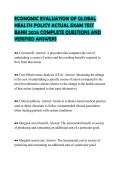
ECONOMIC EVALUATION OF GLOBAL
HEALTH POLICY ACTUAL EXAM TEST
BANK 2026 COMPLETE QUESTIONS AND
VERIFIED ANSWERS
●● Cost benefit. Answer: A procedure that compares the cost of
undertaking a course of action and the resulting benefits expected to
flow from that action.
●● Cost Effectiveness Analysis (CEA). Answer: Measuring the change
in the cost of undertaking a specific course of action (compared to the
next best alternative action) relative to the change in the health outcome
of that action (compared to that same alternative).
●● Clinical pathway. Answer: Guide to evidence-based medical practice
used to direct clinicians to follow recommended clinical procedures
when treating patients with certain conditions.
●● Marginal social benefit. Answer: The incremental benefit to society
of producing and consuming an additional unit of a particular good.
●● Marginal social cost. Answer: The incremental cost to society of
producing and consuming an additional unit of a particular good.
, ●● Rate of return. Answer: The amount earned on an investment
translated into an annual interest rate.
●● Basic research. Answer: Research whose purpose is to advance
fundamental knowledge.
●● Incremental cost-effectiveness ratio (ICER). Answer: A ratio used in
cost-effectiveness analysis that compares the difference in the expected
costs of two interventions relative to the difference in expected
outcomes.
●● Efficacy. Answer: The ability to achieve the desired result in an ideal
setting under controlled conditions.
●● Effectiveness. Answer: The ability to achieve the desired result under
real-world conditions.
●● Markov decision model. Answer: A mathematical model used to
depict a situation where outcomes are partially determined by disease
progression and partially under the control of a decision maker.
●● Complete life. Answer: A utilitarian construct promoted by certain
bioethicists that places a chronological age limit on the life worth living.
After we reach a certain age (some say 75 years), our physical and
mental capacity diminishes and we should not waste scarce medical
resources to prolong life.
HEALTH POLICY ACTUAL EXAM TEST
BANK 2026 COMPLETE QUESTIONS AND
VERIFIED ANSWERS
●● Cost benefit. Answer: A procedure that compares the cost of
undertaking a course of action and the resulting benefits expected to
flow from that action.
●● Cost Effectiveness Analysis (CEA). Answer: Measuring the change
in the cost of undertaking a specific course of action (compared to the
next best alternative action) relative to the change in the health outcome
of that action (compared to that same alternative).
●● Clinical pathway. Answer: Guide to evidence-based medical practice
used to direct clinicians to follow recommended clinical procedures
when treating patients with certain conditions.
●● Marginal social benefit. Answer: The incremental benefit to society
of producing and consuming an additional unit of a particular good.
●● Marginal social cost. Answer: The incremental cost to society of
producing and consuming an additional unit of a particular good.
, ●● Rate of return. Answer: The amount earned on an investment
translated into an annual interest rate.
●● Basic research. Answer: Research whose purpose is to advance
fundamental knowledge.
●● Incremental cost-effectiveness ratio (ICER). Answer: A ratio used in
cost-effectiveness analysis that compares the difference in the expected
costs of two interventions relative to the difference in expected
outcomes.
●● Efficacy. Answer: The ability to achieve the desired result in an ideal
setting under controlled conditions.
●● Effectiveness. Answer: The ability to achieve the desired result under
real-world conditions.
●● Markov decision model. Answer: A mathematical model used to
depict a situation where outcomes are partially determined by disease
progression and partially under the control of a decision maker.
●● Complete life. Answer: A utilitarian construct promoted by certain
bioethicists that places a chronological age limit on the life worth living.
After we reach a certain age (some say 75 years), our physical and
mental capacity diminishes and we should not waste scarce medical
resources to prolong life.

