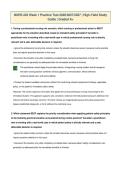
NURS 222 Week 1 Practice Test 2026/2027/2027 | High-Yield Study
Guide | Graded A+
1. During a professional nursing role scenario, which nursing or professional action is MOST
appropriate for the situation described, based on standard safety principles? Consider a
practitioner who is working with a real-world case in which professional nursing role is directly
relevant and a safe, defensible decision is required.
• Ignore the professional nursing role concern unless the situation becomes severe, because routine practice
does not require proactive attention to this issue.
• Document the situation only after completing unrelated tasks, because professional nursing role
considerations can generally be addressed after the immediate workflow is finished.
✓ The practitioner should apply the principle directly: A beginning nursing student should recognize
that safe nursing practice combines clinical judgment, communication, ethical behavior,
evidence-based care, and accountability.
• Choose the fastest available intervention without first confirming relevant assessment findings, applicable
policy, or the patient’s immediate safety needs.
Rationale: The correct response is the option that applies the central professional nursing role principle to the
immediate situation. This approach supports safe, consistent, evidence-informed practice because it addresses the
relevant risk before secondary concerns. The other choices are inappropriate because they delay assessment,
bypass established safeguards, or fail to address the underlying issue.
2. Which statement BEST explains the priority consideration when applying patient safety principles
to the following practical situation encountered during routine practice? Consider a practitioner
who is working with a real-world case in which patient safety is directly relevant and a safe,
defensible decision is required.
• Ignore the patient safety concern unless the situation becomes severe, because routine practice does not
require proactive attention to this issue.
• Document the situation only after completing unrelated tasks, because patient safety considerations can
generally be addressed after the immediate workflow is finished.
, ✓ The best approach is to recognize the key safety issue and act accordingly: Patient safety begins
with identifying risks, using appropriate precautions, communicating concerns, and reporting errors
or near misses through established processes.
• Choose the fastest available intervention without first confirming relevant assessment findings, applicable
policy, or the patient’s immediate safety needs.
Rationale: The correct response is the option that applies the central patient safety principle to the immediate
situation. This approach supports safe, consistent, evidence-informed practice because it addresses the relevant risk
before secondary concerns. The other choices are inappropriate because they delay assessment, bypass
established safeguards, or fail to address the underlying issue.
3. A learner is being evaluated on hand hygiene. Which response BEST demonstrates correct
application of the principle rather than simple memorization? Consider a practitioner who is working
with a real-world case in which hand hygiene is directly relevant and a safe, defensible decision is
required.
• Ignore the hand hygiene concern unless the situation becomes severe, because routine practice does not
require proactive attention to this issue.
• Choose the fastest available intervention without first confirming relevant assessment findings, applicable
policy, or the patient’s immediate safety needs.
✓ Correct practice requires the practitioner to prioritize the central principle: Hand hygiene should be
performed at appropriate moments before and after patient contact and after exposure to potentially
contaminated materials.
• Document the situation only after completing unrelated tasks, because hand hygiene considerations can
generally be addressed after the immediate workflow is finished.
Rationale: The correct response is the option that applies the central hand hygiene principle to the immediate
situation. This approach supports safe, consistent, evidence-informed practice because it addresses the relevant risk
before secondary concerns. The other choices are inappropriate because they delay assessment, bypass
established safeguards, or fail to address the underlying issue.
4. Which action should be taken FIRST when the circumstances involve vital signs and the
practitioner must protect safety while following accepted professional standards? Consider a
practitioner who is working with a real-world case in which vital signs is directly relevant and a safe,
,defensible decision is required.
• Choose the fastest available intervention without first confirming relevant assessment findings, applicable
policy, or the patient’s immediate safety needs.
• Document the situation only after completing unrelated tasks, because vital signs considerations can
generally be addressed after the immediate workflow is finished.
✓ The most appropriate response is consistent with accepted practice: Abnormal vital signs should be
interpreted in the context of the patient’s condition, baseline, symptoms, medications, and trends
rather than treated as isolated numbers.
• Ignore the vital signs concern unless the situation becomes severe, because routine practice does not require
proactive attention to this issue.
Rationale: The correct response is the option that applies the central vital signs principle to the immediate situation.
This approach supports safe, consistent, evidence-informed practice because it addresses the relevant risk before
secondary concerns. The other choices are inappropriate because they delay assessment, bypass established
safeguards, or fail to address the underlying issue.
5. When reviewing a case involving health history, which finding or intervention most strongly
indicates that the practitioner understands the underlying principle and its practical implications?
Consider a practitioner who is working with a real-world case in which health history is directly
relevant and a safe, defensible decision is required.
• Ignore the health history concern unless the situation becomes severe, because routine practice does not
require proactive attention to this issue.
✓ The practitioner should apply the principle directly: A nursing health history gathers subjective
information about symptoms, health practices, medications, allergies, functional status, and relevant
psychosocial factors.
• Choose the fastest available intervention without first confirming relevant assessment findings, applicable
policy, or the patient’s immediate safety needs.
• Document the situation only after completing unrelated tasks, because health history considerations can
generally be addressed after the immediate workflow is finished.
Rationale: The correct response is the option that applies the central health history principle to the immediate
situation. This approach supports safe, consistent, evidence-informed practice because it addresses the relevant risk
before secondary concerns. The other choices are inappropriate because they delay assessment, bypass
, established safeguards, or fail to address the underlying issue.
6. Which option BEST reflects the evidence-informed approach to physical assessment when the
practitioner must make a safe decision under realistic examination conditions? Consider a
practitioner who is working with a real-world case in which physical assessment is directly relevant
and a safe, defensible decision is required.
• Choose the fastest available intervention without first confirming relevant assessment findings, applicable
policy, or the patient’s immediate safety needs.
• Ignore the physical assessment concern unless the situation becomes severe, because routine practice does
not require proactive attention to this issue.
✓ The best approach is to recognize the key safety issue and act accordingly: A systematic physical
assessment helps the nurse identify normal findings, abnormalities, changes from baseline, and
information requiring further evaluation.
• Document the situation only after completing unrelated tasks, because physical assessment considerations
can generally be addressed after the immediate workflow is finished.
Rationale: The correct response is the option that applies the central physical assessment principle to the immediate
situation. This approach supports safe, consistent, evidence-informed practice because it addresses the relevant risk
before secondary concerns. The other choices are inappropriate because they delay assessment, bypass
established safeguards, or fail to address the underlying issue.
7. During a confidentiality scenario, which nursing or professional action is MOST appropriate for
the situation described, based on standard safety principles? Consider a practitioner who is
working with a real-world case in which confidentiality is directly relevant and a safe, defensible
decision is required.
• Document the situation only after completing unrelated tasks, because confidentiality considerations can
generally be addressed after the immediate workflow is finished.
• Choose the fastest available intervention without first confirming relevant assessment findings, applicable
policy, or the patient’s immediate safety needs.
✓ Correct practice requires the practitioner to prioritize the central principle: Patient information should
be shared only with individuals who have a legitimate need to know and through appropriate
communication channels.
Guide | Graded A+
1. During a professional nursing role scenario, which nursing or professional action is MOST
appropriate for the situation described, based on standard safety principles? Consider a
practitioner who is working with a real-world case in which professional nursing role is directly
relevant and a safe, defensible decision is required.
• Ignore the professional nursing role concern unless the situation becomes severe, because routine practice
does not require proactive attention to this issue.
• Document the situation only after completing unrelated tasks, because professional nursing role
considerations can generally be addressed after the immediate workflow is finished.
✓ The practitioner should apply the principle directly: A beginning nursing student should recognize
that safe nursing practice combines clinical judgment, communication, ethical behavior,
evidence-based care, and accountability.
• Choose the fastest available intervention without first confirming relevant assessment findings, applicable
policy, or the patient’s immediate safety needs.
Rationale: The correct response is the option that applies the central professional nursing role principle to the
immediate situation. This approach supports safe, consistent, evidence-informed practice because it addresses the
relevant risk before secondary concerns. The other choices are inappropriate because they delay assessment,
bypass established safeguards, or fail to address the underlying issue.
2. Which statement BEST explains the priority consideration when applying patient safety principles
to the following practical situation encountered during routine practice? Consider a practitioner
who is working with a real-world case in which patient safety is directly relevant and a safe,
defensible decision is required.
• Ignore the patient safety concern unless the situation becomes severe, because routine practice does not
require proactive attention to this issue.
• Document the situation only after completing unrelated tasks, because patient safety considerations can
generally be addressed after the immediate workflow is finished.
, ✓ The best approach is to recognize the key safety issue and act accordingly: Patient safety begins
with identifying risks, using appropriate precautions, communicating concerns, and reporting errors
or near misses through established processes.
• Choose the fastest available intervention without first confirming relevant assessment findings, applicable
policy, or the patient’s immediate safety needs.
Rationale: The correct response is the option that applies the central patient safety principle to the immediate
situation. This approach supports safe, consistent, evidence-informed practice because it addresses the relevant risk
before secondary concerns. The other choices are inappropriate because they delay assessment, bypass
established safeguards, or fail to address the underlying issue.
3. A learner is being evaluated on hand hygiene. Which response BEST demonstrates correct
application of the principle rather than simple memorization? Consider a practitioner who is working
with a real-world case in which hand hygiene is directly relevant and a safe, defensible decision is
required.
• Ignore the hand hygiene concern unless the situation becomes severe, because routine practice does not
require proactive attention to this issue.
• Choose the fastest available intervention without first confirming relevant assessment findings, applicable
policy, or the patient’s immediate safety needs.
✓ Correct practice requires the practitioner to prioritize the central principle: Hand hygiene should be
performed at appropriate moments before and after patient contact and after exposure to potentially
contaminated materials.
• Document the situation only after completing unrelated tasks, because hand hygiene considerations can
generally be addressed after the immediate workflow is finished.
Rationale: The correct response is the option that applies the central hand hygiene principle to the immediate
situation. This approach supports safe, consistent, evidence-informed practice because it addresses the relevant risk
before secondary concerns. The other choices are inappropriate because they delay assessment, bypass
established safeguards, or fail to address the underlying issue.
4. Which action should be taken FIRST when the circumstances involve vital signs and the
practitioner must protect safety while following accepted professional standards? Consider a
practitioner who is working with a real-world case in which vital signs is directly relevant and a safe,
,defensible decision is required.
• Choose the fastest available intervention without first confirming relevant assessment findings, applicable
policy, or the patient’s immediate safety needs.
• Document the situation only after completing unrelated tasks, because vital signs considerations can
generally be addressed after the immediate workflow is finished.
✓ The most appropriate response is consistent with accepted practice: Abnormal vital signs should be
interpreted in the context of the patient’s condition, baseline, symptoms, medications, and trends
rather than treated as isolated numbers.
• Ignore the vital signs concern unless the situation becomes severe, because routine practice does not require
proactive attention to this issue.
Rationale: The correct response is the option that applies the central vital signs principle to the immediate situation.
This approach supports safe, consistent, evidence-informed practice because it addresses the relevant risk before
secondary concerns. The other choices are inappropriate because they delay assessment, bypass established
safeguards, or fail to address the underlying issue.
5. When reviewing a case involving health history, which finding or intervention most strongly
indicates that the practitioner understands the underlying principle and its practical implications?
Consider a practitioner who is working with a real-world case in which health history is directly
relevant and a safe, defensible decision is required.
• Ignore the health history concern unless the situation becomes severe, because routine practice does not
require proactive attention to this issue.
✓ The practitioner should apply the principle directly: A nursing health history gathers subjective
information about symptoms, health practices, medications, allergies, functional status, and relevant
psychosocial factors.
• Choose the fastest available intervention without first confirming relevant assessment findings, applicable
policy, or the patient’s immediate safety needs.
• Document the situation only after completing unrelated tasks, because health history considerations can
generally be addressed after the immediate workflow is finished.
Rationale: The correct response is the option that applies the central health history principle to the immediate
situation. This approach supports safe, consistent, evidence-informed practice because it addresses the relevant risk
before secondary concerns. The other choices are inappropriate because they delay assessment, bypass
, established safeguards, or fail to address the underlying issue.
6. Which option BEST reflects the evidence-informed approach to physical assessment when the
practitioner must make a safe decision under realistic examination conditions? Consider a
practitioner who is working with a real-world case in which physical assessment is directly relevant
and a safe, defensible decision is required.
• Choose the fastest available intervention without first confirming relevant assessment findings, applicable
policy, or the patient’s immediate safety needs.
• Ignore the physical assessment concern unless the situation becomes severe, because routine practice does
not require proactive attention to this issue.
✓ The best approach is to recognize the key safety issue and act accordingly: A systematic physical
assessment helps the nurse identify normal findings, abnormalities, changes from baseline, and
information requiring further evaluation.
• Document the situation only after completing unrelated tasks, because physical assessment considerations
can generally be addressed after the immediate workflow is finished.
Rationale: The correct response is the option that applies the central physical assessment principle to the immediate
situation. This approach supports safe, consistent, evidence-informed practice because it addresses the relevant risk
before secondary concerns. The other choices are inappropriate because they delay assessment, bypass
established safeguards, or fail to address the underlying issue.
7. During a confidentiality scenario, which nursing or professional action is MOST appropriate for
the situation described, based on standard safety principles? Consider a practitioner who is
working with a real-world case in which confidentiality is directly relevant and a safe, defensible
decision is required.
• Document the situation only after completing unrelated tasks, because confidentiality considerations can
generally be addressed after the immediate workflow is finished.
• Choose the fastest available intervention without first confirming relevant assessment findings, applicable
policy, or the patient’s immediate safety needs.
✓ Correct practice requires the practitioner to prioritize the central principle: Patient information should
be shared only with individuals who have a legitimate need to know and through appropriate
communication channels.