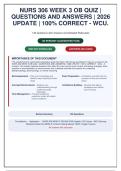
NURS 306 WEEK 3 OB QUIZ |
QUESTIONS AND ANSWERS | 2026
UPDATE | 100% CORRECT - WCU.
140 Questions with Answers and Detailed Rationales
100 PERCENT GUARANTEED PASS
INSTANT DOWNLOAD ANSWERS INCLUDED
IMPORTANCE OF THIS DOCUMENT
This comprehensive examination preparation guide has been meticulously developed to help you succeed in the
NURS 306 WEEK 3 OB QUIZ | QUESTIONS AND ANSWERS | 2026 UPDATE | 100% CORRECT - WCU.. It
contains 140 carefully selected questions that reflect the most current exam content and testing strategies. Each
question is accompanied by a correct answer and a detailed rationale that explains the underlying
pathophysiology, pharmacology, or clinical reasoning.
Self-Assessment – Test your knowledge and Exam Preparation – Familiarize yourself with the
identify areas requiring further question format and content
study areas
Concept Reinforcement – Deepen your Confidence Building – Develop test-taking
understanding through strategies and reduce
evidence-based exam anxiety
rationales
Time Management – Practice answering
questions under simulated
exam conditions
Review Summary 140 Questions
Foundations - Application - NURS 306 WEEK 3 OB AND 2026 Update 100 Correct - WCU Nursing
Obstetrics Maternity WEEK 3 Content Undergraduate YEAR 3 Upper Division
All answers with rationales
,Table of Contents
Content Area Questions Key Topics
Antepartum Assessment 1-24 Labor, Fetal, Weeks, Appropriate, Heart
AND CARE
Intrapartum Assessment 25-48 Finding, Weeks, Gestation, Fetal, Heart RATE
AND CARE
Postpartum Assessment 49-72 Weeks, Fetal, Gestation, Finding, Management
AND CARE
Newborn Assessment AND 73-96 Fetal, Weeks, Heart RATE, Finding, Severe
CARE
Complications OF Pregnancy 97-120 Weeks, Fetal, Finding, Heart RATE, Appropriate
Labor AND Delivery 121-140 Fetal, Weeks Gestation, Finding, Uterine, Increased
Complications
TOTAL 140 All questions include answers and detailed rationales
,Section A - Antepartum Assessment AND CARE
Q1.
A patient at 30 weeks gestation presents with a blood pressure of 160/110 mmHg,
headache, and epigastric pain. Laboratory results show platelet count 80,000/µL, AST 120
U/L, and creatinine 1.4 mg/dL. Which delivery timing is most appropriate?
A. Immediate delivery regardless of B. Delay delivery until 34 weeks to enhance
gestational age fetal lung maturity
C. Administer betamethasone and deliver D. Expectant management with
within 48 hours antihypertensives and seizure prophylaxis
Correct: A - Immediate delivery regardless of gestational age
Rationale:The presence of severe features (BP "e160/110, thrombocytopenia, elevated liver
enzymes, renal insufficiency) in preeclampsia mandates delivery after maternal stabilization,
irrespective of gestational age, to prevent maternal morbidity. Delaying delivery risks
eclampsia, hepatic rupture, or renal failure. Betamethasone may be given if time permits, but
delivery should not be postponed for 48 hours when severe features are present.
Q2.
A patient in active labor has a category III fetal heart tracing with recurrent late
decelerations and minimal variability. The provider orders an amnioinfusion. What is the
primary therapeutic goal of this intervention?
A. Correct uterine hyperstimulation B. Relieve umbilical cord compression
C. Reduce the risk of intra-amniotic infection D. Accelerate cervical dilation
Correct: B - Relieve umbilical cord compression
Rationale:Amnioinfusion replaces amniotic fluid volume to cushion the umbilical cord,
alleviating variable decelerations due to cord compression. It does not address
hyperstimulation (which requires tocolytics) or infection risk, and it does not accelerate labor.
Late decelerations are typically due to uteroplacental insufficiency, not cord compression, but
the scenario indicates recurrent late decelerations with minimal variability-still, amnioinfusion
is often used for variable decelerations; however, the question tests the mechanism of
amnioinfusion, which is to relieve cord compression.
Q3.
A postpartum patient who delivered vaginally 6 hours ago has a fundus that is boggy,
displaced to the right of the umbilicus, and lochia is moderate with small clots. Which
nursing action is most appropriate?
Page 3
, Section A - Antepartum Assessment AND CARE
A. Encourage ambulation to promote uterine B. Assist the patient to void and reassess
tone the fundus
C. Massage the fundus firmly in a circular D. Administer methylergonovine 0.2 mg IM
motion as ordered
Correct: B - Assist the patient to void and reassess the fundus
Rationale:A boggy fundus displaced to the right suggests a distended bladder, which
elevates the uterus and impairs contraction. The priority is to help the patient void; after
bladder emptying, reassess fundal position and tone. Ambulation is not indicated until bladder
is emptied. Massage may be needed after voiding if still boggy, but initial action is voiding.
Methylergonovine is used for uterine atony unresponsive to massage and after bladder
emptying.
Q4.
Which fetal heart rate pattern is most indicative of fetal acidemia when persistent?
A. Accelerations with fetal movement B. Early decelerations with variability of 6-10
bpm
C. Variable decelerations with rapid return to D. Prolonged deceleration for 12 minutes
baseline with minimal variability
Correct: D - Prolonged deceleration for 12 minutes with minimal variability
Rationale:Prolonged decelerations lasting >10 minutes with minimal variability indicate
profound hypoxemia and metabolic acidemia, requiring immediate intervention. Accelerations
and early decelerations are reassuring. Variable decelerations with rapid return are typically
benign. Minimal variability combined with a prolonged deceleration is an ominous sign.
Q5.
A patient at 28 weeks gestation with preterm premature rupture of membranes (PPROM) is
being managed expectantly. Which finding would indicate the need for immediate
delivery?
A. Amniotic fluid index of 6 cm B. Maternal temperature of 38.1°C
C. Fetal heart rate with moderate variability D. White blood cell count of 11,000/mm³
Correct: B - Maternal temperature of 38.1°C
Rationale:Maternal fever ("e38.0°C) in the setting of PPROM suggests chorioamnionitis,
which is an indication for delivery to prevent maternal and neonatal sepsis. Amniotic fluid
index of 6 cm is borderline but not an immediate delivery indication. Moderate variability is
reassuring. WBC of 11,000 is within normal limits for pregnancy.
Page 4
QUESTIONS AND ANSWERS | 2026
UPDATE | 100% CORRECT - WCU.
140 Questions with Answers and Detailed Rationales
100 PERCENT GUARANTEED PASS
INSTANT DOWNLOAD ANSWERS INCLUDED
IMPORTANCE OF THIS DOCUMENT
This comprehensive examination preparation guide has been meticulously developed to help you succeed in the
NURS 306 WEEK 3 OB QUIZ | QUESTIONS AND ANSWERS | 2026 UPDATE | 100% CORRECT - WCU.. It
contains 140 carefully selected questions that reflect the most current exam content and testing strategies. Each
question is accompanied by a correct answer and a detailed rationale that explains the underlying
pathophysiology, pharmacology, or clinical reasoning.
Self-Assessment – Test your knowledge and Exam Preparation – Familiarize yourself with the
identify areas requiring further question format and content
study areas
Concept Reinforcement – Deepen your Confidence Building – Develop test-taking
understanding through strategies and reduce
evidence-based exam anxiety
rationales
Time Management – Practice answering
questions under simulated
exam conditions
Review Summary 140 Questions
Foundations - Application - NURS 306 WEEK 3 OB AND 2026 Update 100 Correct - WCU Nursing
Obstetrics Maternity WEEK 3 Content Undergraduate YEAR 3 Upper Division
All answers with rationales
,Table of Contents
Content Area Questions Key Topics
Antepartum Assessment 1-24 Labor, Fetal, Weeks, Appropriate, Heart
AND CARE
Intrapartum Assessment 25-48 Finding, Weeks, Gestation, Fetal, Heart RATE
AND CARE
Postpartum Assessment 49-72 Weeks, Fetal, Gestation, Finding, Management
AND CARE
Newborn Assessment AND 73-96 Fetal, Weeks, Heart RATE, Finding, Severe
CARE
Complications OF Pregnancy 97-120 Weeks, Fetal, Finding, Heart RATE, Appropriate
Labor AND Delivery 121-140 Fetal, Weeks Gestation, Finding, Uterine, Increased
Complications
TOTAL 140 All questions include answers and detailed rationales
,Section A - Antepartum Assessment AND CARE
Q1.
A patient at 30 weeks gestation presents with a blood pressure of 160/110 mmHg,
headache, and epigastric pain. Laboratory results show platelet count 80,000/µL, AST 120
U/L, and creatinine 1.4 mg/dL. Which delivery timing is most appropriate?
A. Immediate delivery regardless of B. Delay delivery until 34 weeks to enhance
gestational age fetal lung maturity
C. Administer betamethasone and deliver D. Expectant management with
within 48 hours antihypertensives and seizure prophylaxis
Correct: A - Immediate delivery regardless of gestational age
Rationale:The presence of severe features (BP "e160/110, thrombocytopenia, elevated liver
enzymes, renal insufficiency) in preeclampsia mandates delivery after maternal stabilization,
irrespective of gestational age, to prevent maternal morbidity. Delaying delivery risks
eclampsia, hepatic rupture, or renal failure. Betamethasone may be given if time permits, but
delivery should not be postponed for 48 hours when severe features are present.
Q2.
A patient in active labor has a category III fetal heart tracing with recurrent late
decelerations and minimal variability. The provider orders an amnioinfusion. What is the
primary therapeutic goal of this intervention?
A. Correct uterine hyperstimulation B. Relieve umbilical cord compression
C. Reduce the risk of intra-amniotic infection D. Accelerate cervical dilation
Correct: B - Relieve umbilical cord compression
Rationale:Amnioinfusion replaces amniotic fluid volume to cushion the umbilical cord,
alleviating variable decelerations due to cord compression. It does not address
hyperstimulation (which requires tocolytics) or infection risk, and it does not accelerate labor.
Late decelerations are typically due to uteroplacental insufficiency, not cord compression, but
the scenario indicates recurrent late decelerations with minimal variability-still, amnioinfusion
is often used for variable decelerations; however, the question tests the mechanism of
amnioinfusion, which is to relieve cord compression.
Q3.
A postpartum patient who delivered vaginally 6 hours ago has a fundus that is boggy,
displaced to the right of the umbilicus, and lochia is moderate with small clots. Which
nursing action is most appropriate?
Page 3
, Section A - Antepartum Assessment AND CARE
A. Encourage ambulation to promote uterine B. Assist the patient to void and reassess
tone the fundus
C. Massage the fundus firmly in a circular D. Administer methylergonovine 0.2 mg IM
motion as ordered
Correct: B - Assist the patient to void and reassess the fundus
Rationale:A boggy fundus displaced to the right suggests a distended bladder, which
elevates the uterus and impairs contraction. The priority is to help the patient void; after
bladder emptying, reassess fundal position and tone. Ambulation is not indicated until bladder
is emptied. Massage may be needed after voiding if still boggy, but initial action is voiding.
Methylergonovine is used for uterine atony unresponsive to massage and after bladder
emptying.
Q4.
Which fetal heart rate pattern is most indicative of fetal acidemia when persistent?
A. Accelerations with fetal movement B. Early decelerations with variability of 6-10
bpm
C. Variable decelerations with rapid return to D. Prolonged deceleration for 12 minutes
baseline with minimal variability
Correct: D - Prolonged deceleration for 12 minutes with minimal variability
Rationale:Prolonged decelerations lasting >10 minutes with minimal variability indicate
profound hypoxemia and metabolic acidemia, requiring immediate intervention. Accelerations
and early decelerations are reassuring. Variable decelerations with rapid return are typically
benign. Minimal variability combined with a prolonged deceleration is an ominous sign.
Q5.
A patient at 28 weeks gestation with preterm premature rupture of membranes (PPROM) is
being managed expectantly. Which finding would indicate the need for immediate
delivery?
A. Amniotic fluid index of 6 cm B. Maternal temperature of 38.1°C
C. Fetal heart rate with moderate variability D. White blood cell count of 11,000/mm³
Correct: B - Maternal temperature of 38.1°C
Rationale:Maternal fever ("e38.0°C) in the setting of PPROM suggests chorioamnionitis,
which is an indication for delivery to prevent maternal and neonatal sepsis. Amniotic fluid
index of 6 cm is borderline but not an immediate delivery indication. Moderate variability is
reassuring. WBC of 11,000 is within normal limits for pregnancy.
Page 4