
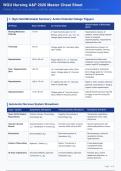
WGU Nursing A&P 2026 Master Cheat Sheet
TARGET: WGU OA & NCLEX-RN | CHAPTER: NERVOUS SYSTEM & AUTONOMIC PHYSIOLOGY
1. High-Yield Minimalist Summary: Action Potential Voltage Triggers
Clinical Impact of Electrolyte
AP Phase Exact mV Metric Ion Channel State
Shifts
Resting Membrane -70 mV K+ leak channels open; Na+/K+- Hyperkalemia reduces K+
Potential + + gradient, raising resting potential
ATPase active (3 Na out / 2 K in);
Voltage-gated channels closed. closer to threshold
(hyperexcitability). Hypokalemia
hyperpolarizes cells.
Threshold -55 mV Voltage-gated Na+ activation gates Hypocalcemia increases Na+
open rapidly. channel permeability, lowering
threshold and causing tetany/
seizures.
Depolarization -55 to +30 mV Rapid inflow of Na+; K+ channels Hypernatremia alters peak
remain closed/opening slowly. amplitude; severe hyponatremia
impairs rapid AP propagation.
Peak / Repolarization +30 mV Na+ inactivation gates close (influx Local anesthetics (Lidocaine)
Start stops); Voltage-gated K+ channels bind voltage-gated Na+ channels,
open. blocking AP generation
completely.
Repolarization +30 to -70 mV K+ rapidly exits cell; Na+ channels Rapid K+ efflux restores electrical
reset to closed state. potential; extracellular K+ buildup
impairs further repolarization.
Hyperpolarization -70 to -90 mV Voltage-gated K+ channels slow to Suprathreshold stimulus required
close; Relative refractory period. to trigger a new AP during this
window.
Autonomic Nervous System Showdown
Organ / System Sympathetic (Receptors) Parasympathetic (Receptors) Emergency Overdrive
Heart (SA/AV Node & Positive Inotropy, Chronotropy, Negative Chronotropy & Tachycardia, palpitations,
Myocardium) Dromotropy (β1) Dromotropy (M2) hypertensive crisis, fatal
arrhythmia.
Vascular Smooth Vasoconstriction in skin/viscera No direct innervation (minimal Severe hypertension with
Muscle (α1). Vasodilation in muscle (β2) vascular effect via local NO) reflex bradycardia or severe
shock.
Bronchioles Bronchodilation (β2) Bronchoconstriction & Bronchospasm, profound
Secretions (M3) respiratory distress,
hypersecretion.
Pupils & Ciliary Body Mydriasis / Dilator (α1) Miosis / Constrictor & Fixed dilated pupils
Accommodation (M3) (sympathetic blast /
anticholinergic tox).
GI Tract & Sphincters Decreased Motility, Sphincter Increased Motility, Sphincter Paralytic ileus, severe
Contraction (α1, β2) Relaxation (M3) abdominal distension, or
profuse diarrhea.
Page 1 of 8
, Urinary Bladder Detrusor Relaxation (β2, β3). Detrusor Contraction, Sphincter Urinary retention or involuntary
Sphincter Contraction (α1) Relaxation (M3) incontinence (cholinergic
crisis).
Neurological Failure Modes
• Multiple Sclerosis (MS): Autoimmune destruction of CNS myelin sheaths (oligodendrocytes) leads to sclerosis formation,
slowing/blocking saltatory conduction along nodes of Ranvier.
• Guillain-Barré Syndrome (GBS): Acute demyelination of PNS nerves (Schwann cells), causing ascending motor paralysis.
• Myasthenia Gravis (MG): Autoimmune destruction/blockade of nicotinic ACh receptors (nAChR) at the NMJ postsynaptic
membrane, causing weakness that worsens with repetition.
• Lambert-Eaton Syndrome: Autoimmune attack against presynaptic voltage-gated calcium channels (Ca ), preventing ACh
v
release.
• Botulinum Toxicity: Cleaves SNARE proteins in presynaptic terminals, blocking ACh exocytosis & causing flaccid paralysis.
• Organophosphate Toxicity: Irreversibly inhibits acetylcholinesterase (AChE), causing massive ACh accumulation (SLUDGEM).
2. Critical Assessment Questions
1. A 34yo female presents with muscle weakness, diplopia, and ptosis worsening at end of day. Tensilon
test shows immediate temporary improvement. Mechanism?
Correct Answer: Autoimmune destruction of postsynaptic nicotinic acetylcholine receptors at the NMJ.
Rationale: Tensilon inhibits acetylcholinesterase, transiently preserving ACh in the synaptic cleft to overcome competitive receptor
block in Myasthenia Gravis.
2. ICU patient develops serum K+ 7.2 mEq/L with peaked T waves and wide QRS. How does hyperkalemia
alter AP mechanics?
Correct Answer: Raises resting potential closer to threshold, causing initial hyperexcitability followed by
inactivation of fast Na+ channels.
Rationale: Reduced extracellular K+ gradient depolarizes RMP. Persistent depolarization inactivates voltage-gated Na+ channels,
halting normal AP generation.
3. During resuscitation, IV atropine is administered. Which direct autonomic effect will the nurse monitor?
Correct Answer: Competitive blockade of postganglionic muscarinic receptors causing increased heart rate and
decreased secretions.
Rationale: Atropine blocks muscarinic ACh receptors, blunting parasympathetic vagal tone on the SA node to increase sinus rate and
AV conduction.
4. A 45yo male with an MS exacerbation exhibits slow motor conduction. Which structure is compromised?
Correct Answer: Oligodendrocytes forming the myelin sheath around central axons.
Rationale: MS causes demyelination of central axons, disrupting saltatory conduction across Nodes of Ranvier and leaking current
across axolemma.
5. Pesticide exposure causes bronchorrhea, bradycardia, miosis, and muscle fasciculations.
Pharmacological mechanism?
Correct Answer: Irreversible inhibition of acetylcholinesterase resulting in excessive cholinergic stimulation.
Rationale: Organophosphates prevent ACh breakdown, causing continuous muscarinic and nicotinic overstimulation requiring
immediate atropine and pralidoxime.
Page 2 of 8
TARGET: WGU OA & NCLEX-RN | CHAPTER: NERVOUS SYSTEM & AUTONOMIC PHYSIOLOGY
1. High-Yield Minimalist Summary: Action Potential Voltage Triggers
Clinical Impact of Electrolyte
AP Phase Exact mV Metric Ion Channel State
Shifts
Resting Membrane -70 mV K+ leak channels open; Na+/K+- Hyperkalemia reduces K+
Potential + + gradient, raising resting potential
ATPase active (3 Na out / 2 K in);
Voltage-gated channels closed. closer to threshold
(hyperexcitability). Hypokalemia
hyperpolarizes cells.
Threshold -55 mV Voltage-gated Na+ activation gates Hypocalcemia increases Na+
open rapidly. channel permeability, lowering
threshold and causing tetany/
seizures.
Depolarization -55 to +30 mV Rapid inflow of Na+; K+ channels Hypernatremia alters peak
remain closed/opening slowly. amplitude; severe hyponatremia
impairs rapid AP propagation.
Peak / Repolarization +30 mV Na+ inactivation gates close (influx Local anesthetics (Lidocaine)
Start stops); Voltage-gated K+ channels bind voltage-gated Na+ channels,
open. blocking AP generation
completely.
Repolarization +30 to -70 mV K+ rapidly exits cell; Na+ channels Rapid K+ efflux restores electrical
reset to closed state. potential; extracellular K+ buildup
impairs further repolarization.
Hyperpolarization -70 to -90 mV Voltage-gated K+ channels slow to Suprathreshold stimulus required
close; Relative refractory period. to trigger a new AP during this
window.
Autonomic Nervous System Showdown
Organ / System Sympathetic (Receptors) Parasympathetic (Receptors) Emergency Overdrive
Heart (SA/AV Node & Positive Inotropy, Chronotropy, Negative Chronotropy & Tachycardia, palpitations,
Myocardium) Dromotropy (β1) Dromotropy (M2) hypertensive crisis, fatal
arrhythmia.
Vascular Smooth Vasoconstriction in skin/viscera No direct innervation (minimal Severe hypertension with
Muscle (α1). Vasodilation in muscle (β2) vascular effect via local NO) reflex bradycardia or severe
shock.
Bronchioles Bronchodilation (β2) Bronchoconstriction & Bronchospasm, profound
Secretions (M3) respiratory distress,
hypersecretion.
Pupils & Ciliary Body Mydriasis / Dilator (α1) Miosis / Constrictor & Fixed dilated pupils
Accommodation (M3) (sympathetic blast /
anticholinergic tox).
GI Tract & Sphincters Decreased Motility, Sphincter Increased Motility, Sphincter Paralytic ileus, severe
Contraction (α1, β2) Relaxation (M3) abdominal distension, or
profuse diarrhea.
Page 1 of 8
, Urinary Bladder Detrusor Relaxation (β2, β3). Detrusor Contraction, Sphincter Urinary retention or involuntary
Sphincter Contraction (α1) Relaxation (M3) incontinence (cholinergic
crisis).
Neurological Failure Modes
• Multiple Sclerosis (MS): Autoimmune destruction of CNS myelin sheaths (oligodendrocytes) leads to sclerosis formation,
slowing/blocking saltatory conduction along nodes of Ranvier.
• Guillain-Barré Syndrome (GBS): Acute demyelination of PNS nerves (Schwann cells), causing ascending motor paralysis.
• Myasthenia Gravis (MG): Autoimmune destruction/blockade of nicotinic ACh receptors (nAChR) at the NMJ postsynaptic
membrane, causing weakness that worsens with repetition.
• Lambert-Eaton Syndrome: Autoimmune attack against presynaptic voltage-gated calcium channels (Ca ), preventing ACh
v
release.
• Botulinum Toxicity: Cleaves SNARE proteins in presynaptic terminals, blocking ACh exocytosis & causing flaccid paralysis.
• Organophosphate Toxicity: Irreversibly inhibits acetylcholinesterase (AChE), causing massive ACh accumulation (SLUDGEM).
2. Critical Assessment Questions
1. A 34yo female presents with muscle weakness, diplopia, and ptosis worsening at end of day. Tensilon
test shows immediate temporary improvement. Mechanism?
Correct Answer: Autoimmune destruction of postsynaptic nicotinic acetylcholine receptors at the NMJ.
Rationale: Tensilon inhibits acetylcholinesterase, transiently preserving ACh in the synaptic cleft to overcome competitive receptor
block in Myasthenia Gravis.
2. ICU patient develops serum K+ 7.2 mEq/L with peaked T waves and wide QRS. How does hyperkalemia
alter AP mechanics?
Correct Answer: Raises resting potential closer to threshold, causing initial hyperexcitability followed by
inactivation of fast Na+ channels.
Rationale: Reduced extracellular K+ gradient depolarizes RMP. Persistent depolarization inactivates voltage-gated Na+ channels,
halting normal AP generation.
3. During resuscitation, IV atropine is administered. Which direct autonomic effect will the nurse monitor?
Correct Answer: Competitive blockade of postganglionic muscarinic receptors causing increased heart rate and
decreased secretions.
Rationale: Atropine blocks muscarinic ACh receptors, blunting parasympathetic vagal tone on the SA node to increase sinus rate and
AV conduction.
4. A 45yo male with an MS exacerbation exhibits slow motor conduction. Which structure is compromised?
Correct Answer: Oligodendrocytes forming the myelin sheath around central axons.
Rationale: MS causes demyelination of central axons, disrupting saltatory conduction across Nodes of Ranvier and leaking current
across axolemma.
5. Pesticide exposure causes bronchorrhea, bradycardia, miosis, and muscle fasciculations.
Pharmacological mechanism?
Correct Answer: Irreversible inhibition of acetylcholinesterase resulting in excessive cholinergic stimulation.
Rationale: Organophosphates prevent ACh breakdown, causing continuous muscarinic and nicotinic overstimulation requiring
immediate atropine and pralidoxime.
Page 2 of 8

