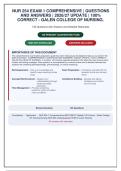
NUR 254 EXAM 1 COMPREHENSIVE | QUESTIONS
AND ANSWERS | 2026/27 UPDATE | 100%
CORRECT - GALEN COLLEGE OF NURSING.
140 Questions with Answers and Detailed Rationales
100 PERCENT GUARANTEED PASS
INSTANT DOWNLOAD ANSWERS INCLUDED
IMPORTANCE OF THIS DOCUMENT
This comprehensive examination preparation guide has been meticulously developed to help you succeed in the
NUR 254 EXAM 1 COMPREHENSIVE | QUESTIONS AND ANSWERS | 2026/27 UPDATE | 100% CORRECT -
GALEN COLLEGE OF NURSING.. It contains 140 carefully selected questions that reflect the most current exam
content and testing strategies. Each question is accompanied by a correct answer and a detailed rationale that
explains the underlying pathophysiology, pharmacology, or clinical reasoning.
Self-Assessment – Test your knowledge and Exam Preparation – Familiarize yourself with the
identify areas requiring further question format and content
study areas
Concept Reinforcement – Deepen your Confidence Building – Develop test-taking
understanding through strategies and reduce
evidence-based exam anxiety
rationales
Time Management – Practice answering
questions under simulated
exam conditions
Review Summary 140 Questions
Foundations - Application - NUR 254 1 Comprehensive AND 2026/27 Update 100 Correct - Galen College
OF Nursing Nursing NUR 254 Undergraduate YEAR 3 Junior Nursing
All answers with rationales
,Table of Contents
Content Area Questions Key Topics
Management OF CARE 1-24 Infusion, Receiving, Medication, Appropriate, Hours
Safety AND Infection Control 25-48 Indicates, Heart, Mechanism, Chronic, Disease
Health Promotion AND 49-72 Prescribed, Indicates, Chronic, Disease, Medication
Maintenance
Psychosocial Integrity 73-96 Finding, Serum, Potassium, Consistent, Appropriate
Basic CARE AND Comfort 97-120 Finding, Indicates, Intervention, Appropriate, Severe
Pharmacological Therapies 121-140 Finding, Blood, Indicates, Prevent, Chest TUBE
TOTAL 140 All questions include answers and detailed rationales
,Section A - Management OF CARE
Q1.
A patient with chronic kidney disease (CKD) is prescribed enoxaparin for prophylaxis. The
nurse reviews the medication reconciliation and notes the patient also takes warfarin.
Which pharmacokinetic principle is most critical when evaluating this combination?
A. Protein-binding displacement increases B. Renal excretion of enoxaparin is
free warfarin concentration, potentiating unaffected by CKD, so no dose adjustment
anticoagulant effect. is needed.
C. Enoxaparin and warfarin compete for the D. Enoxaparin induces hepatic enzymes,
same receptor sites, reducing efficacy. accelerating warfarin metabolism.
Correct: A - Protein-binding displacement increases free warfarin concentration,
potentiating anticoagulant effect.
Rationale:Warfarin is highly protein-bound; enoxaparin can displace it, increasing free
warfarin and bleeding risk. CKD affects enoxaparin clearance, requiring dose adjustment, not
B. They do not compete for receptors (C), and enoxaparin does not induce CYP enzymes
(D).
Q2.
During a root cause analysis of a medication error, the team identifies that the nurse
misread a prescription because of a trailing zero. Which system-based intervention best
addresses this latent error?
A. Retrain the nurse on decimal point B. Implement a computerized provider order
documentation. entry (CPOE) system with forced decimal
places.
C. Require a second nurse to double-check D. Create a policy that all prescriptions must
all high-alert medications. be written in metric units.
Correct: B - Implement a computerized provider order entry (CPOE) system with forced
decimal places.
Rationale:CPOE with forcing functions prevents trailing zeros at the point of entry, a
systems-level fix. Retraining (A) is individual-focused; double-checks (C) and metric-only
policy (D) do not eliminate the design flaw.
Q3.
A patient is receiving an IV infusion of norepinephrine. The nurse notes extravasation at
the insertion site. Which action is most appropriate, and why?
Page 3
, Section A - Management OF CARE
A. Stop the infusion, aspirate residual drug, B. Flush the line with normal saline to dilute
and administer phentolamine locally. the drug.
C. Apply a warm compress to promote D. Continue the infusion but elevate the
absorption. extremity.
Correct: A - Stop the infusion, aspirate residual drug, and administer phentolamine locally.
Rationale:Extravasation of vasopressors like norepinephrine causes severe tissue necrosis;
phentolamine is the antidote. Flushing (B) worsens damage, warm compresses (C) increase
metabolism and tissue injury, and continuing (D) is unsafe.
Q4.
A nurse is caring for a post-operative patient with a patient-controlled analgesia (PCA)
pump. The family member expresses concern about the patient's sedation level. Which
assessment finding warrants immediate intervention?
A. Respiratory rate 12 breaths/min, SpO2 B. Patient is easily arousable but drifts to
95% on room air. sleep during conversation.
C. Pain score of 5 on a 0-10 scale despite D. Sedation scale score of 4 (difficult to
pressing the button frequently. arouse).
Correct: D - Sedation scale score of 4 (difficult to arouse).
Rationale:A sedation score of 4 indicates over-sedation and high risk for respiratory
depression; opioid should be withheld and provider notified. Other options are less critical: A
is normal, B is mild sedation, C indicates inadequate analgesia rather than over-sedation.
Q5.
A patient on a medical-surgical unit develops sudden onset of dyspnea, chest pain, and
hypoxia. A pulmonary embolism (PE) is suspected. Which diagnostic finding is most
definitive for PE?
A. Elevated D-dimer level B. CT pulmonary angiography showing a
filling defect
C. ABG showing respiratory alkalosis D. EKG showing S1Q3T3 pattern
Correct: B - CT pulmonary angiography showing a filling defect
Rationale:CT pulmonary angiography is the gold standard for diagnosing PE. D-dimer is
sensitive but not specific; ABG and EKG findings are supportive but not definitive.
Q6.
A nurse is preparing to administer a blood transfusion. The patient's blood type is O
negative. Which blood product can be safely transfused?
Page 4
AND ANSWERS | 2026/27 UPDATE | 100%
CORRECT - GALEN COLLEGE OF NURSING.
140 Questions with Answers and Detailed Rationales
100 PERCENT GUARANTEED PASS
INSTANT DOWNLOAD ANSWERS INCLUDED
IMPORTANCE OF THIS DOCUMENT
This comprehensive examination preparation guide has been meticulously developed to help you succeed in the
NUR 254 EXAM 1 COMPREHENSIVE | QUESTIONS AND ANSWERS | 2026/27 UPDATE | 100% CORRECT -
GALEN COLLEGE OF NURSING.. It contains 140 carefully selected questions that reflect the most current exam
content and testing strategies. Each question is accompanied by a correct answer and a detailed rationale that
explains the underlying pathophysiology, pharmacology, or clinical reasoning.
Self-Assessment – Test your knowledge and Exam Preparation – Familiarize yourself with the
identify areas requiring further question format and content
study areas
Concept Reinforcement – Deepen your Confidence Building – Develop test-taking
understanding through strategies and reduce
evidence-based exam anxiety
rationales
Time Management – Practice answering
questions under simulated
exam conditions
Review Summary 140 Questions
Foundations - Application - NUR 254 1 Comprehensive AND 2026/27 Update 100 Correct - Galen College
OF Nursing Nursing NUR 254 Undergraduate YEAR 3 Junior Nursing
All answers with rationales
,Table of Contents
Content Area Questions Key Topics
Management OF CARE 1-24 Infusion, Receiving, Medication, Appropriate, Hours
Safety AND Infection Control 25-48 Indicates, Heart, Mechanism, Chronic, Disease
Health Promotion AND 49-72 Prescribed, Indicates, Chronic, Disease, Medication
Maintenance
Psychosocial Integrity 73-96 Finding, Serum, Potassium, Consistent, Appropriate
Basic CARE AND Comfort 97-120 Finding, Indicates, Intervention, Appropriate, Severe
Pharmacological Therapies 121-140 Finding, Blood, Indicates, Prevent, Chest TUBE
TOTAL 140 All questions include answers and detailed rationales
,Section A - Management OF CARE
Q1.
A patient with chronic kidney disease (CKD) is prescribed enoxaparin for prophylaxis. The
nurse reviews the medication reconciliation and notes the patient also takes warfarin.
Which pharmacokinetic principle is most critical when evaluating this combination?
A. Protein-binding displacement increases B. Renal excretion of enoxaparin is
free warfarin concentration, potentiating unaffected by CKD, so no dose adjustment
anticoagulant effect. is needed.
C. Enoxaparin and warfarin compete for the D. Enoxaparin induces hepatic enzymes,
same receptor sites, reducing efficacy. accelerating warfarin metabolism.
Correct: A - Protein-binding displacement increases free warfarin concentration,
potentiating anticoagulant effect.
Rationale:Warfarin is highly protein-bound; enoxaparin can displace it, increasing free
warfarin and bleeding risk. CKD affects enoxaparin clearance, requiring dose adjustment, not
B. They do not compete for receptors (C), and enoxaparin does not induce CYP enzymes
(D).
Q2.
During a root cause analysis of a medication error, the team identifies that the nurse
misread a prescription because of a trailing zero. Which system-based intervention best
addresses this latent error?
A. Retrain the nurse on decimal point B. Implement a computerized provider order
documentation. entry (CPOE) system with forced decimal
places.
C. Require a second nurse to double-check D. Create a policy that all prescriptions must
all high-alert medications. be written in metric units.
Correct: B - Implement a computerized provider order entry (CPOE) system with forced
decimal places.
Rationale:CPOE with forcing functions prevents trailing zeros at the point of entry, a
systems-level fix. Retraining (A) is individual-focused; double-checks (C) and metric-only
policy (D) do not eliminate the design flaw.
Q3.
A patient is receiving an IV infusion of norepinephrine. The nurse notes extravasation at
the insertion site. Which action is most appropriate, and why?
Page 3
, Section A - Management OF CARE
A. Stop the infusion, aspirate residual drug, B. Flush the line with normal saline to dilute
and administer phentolamine locally. the drug.
C. Apply a warm compress to promote D. Continue the infusion but elevate the
absorption. extremity.
Correct: A - Stop the infusion, aspirate residual drug, and administer phentolamine locally.
Rationale:Extravasation of vasopressors like norepinephrine causes severe tissue necrosis;
phentolamine is the antidote. Flushing (B) worsens damage, warm compresses (C) increase
metabolism and tissue injury, and continuing (D) is unsafe.
Q4.
A nurse is caring for a post-operative patient with a patient-controlled analgesia (PCA)
pump. The family member expresses concern about the patient's sedation level. Which
assessment finding warrants immediate intervention?
A. Respiratory rate 12 breaths/min, SpO2 B. Patient is easily arousable but drifts to
95% on room air. sleep during conversation.
C. Pain score of 5 on a 0-10 scale despite D. Sedation scale score of 4 (difficult to
pressing the button frequently. arouse).
Correct: D - Sedation scale score of 4 (difficult to arouse).
Rationale:A sedation score of 4 indicates over-sedation and high risk for respiratory
depression; opioid should be withheld and provider notified. Other options are less critical: A
is normal, B is mild sedation, C indicates inadequate analgesia rather than over-sedation.
Q5.
A patient on a medical-surgical unit develops sudden onset of dyspnea, chest pain, and
hypoxia. A pulmonary embolism (PE) is suspected. Which diagnostic finding is most
definitive for PE?
A. Elevated D-dimer level B. CT pulmonary angiography showing a
filling defect
C. ABG showing respiratory alkalosis D. EKG showing S1Q3T3 pattern
Correct: B - CT pulmonary angiography showing a filling defect
Rationale:CT pulmonary angiography is the gold standard for diagnosing PE. D-dimer is
sensitive but not specific; ABG and EKG findings are supportive but not definitive.
Q6.
A nurse is preparing to administer a blood transfusion. The patient's blood type is O
negative. Which blood product can be safely transfused?
Page 4