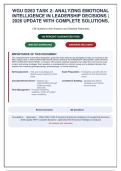
WGU D263 TASK 2: ANALYZING EMOTIONAL
INTELLIGENCE IN LEADERSHIP DECISIONS |
2026 UPDATE WITH COMPLETE SOLUTIONS.
139 Questions with Answers and Detailed Rationales
100 PERCENT GUARANTEED PASS
INSTANT DOWNLOAD ANSWERS INCLUDED
IMPORTANCE OF THIS DOCUMENT
This comprehensive examination preparation guide has been meticulously developed to help you succeed in the
WGU D263 TASK 2: ANALYZING EMOTIONAL INTELLIGENCE IN LEADERSHIP DECISIONS | 2026 UPDATE
WITH COMPLETE SOLUTIONS.. It contains 139 carefully selected questions that reflect the most current exam
content and testing strategies. Each question is accompanied by a correct answer and a detailed rationale that
explains the underlying pathophysiology, pharmacology, or clinical reasoning.
Self-Assessment – Test your knowledge and Exam Preparation – Familiarize yourself with the
identify areas requiring further question format and content
study areas
Concept Reinforcement – Deepen your Confidence Building – Develop test-taking
understanding through strategies and reduce
evidence-based exam anxiety
rationales
Time Management – Practice answering
questions under simulated
exam conditions
Review Summary 139 Questions
Foundations - Application - WGU D263 TASK 2 Analyzing Emotional Intelligence IN Leadership Decisions
2026 Update WITH Complete Solutions Leadership AND Emotional Intelligence Graduate
All answers with rationales
,Table of Contents
Content Area Questions Key Topics
Emotional Intelligence 1-24 Emotional, Leader, Intelligence, Manager, Decision
Frameworks AND
Competencies
Leadership Decision-making 25-48 Leader, Emotional, Intelligence, Decision, Manager
Models
Self-awareness AND 49-72 Leader, Emotional, Intelligence, Competency, Consistently
Self-regulation IN Leadership
Empathy AND Social Skills IN 73-96 Leader, Emotional, Intelligence, Approach, Decision
Leadership
Applying Emotional 97-120 Emotional, Leader, Intelligence, Framework, Effective
Intelligence TO Ethical
Dilemmas
CASE Study Analysis 121-139 Leader, Emotional, Intelligence, WGU D263, Model
Emotional Intelligence IN
Leadership Decisions
TOTAL 139 All questions include answers and detailed rationales
,Section A - Emotional Intelligence Frameworks AND
Competencies
Q1.
In a high-stakes merger negotiation, the CEO notices her own anxiety escalating but
refrains from making a concession until she can articulate the specific trigger. This action
best exemplifies which component of the ability model of EI?
A. Emotion regulation B. Emotion perception
C. Emotion understanding D. Emotion facilitation of thought
Correct: A - Emotion regulation
Rationale:The CEO is managing her emotional state (regulation) by pausing and identifying
the trigger, which is a regulatory strategy. Perception is initial recognition, understanding is
comprehension of causes, and facilitation is using emotions to enhance cognition-none
directly involve modifying the emotional response.
Q2.
A longitudinal study finds that leaders with high EI scores on the MSCEIT are rated as
more transformational by subordinates, but this correlation disappears when controlled
for cognitive ability and personality. Which conclusion is most justified?
A. EI is a spurious construct with no B. EI may not have incremental validity
predictive validity. beyond established predictors.
C. Transformational leadership is unrelated D. The MSCEIT is an invalid measure of EI.
to EI.
Correct: B - EI may not have incremental validity beyond established predictors.
Rationale:The finding indicates that EI does not explain variance beyond cognitive ability and
personality, questioning its incremental validity. It does not prove EI is spurious, as it may still
matter in other contexts, nor does it invalidate the measure or the leadership relationship
entirely.
Q3.
In the somatic marker hypothesis, a manager who 'feels' that a risky investment is
wrong-even before conscious analysis-is relying on which mechanism?
A. Emotional contagion from team members B. Biasing signals from the body that guide
decision-making
Page 3
, Section A - Emotional Intelligence Frameworks AND Competencies
C. Cognitive dissonance reduction D. Heuristic-based intuition devoid of
emotion
Correct: B - Biasing signals from the body that guide decision-making
Rationale:The somatic marker hypothesis posits that bodily (somatic) signals, often from past
emotional experiences, bias decision-making. This is not mere contagion, dissonance, or
purely cognitive heuristics; it is the integration of emotional signals into the decision process.
Q4.
A leader consistently uses emotional displays to motivate her team, but her expressions
are perceived as inauthentic. According to the theory of emotional labor, this discrepancy
is likely to result in:
A. Increased emotional dissonance and B. Enhanced team performance due to
burnout for the leader display rules
C. Reduced need for emotional regulation D. Higher EI scores on self-report measures
Correct: A - Increased emotional dissonance and burnout for the leader
Rationale:Inauthentic emotional displays create emotional dissonance, which is linked to
burnout and strain. While display rules may exist, the negative effect on the leader is the key
outcome. Performance and EI scores are not directly enhanced by inauthenticity.
Q5.
In a cross-cultural team, a manager from a high-context culture interprets silence during a
negotiation as agreement, while a colleague from a low-context culture sees it as
disagreement. This miscommunication primarily illustrates the role of EI in:
A. Emotion perception accuracy across B. Emotion regulation in intercultural
cultural display rules settings
C. Using emotions to facilitate thought D. Understanding the causes and
consequences of emotions
Correct: A - Emotion perception accuracy across cultural display rules
Rationale:The scenario highlights differences in reading emotional cues (silence) across
cultures, which is a matter of emotion perception accuracy. Regulation, facilitation, and
understanding are less directly implicated, as the core issue is perceiving the emotional
meaning of a behavior.
Q6.
Which of the following best describes a leader's use of 'emotional aperture'?
Page 4
INTELLIGENCE IN LEADERSHIP DECISIONS |
2026 UPDATE WITH COMPLETE SOLUTIONS.
139 Questions with Answers and Detailed Rationales
100 PERCENT GUARANTEED PASS
INSTANT DOWNLOAD ANSWERS INCLUDED
IMPORTANCE OF THIS DOCUMENT
This comprehensive examination preparation guide has been meticulously developed to help you succeed in the
WGU D263 TASK 2: ANALYZING EMOTIONAL INTELLIGENCE IN LEADERSHIP DECISIONS | 2026 UPDATE
WITH COMPLETE SOLUTIONS.. It contains 139 carefully selected questions that reflect the most current exam
content and testing strategies. Each question is accompanied by a correct answer and a detailed rationale that
explains the underlying pathophysiology, pharmacology, or clinical reasoning.
Self-Assessment – Test your knowledge and Exam Preparation – Familiarize yourself with the
identify areas requiring further question format and content
study areas
Concept Reinforcement – Deepen your Confidence Building – Develop test-taking
understanding through strategies and reduce
evidence-based exam anxiety
rationales
Time Management – Practice answering
questions under simulated
exam conditions
Review Summary 139 Questions
Foundations - Application - WGU D263 TASK 2 Analyzing Emotional Intelligence IN Leadership Decisions
2026 Update WITH Complete Solutions Leadership AND Emotional Intelligence Graduate
All answers with rationales
,Table of Contents
Content Area Questions Key Topics
Emotional Intelligence 1-24 Emotional, Leader, Intelligence, Manager, Decision
Frameworks AND
Competencies
Leadership Decision-making 25-48 Leader, Emotional, Intelligence, Decision, Manager
Models
Self-awareness AND 49-72 Leader, Emotional, Intelligence, Competency, Consistently
Self-regulation IN Leadership
Empathy AND Social Skills IN 73-96 Leader, Emotional, Intelligence, Approach, Decision
Leadership
Applying Emotional 97-120 Emotional, Leader, Intelligence, Framework, Effective
Intelligence TO Ethical
Dilemmas
CASE Study Analysis 121-139 Leader, Emotional, Intelligence, WGU D263, Model
Emotional Intelligence IN
Leadership Decisions
TOTAL 139 All questions include answers and detailed rationales
,Section A - Emotional Intelligence Frameworks AND
Competencies
Q1.
In a high-stakes merger negotiation, the CEO notices her own anxiety escalating but
refrains from making a concession until she can articulate the specific trigger. This action
best exemplifies which component of the ability model of EI?
A. Emotion regulation B. Emotion perception
C. Emotion understanding D. Emotion facilitation of thought
Correct: A - Emotion regulation
Rationale:The CEO is managing her emotional state (regulation) by pausing and identifying
the trigger, which is a regulatory strategy. Perception is initial recognition, understanding is
comprehension of causes, and facilitation is using emotions to enhance cognition-none
directly involve modifying the emotional response.
Q2.
A longitudinal study finds that leaders with high EI scores on the MSCEIT are rated as
more transformational by subordinates, but this correlation disappears when controlled
for cognitive ability and personality. Which conclusion is most justified?
A. EI is a spurious construct with no B. EI may not have incremental validity
predictive validity. beyond established predictors.
C. Transformational leadership is unrelated D. The MSCEIT is an invalid measure of EI.
to EI.
Correct: B - EI may not have incremental validity beyond established predictors.
Rationale:The finding indicates that EI does not explain variance beyond cognitive ability and
personality, questioning its incremental validity. It does not prove EI is spurious, as it may still
matter in other contexts, nor does it invalidate the measure or the leadership relationship
entirely.
Q3.
In the somatic marker hypothesis, a manager who 'feels' that a risky investment is
wrong-even before conscious analysis-is relying on which mechanism?
A. Emotional contagion from team members B. Biasing signals from the body that guide
decision-making
Page 3
, Section A - Emotional Intelligence Frameworks AND Competencies
C. Cognitive dissonance reduction D. Heuristic-based intuition devoid of
emotion
Correct: B - Biasing signals from the body that guide decision-making
Rationale:The somatic marker hypothesis posits that bodily (somatic) signals, often from past
emotional experiences, bias decision-making. This is not mere contagion, dissonance, or
purely cognitive heuristics; it is the integration of emotional signals into the decision process.
Q4.
A leader consistently uses emotional displays to motivate her team, but her expressions
are perceived as inauthentic. According to the theory of emotional labor, this discrepancy
is likely to result in:
A. Increased emotional dissonance and B. Enhanced team performance due to
burnout for the leader display rules
C. Reduced need for emotional regulation D. Higher EI scores on self-report measures
Correct: A - Increased emotional dissonance and burnout for the leader
Rationale:Inauthentic emotional displays create emotional dissonance, which is linked to
burnout and strain. While display rules may exist, the negative effect on the leader is the key
outcome. Performance and EI scores are not directly enhanced by inauthenticity.
Q5.
In a cross-cultural team, a manager from a high-context culture interprets silence during a
negotiation as agreement, while a colleague from a low-context culture sees it as
disagreement. This miscommunication primarily illustrates the role of EI in:
A. Emotion perception accuracy across B. Emotion regulation in intercultural
cultural display rules settings
C. Using emotions to facilitate thought D. Understanding the causes and
consequences of emotions
Correct: A - Emotion perception accuracy across cultural display rules
Rationale:The scenario highlights differences in reading emotional cues (silence) across
cultures, which is a matter of emotion perception accuracy. Regulation, facilitation, and
understanding are less directly implicated, as the core issue is perceiving the emotional
meaning of a behavior.
Q6.
Which of the following best describes a leader's use of 'emotional aperture'?
Page 4