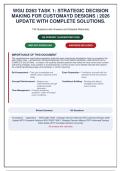
WGU D263 TASK 1: STRATEGIC DECISION
MAKING FOR CUSTOMAYD DESIGNS | 2026
UPDATE WITH COMPLETE SOLUTIONS.
130 Questions with Answers and Detailed Rationales
100 PERCENT GUARANTEED PASS
INSTANT DOWNLOAD ANSWERS INCLUDED
IMPORTANCE OF THIS DOCUMENT
This comprehensive examination preparation guide has been meticulously developed to help you succeed in the
WGU D263 TASK 1: STRATEGIC DECISION MAKING FOR CUSTOMAYD DESIGNS | 2026 UPDATE WITH
COMPLETE SOLUTIONS.. It contains 130 carefully selected questions that reflect the most current exam content
and testing strategies. Each question is accompanied by a correct answer and a detailed rationale that explains
the underlying pathophysiology, pharmacology, or clinical reasoning.
Self-Assessment – Test your knowledge and Exam Preparation – Familiarize yourself with the
identify areas requiring further question format and content
study areas
Concept Reinforcement – Deepen your Confidence Building – Develop test-taking
understanding through strategies and reduce
evidence-based exam anxiety
rationales
Time Management – Practice answering
questions under simulated
exam conditions
Review Summary 130 Questions
Foundations - Application - WGU D263 TASK 1 Strategic Decision Making FOR Customayd Designs 2026
Update WITH Complete Solutions WGU D263 TASK 1 Strategic Decision Making FOR Customayd Designs
2026 Update WITH Complete Solutions University
All answers with rationales
,Table of Contents
Content Area Questions Key Topics
Strategic Decision Making 1-22 Customayd, Strategic, Designs, Considering, Strategy
AND Business Strategy
DATA Analysis AND Decision 23-44 Customayd Designs, Value, Considering, Strategic, Project
Support Tools
Customer Relationship 45-66 Customayd, Designs, Strategic, Considering, Market
Management CRM AND
Customer Segmentation
Market Analysis AND 67-88 Customayd, Designs, Strategic, Considering, Framework
Competitive Intelligence
Financial Analysis AND 89-110 Customayd, Strategic, Strategy, Designs, Decision
Cost-benefit Assessment
RISK Management AND 111-130 Customayd, Designs, Strategic, Decision, Supplier
Mitigation Strategies
TOTAL 130 All questions include answers and detailed rationales
,Section A - Strategic Decision Making AND Business
Strategy
Q1.
In the context of CustoMayD Designs' strategic decision-making framework, which
decision-making model is most appropriate when the organization faces high ambiguity,
conflicting objectives, and shifting stakeholder requirements?
A. Rational decision-making model B. Bounded rationality model
C. Garbage can model D. Intuitive decision-making model
Correct: C - Garbage can model
Rationale:The garbage can model is best suited for highly ambiguous, turbulent
environments where problems, solutions, and decision-makers are fluid. Rational model
assumes clear objectives; bounded rationality still requires stable preferences; intuitive model
relies on pattern recognition, not ambiguity.
Q2.
CustoMayD Designs is evaluating two mutually exclusive projects. Project A has a net
present value (NPV) of $1.2 million and an internal rate of return (IRR) of 18%. Project B
has an NPV of $1.5 million and an IRR of 15%. The firm's cost of capital is 12%. Which
project should be selected and why?
A. Project A because higher IRR indicates B. Project B because higher NPV adds more
better return on invested capital. absolute value to the firm.
C. Project A because IRR exceeds cost of D. Project B because NPV and IRR conflict,
capital by a larger margin. and NPV is preferred for mutually exclusive
projects.
Correct: D - Project B because NPV and IRR conflict, and NPV is preferred for mutually
exclusive projects.
Rationale:For mutually exclusive projects, NPV is the theoretically correct criterion because it
measures absolute wealth creation, assuming reinvestment at the cost of capital. IRR can be
misleading due to scale and reinvestment assumptions. Therefore, Project B with higher NPV
is selected.
Q3.
CustoMayD Designs is considering entering a new market. The management team uses
scenario analysis to evaluate the decision. Which statement best captures the primary
advantage of scenario analysis over sensitivity analysis in strategic decision-making?
Page 3
, Section A - Strategic Decision Making AND Business Strategy
A. Scenario analysis identifies the single B. Scenario analysis examines the impact of
most critical variable affecting the outcome. changing one variable at a time.
C. Scenario analysis considers the joint D. Scenario analysis provides a probability
impact of multiple variables changing distribution of all possible outcomes.
simultaneously.
Correct: C - Scenario analysis considers the joint impact of multiple variables changing
simultaneously.
Rationale:Scenario analysis evaluates the effect of different combinations of variables,
providing a holistic view of possible futures. Sensitivity analysis changes one variable at a
time, ignoring interactions. Monte Carlo simulation, not scenario analysis, provides probability
distributions.
Q4.
CustoMayD Designs uses a balanced scorecard. Which of the following performance
measures would be classified under the 'learning and growth' perspective?
A. Percentage of revenue from new B. Employee turnover rate
products
C. On-time delivery rate D. Customer satisfaction index
Correct: B - Employee turnover rate
Rationale:The learning and growth perspective focuses on employee capabilities, information
systems, and organizational climate. Employee turnover rate is a key metric. Revenue from
new products is innovation-related (internal process or financial), on-time delivery is internal
process, and customer satisfaction is customer perspective.
Q5.
CustoMayD Designs is considering a strategic alliance with a supplier. Which of the
following is a key characteristic of a strategic alliance that distinguishes it from a joint
venture?
A. It requires the creation of a separate legal B. It involves shared ownership and control.
entity.
C. It does not necessarily involve equity D. It is limited to a single project with
sharing. defined duration.
Correct: C - It does not necessarily involve equity sharing.
Page 4
MAKING FOR CUSTOMAYD DESIGNS | 2026
UPDATE WITH COMPLETE SOLUTIONS.
130 Questions with Answers and Detailed Rationales
100 PERCENT GUARANTEED PASS
INSTANT DOWNLOAD ANSWERS INCLUDED
IMPORTANCE OF THIS DOCUMENT
This comprehensive examination preparation guide has been meticulously developed to help you succeed in the
WGU D263 TASK 1: STRATEGIC DECISION MAKING FOR CUSTOMAYD DESIGNS | 2026 UPDATE WITH
COMPLETE SOLUTIONS.. It contains 130 carefully selected questions that reflect the most current exam content
and testing strategies. Each question is accompanied by a correct answer and a detailed rationale that explains
the underlying pathophysiology, pharmacology, or clinical reasoning.
Self-Assessment – Test your knowledge and Exam Preparation – Familiarize yourself with the
identify areas requiring further question format and content
study areas
Concept Reinforcement – Deepen your Confidence Building – Develop test-taking
understanding through strategies and reduce
evidence-based exam anxiety
rationales
Time Management – Practice answering
questions under simulated
exam conditions
Review Summary 130 Questions
Foundations - Application - WGU D263 TASK 1 Strategic Decision Making FOR Customayd Designs 2026
Update WITH Complete Solutions WGU D263 TASK 1 Strategic Decision Making FOR Customayd Designs
2026 Update WITH Complete Solutions University
All answers with rationales
,Table of Contents
Content Area Questions Key Topics
Strategic Decision Making 1-22 Customayd, Strategic, Designs, Considering, Strategy
AND Business Strategy
DATA Analysis AND Decision 23-44 Customayd Designs, Value, Considering, Strategic, Project
Support Tools
Customer Relationship 45-66 Customayd, Designs, Strategic, Considering, Market
Management CRM AND
Customer Segmentation
Market Analysis AND 67-88 Customayd, Designs, Strategic, Considering, Framework
Competitive Intelligence
Financial Analysis AND 89-110 Customayd, Strategic, Strategy, Designs, Decision
Cost-benefit Assessment
RISK Management AND 111-130 Customayd, Designs, Strategic, Decision, Supplier
Mitigation Strategies
TOTAL 130 All questions include answers and detailed rationales
,Section A - Strategic Decision Making AND Business
Strategy
Q1.
In the context of CustoMayD Designs' strategic decision-making framework, which
decision-making model is most appropriate when the organization faces high ambiguity,
conflicting objectives, and shifting stakeholder requirements?
A. Rational decision-making model B. Bounded rationality model
C. Garbage can model D. Intuitive decision-making model
Correct: C - Garbage can model
Rationale:The garbage can model is best suited for highly ambiguous, turbulent
environments where problems, solutions, and decision-makers are fluid. Rational model
assumes clear objectives; bounded rationality still requires stable preferences; intuitive model
relies on pattern recognition, not ambiguity.
Q2.
CustoMayD Designs is evaluating two mutually exclusive projects. Project A has a net
present value (NPV) of $1.2 million and an internal rate of return (IRR) of 18%. Project B
has an NPV of $1.5 million and an IRR of 15%. The firm's cost of capital is 12%. Which
project should be selected and why?
A. Project A because higher IRR indicates B. Project B because higher NPV adds more
better return on invested capital. absolute value to the firm.
C. Project A because IRR exceeds cost of D. Project B because NPV and IRR conflict,
capital by a larger margin. and NPV is preferred for mutually exclusive
projects.
Correct: D - Project B because NPV and IRR conflict, and NPV is preferred for mutually
exclusive projects.
Rationale:For mutually exclusive projects, NPV is the theoretically correct criterion because it
measures absolute wealth creation, assuming reinvestment at the cost of capital. IRR can be
misleading due to scale and reinvestment assumptions. Therefore, Project B with higher NPV
is selected.
Q3.
CustoMayD Designs is considering entering a new market. The management team uses
scenario analysis to evaluate the decision. Which statement best captures the primary
advantage of scenario analysis over sensitivity analysis in strategic decision-making?
Page 3
, Section A - Strategic Decision Making AND Business Strategy
A. Scenario analysis identifies the single B. Scenario analysis examines the impact of
most critical variable affecting the outcome. changing one variable at a time.
C. Scenario analysis considers the joint D. Scenario analysis provides a probability
impact of multiple variables changing distribution of all possible outcomes.
simultaneously.
Correct: C - Scenario analysis considers the joint impact of multiple variables changing
simultaneously.
Rationale:Scenario analysis evaluates the effect of different combinations of variables,
providing a holistic view of possible futures. Sensitivity analysis changes one variable at a
time, ignoring interactions. Monte Carlo simulation, not scenario analysis, provides probability
distributions.
Q4.
CustoMayD Designs uses a balanced scorecard. Which of the following performance
measures would be classified under the 'learning and growth' perspective?
A. Percentage of revenue from new B. Employee turnover rate
products
C. On-time delivery rate D. Customer satisfaction index
Correct: B - Employee turnover rate
Rationale:The learning and growth perspective focuses on employee capabilities, information
systems, and organizational climate. Employee turnover rate is a key metric. Revenue from
new products is innovation-related (internal process or financial), on-time delivery is internal
process, and customer satisfaction is customer perspective.
Q5.
CustoMayD Designs is considering a strategic alliance with a supplier. Which of the
following is a key characteristic of a strategic alliance that distinguishes it from a joint
venture?
A. It requires the creation of a separate legal B. It involves shared ownership and control.
entity.
C. It does not necessarily involve equity D. It is limited to a single project with
sharing. defined duration.
Correct: C - It does not necessarily involve equity sharing.
Page 4