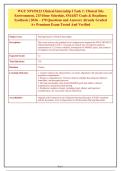
WGU NP1/D122 Clinical Internship I Task 1: Clinical Site
Environment, 215-Hour Schedule, SMART Goals & Readiness
Synthesis | 2026. - 170 Questions and Answers Already Graded
A+ Premium Exam Tested And Verified
Subject Area Nursing Practice (Clinical Internship)
Description This exam assesses the graduate-level competencies required for WGU NP1/D122
Clinical Internship I Task 1, focusing on clinical site environment analysis,
construction of a 215-hour schedule, formulation of SMART goals, and synthesis
of readiness for advanced practice clinical placement.
Expected Grade A+
Total Questions 170
Duration 3 hours
Learning Outcomes 1. Analyze clinical site characteristics to ensure alignment with specialty track and
regulatory requirements.
2. Design a comprehensive 215-hour clinical schedule that integrates didactic,
simulation, and precepted practice.
3. Develop measurable, time-bound SMART goals that address clinical
competencies and professional growth.
4. Synthesize readiness factors, including legal, ethical, and logistical
considerations, for successful clinical immersion.
Accreditation Aligned with Commission on Collegiate Nursing Education (CCNE) standards
and the Essentials: Core Competencies for Professional Nursing Education.
Page 1
,1. During a clinical site evaluation, a graduate nursing student identifies that the
proposed preceptor holds an active license but has no prior experience supervising
advanced practice students. Which regulatory and accreditation standard should the
student prioritize when determining site acceptability?
A. The preceptor must have a minimum of five years of independent practice experience.
B. The preceptor must be in good standing and the site must provide access to a patient
population that supports the student's specialty competencies.
C. The site must be affiliated with a teaching hospital to qualify as a clinical placement.
D. The preceptor must hold a doctoral degree to supervise graduate nursing students.
Answer: B. The preceptor must be in good standing and the site must provide
access to a patient population that supports the student's specialty competencies.
Accreditation standards (e.g., CCNE) require that preceptors be appropriately
credentialed and that clinical sites provide learning experiences aligned with program
outcomes. While experience is valuable, the primary criteria are licensure, good
standing, and the ability to support required competencies. A teaching hospital
affiliation and doctoral degree are not universal requirements.
2. A student is constructing a 215-hour clinical schedule across a 14-week semester.
The program mandates that at least 40% of hours be completed in direct patient
care, and no more than 25% can be simulation. If the student plans 90 hours of
direct care and 40 hours of simulation, what is the maximum number of hours that
can be allocated to indirect learning activities?
A. 85 hours
B. 125 hours
C. 75 hours
D. 95 hours
Answer: A. 85 hours
Total hours = 215. Direct care = 90 (41.9%, meets 40% minimum). Simulation = 40
(18.6%, under 25% cap). Remaining = 215 - 90 - 40 = 85 hours. This is the maximum
for indirect activities because the direct care and simulation allocations are already set.
Page 2
,3. Which of the following best exemplifies a SMART goal for a clinical internship
focused on improving diagnostic reasoning skills?
A. By the end of the internship, I will enhance my ability to formulate differential diagnoses
for common conditions.
B. I will complete 50 patient encounters and achieve a 90% concordance rate with the
preceptor's final diagnosis over the 14-week period.
C. I will read one article per week about diagnostic reasoning and discuss it with my
preceptor.
D. I will become more confident in presenting cases to my preceptor.
Answer: B. I will complete 50 patient encounters and achieve a 90% concordance
rate with the preceptor's final diagnosis over the 14-week period.
Option B is specific (50 encounters, 90% concordance), measurable (concordance rate),
achievable, relevant (diagnostic reasoning), and time-bound (14 weeks). Other options
lack measurable outcomes or specific timelines.
4. When synthesizing readiness for clinical placement, a student discovers that the
clinical site requires proof of malpractice insurance and a background check. Which
of the following actions best demonstrates professional accountability and readiness?
A. Defer the requirements until after the first week of clinical to avoid delaying the start date.
B. Submit the necessary documentation to the appropriate institutional office and confirm
receipt before the deadline.
C. Ask the preceptor to sign a waiver acknowledging the missing documentation.
D. Contact the state board of nursing to request an exemption from the background check
requirement.
Answer: B. Submit the necessary documentation to the appropriate institutional
office and confirm receipt before the deadline.
Professional accountability involves proactively meeting all requirements. Submitting
documentation and confirming receipt ensures compliance. Delaying, seeking waivers,
or requesting exemptions undermines readiness and may violate site policies.
Page 3
, 5. A graduate nursing student is evaluating two potential clinical sites. Site A has a
high patient volume but preceptors frequently change shifts. Site B has lower volume
but consistent preceptor availability. According to best practices for clinical
education, which factor should carry the most weight in the final decision?
A. Higher patient volume ensures more diverse clinical experiences.
B. Consistent preceptor availability facilitates continuity of supervision and evaluation.
C. Lower volume allows more time for reflection and documentation.
D. Frequent preceptor changes expose the student to multiple practice styles.
Answer: B. Consistent preceptor availability facilitates continuity of supervision
and evaluation.
Continuity of preceptorship is critical for meaningful evaluation, progressive
responsibility, and the development of a trusting educational relationship. While
volume and variety are valuable, inconsistent preceptors can fragment learning and
complicate competency assessment.
6. In developing the 215-hour schedule, a student must integrate didactic
coursework, simulation, and clinical practice. Which scheduling strategy best
ensures that the student meets program requirements while optimizing learning?
A. Complete all didactic coursework before starting clinical hours to build a foundation.
B. Distribute clinical hours evenly across the semester with integrated simulation and
didactic sessions.
C. Front-load simulation hours to practice skills before any clinical exposure.
D. Cluster all clinical hours into the final weeks to maximize recent practice before
evaluation.
Answer: B. Distribute clinical hours evenly across the semester with integrated
simulation and didactic sessions.
Distributing hours evenly allows for iterative learning, application of didactic content,
and continuous feedback. Front-loading or clustering can lead to cognitive overload or
skill decay. Integration supports competency development and work-life balance.
Page 4
Environment, 215-Hour Schedule, SMART Goals & Readiness
Synthesis | 2026. - 170 Questions and Answers Already Graded
A+ Premium Exam Tested And Verified
Subject Area Nursing Practice (Clinical Internship)
Description This exam assesses the graduate-level competencies required for WGU NP1/D122
Clinical Internship I Task 1, focusing on clinical site environment analysis,
construction of a 215-hour schedule, formulation of SMART goals, and synthesis
of readiness for advanced practice clinical placement.
Expected Grade A+
Total Questions 170
Duration 3 hours
Learning Outcomes 1. Analyze clinical site characteristics to ensure alignment with specialty track and
regulatory requirements.
2. Design a comprehensive 215-hour clinical schedule that integrates didactic,
simulation, and precepted practice.
3. Develop measurable, time-bound SMART goals that address clinical
competencies and professional growth.
4. Synthesize readiness factors, including legal, ethical, and logistical
considerations, for successful clinical immersion.
Accreditation Aligned with Commission on Collegiate Nursing Education (CCNE) standards
and the Essentials: Core Competencies for Professional Nursing Education.
Page 1
,1. During a clinical site evaluation, a graduate nursing student identifies that the
proposed preceptor holds an active license but has no prior experience supervising
advanced practice students. Which regulatory and accreditation standard should the
student prioritize when determining site acceptability?
A. The preceptor must have a minimum of five years of independent practice experience.
B. The preceptor must be in good standing and the site must provide access to a patient
population that supports the student's specialty competencies.
C. The site must be affiliated with a teaching hospital to qualify as a clinical placement.
D. The preceptor must hold a doctoral degree to supervise graduate nursing students.
Answer: B. The preceptor must be in good standing and the site must provide
access to a patient population that supports the student's specialty competencies.
Accreditation standards (e.g., CCNE) require that preceptors be appropriately
credentialed and that clinical sites provide learning experiences aligned with program
outcomes. While experience is valuable, the primary criteria are licensure, good
standing, and the ability to support required competencies. A teaching hospital
affiliation and doctoral degree are not universal requirements.
2. A student is constructing a 215-hour clinical schedule across a 14-week semester.
The program mandates that at least 40% of hours be completed in direct patient
care, and no more than 25% can be simulation. If the student plans 90 hours of
direct care and 40 hours of simulation, what is the maximum number of hours that
can be allocated to indirect learning activities?
A. 85 hours
B. 125 hours
C. 75 hours
D. 95 hours
Answer: A. 85 hours
Total hours = 215. Direct care = 90 (41.9%, meets 40% minimum). Simulation = 40
(18.6%, under 25% cap). Remaining = 215 - 90 - 40 = 85 hours. This is the maximum
for indirect activities because the direct care and simulation allocations are already set.
Page 2
,3. Which of the following best exemplifies a SMART goal for a clinical internship
focused on improving diagnostic reasoning skills?
A. By the end of the internship, I will enhance my ability to formulate differential diagnoses
for common conditions.
B. I will complete 50 patient encounters and achieve a 90% concordance rate with the
preceptor's final diagnosis over the 14-week period.
C. I will read one article per week about diagnostic reasoning and discuss it with my
preceptor.
D. I will become more confident in presenting cases to my preceptor.
Answer: B. I will complete 50 patient encounters and achieve a 90% concordance
rate with the preceptor's final diagnosis over the 14-week period.
Option B is specific (50 encounters, 90% concordance), measurable (concordance rate),
achievable, relevant (diagnostic reasoning), and time-bound (14 weeks). Other options
lack measurable outcomes or specific timelines.
4. When synthesizing readiness for clinical placement, a student discovers that the
clinical site requires proof of malpractice insurance and a background check. Which
of the following actions best demonstrates professional accountability and readiness?
A. Defer the requirements until after the first week of clinical to avoid delaying the start date.
B. Submit the necessary documentation to the appropriate institutional office and confirm
receipt before the deadline.
C. Ask the preceptor to sign a waiver acknowledging the missing documentation.
D. Contact the state board of nursing to request an exemption from the background check
requirement.
Answer: B. Submit the necessary documentation to the appropriate institutional
office and confirm receipt before the deadline.
Professional accountability involves proactively meeting all requirements. Submitting
documentation and confirming receipt ensures compliance. Delaying, seeking waivers,
or requesting exemptions undermines readiness and may violate site policies.
Page 3
, 5. A graduate nursing student is evaluating two potential clinical sites. Site A has a
high patient volume but preceptors frequently change shifts. Site B has lower volume
but consistent preceptor availability. According to best practices for clinical
education, which factor should carry the most weight in the final decision?
A. Higher patient volume ensures more diverse clinical experiences.
B. Consistent preceptor availability facilitates continuity of supervision and evaluation.
C. Lower volume allows more time for reflection and documentation.
D. Frequent preceptor changes expose the student to multiple practice styles.
Answer: B. Consistent preceptor availability facilitates continuity of supervision
and evaluation.
Continuity of preceptorship is critical for meaningful evaluation, progressive
responsibility, and the development of a trusting educational relationship. While
volume and variety are valuable, inconsistent preceptors can fragment learning and
complicate competency assessment.
6. In developing the 215-hour schedule, a student must integrate didactic
coursework, simulation, and clinical practice. Which scheduling strategy best
ensures that the student meets program requirements while optimizing learning?
A. Complete all didactic coursework before starting clinical hours to build a foundation.
B. Distribute clinical hours evenly across the semester with integrated simulation and
didactic sessions.
C. Front-load simulation hours to practice skills before any clinical exposure.
D. Cluster all clinical hours into the final weeks to maximize recent practice before
evaluation.
Answer: B. Distribute clinical hours evenly across the semester with integrated
simulation and didactic sessions.
Distributing hours evenly allows for iterative learning, application of didactic content,
and continuous feedback. Front-loading or clustering can lead to cognitive overload or
skill decay. Integration supports competency development and work-life balance.
Page 4