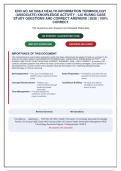
EHR GO AK1008.4 HEALTH INFORMATION TERMINOLOGY
(ASSOCIATE) KNOWLEDGE ACTIVITY - LIU HUANG CASE
STUDY QUESTIONS AND CORRECT ANSWERS | 2026 | 100%
CORRECT
190 Questions with Answers and Detailed Rationales
100 PERCENT GUARANTEED PASS
INSTANT DOWNLOAD ANSWERS INCLUDED
IMPORTANCE OF THIS DOCUMENT
This comprehensive examination preparation guide has been meticulously developed to help you succeed in the
EHR GO AK1008.4 HEALTH INFORMATION TERMINOLOGY (ASSOCIATE) KNOWLEDGE ACTIVITY - LIU
HUANG CASE STUDY QUESTIONS AND CORRECT ANSWERS | 2026 | 100% CORRECT. It contains 190
carefully selected questions that reflect the most current exam content and testing strategies. Each question is
accompanied by a correct answer and a detailed rationale that explains the underlying pathophysiology,
pharmacology, or clinical reasoning.
Self-Assessment – Test your knowledge and Exam Preparation – Familiarize yourself with the
identify areas requiring further question format and content
study areas
Concept Reinforcement – Deepen your Confidence Building – Develop test-taking
understanding through strategies and reduce
evidence-based exam anxiety
rationales
Time Management – Practice answering
questions under simulated
exam conditions
Review Summary 190 Questions
Foundations - Application - EHR GO Ak1008 4 Health Information Terminology Associate Knowledge
Activity LIU Huang CASE Study AND Correct 2026 100 Correct Health Information Management AND
Terminology Associate Degree / Undergraduate YEAR 2
All answers with rationales
,Table of Contents
Content Area Questions Key Topics
Health Information 1-32 LIU Huang, Medication, Huang CASE, Terminology, Patient S
Management AND
Governance
Clinical Terminologies AND 33-64 LIU Huang, Huang CASE, Huang S, CASE Study, Represents
Classification Systems
Icd-10-cm AND CPT Coding 65-96 LIU Huang, Huang CASE, Appropriate, Huang S, Medication
Snomed CT AND Loinc 97-128 LIU Huang, Huang CASE, Icd-10-cm, Health, Coder
DATA Quality AND Integrity 129-160 LIU Huang, Huang CASE, Coding, Clinical, Appropriate
Health DATA Standards AND 161-190 LIU Huang, Huang CASE, Diabetes, Icd-10-cm, Terminology
Interoperability
TOTAL 190 All questions include answers and detailed rationales
,Section A - Health Information Management AND
Governance
Q1.
In the Liu Huang case, which of the following best describes the primary purpose of using
standardized terminology in the EHR?
A. To ensure that all clinicians use the same B. To enable semantic interoperability and
language for documentation data aggregation across systems
C. To replace clinical judgment with D. To satisfy legal requirements for
automated coding malpractice defense
Correct: B - To enable semantic interoperability and data aggregation across systems
Rationale:Standardized terminologies like SNOMED CT and LOINC enable consistent
meaning and exchange of health data, which is essential for interoperability. While they also
support consistent documentation (A), their primary purpose in EHRs is to allow data to be
shared and interpreted across different systems. They do not replace clinical judgment (C)
nor exist solely for legal reasons (D).
Q2.
In the Liu Huang case, a patient is diagnosed with 'type 2 diabetes mellitus with diabetic
nephropathy.' Using ICD-10-CM, which code should be assigned?
A. E11.9 Type 2 diabetes mellitus without B. E11.21 Type 2 diabetes mellitus with
complications diabetic nephropathy
C. N08.3 Glomerular disorders in diseases D. E11.22 Type 2 diabetes mellitus with
classified elsewhere diabetic chronic kidney disease
Correct: B - E11.21 Type 2 diabetes mellitus with diabetic nephropathy
Rationale:ICD-10-CM combination codes capture both the diabetes and its manifestation.
E11.21 specifically codes type 2 diabetes with diabetic nephropathy. E11.9 is for
uncomplicated diabetes, N08.3 is a manifestation code that should not be used as the
primary diagnosis, and E11.22 is for diabetic chronic kidney disease, which is a different
condition.
Q3.
In the context of the Liu Huang case, which of the following is the most critical step to
ensure data quality when documenting a patient's problem list?
A. Using the same terminology as the billing B. Ensuring each problem is coded with the
department most specific concept available
Page 3
, Section A - Health Information Management AND Governance
C. Including only chronic conditions, not D. Using free-text entries to capture
acute ones nuances
Correct: B - Ensuring each problem is coded with the most specific concept available
Rationale:Data quality in problem lists requires specificity and standardization. Using the
most specific concept from a controlled vocabulary (e.g., SNOMED CT) ensures clarity and
interoperability. Billing terminology may differ, free-text reduces consistency, and excluding
acute conditions would make the list incomplete.
Q4.
When mapping a local term 'heart attack' to a standardized terminology, which of the
following represents the correct approach?
A. Map directly to the ICD-10-CM code I21.9 B. Use a terminology server to identify the
preferred SNOMED CT concept 'Myocardial
infarction'
C. Assign a local code and document the D. Ask the clinician to clarify the exact
mapping in a separate file medical term
Correct: B - Use a terminology server to identify the preferred SNOMED CT concept
'Myocardial infarction'
Rationale:Mapping should use a terminology server or reference mapping to identify the
appropriate standardized concept. Direct mapping to ICD-10-CM is not ideal because
SNOMED CT is the clinical terminology, while ICD-10-CM is for billing. Local codes without
mapping do not achieve interoperability. Asking the clinician is helpful but not the systematic
approach.
Q5.
In the Liu Huang case, a clinical note contains the phrase 'the patient's creatinine is
elevated at 2.5 mg/dL.' Which LOINC code would be most appropriate for this laboratory
result?
A. LOINC 2160-0: Creatinine [Mass/volume] B. LOINC 3094-0: Urea nitrogen
in Serum or Plasma [Mass/volume] in Serum or Plasma
C. LOINC 33959-8: Glomerular filtration D. LOINC 14682-9: Creatinine
rate/1.73 sq M.predicted among non-blacks [Moles/volume] in Serum or Plasma
Correct: A - LOINC 2160-0: Creatinine [Mass/volume] in Serum or Plasma
Rationale:LOINC 2160-0 is the standard code for serum creatinine in mass/volume units
(mg/dL). The other options are incorrect: 3094-0 is for urea nitrogen, 33959-8 is for eGFR,
and 14682-9 is for creatinine in moles/volume, which would be a different unit.
Page 4
(ASSOCIATE) KNOWLEDGE ACTIVITY - LIU HUANG CASE
STUDY QUESTIONS AND CORRECT ANSWERS | 2026 | 100%
CORRECT
190 Questions with Answers and Detailed Rationales
100 PERCENT GUARANTEED PASS
INSTANT DOWNLOAD ANSWERS INCLUDED
IMPORTANCE OF THIS DOCUMENT
This comprehensive examination preparation guide has been meticulously developed to help you succeed in the
EHR GO AK1008.4 HEALTH INFORMATION TERMINOLOGY (ASSOCIATE) KNOWLEDGE ACTIVITY - LIU
HUANG CASE STUDY QUESTIONS AND CORRECT ANSWERS | 2026 | 100% CORRECT. It contains 190
carefully selected questions that reflect the most current exam content and testing strategies. Each question is
accompanied by a correct answer and a detailed rationale that explains the underlying pathophysiology,
pharmacology, or clinical reasoning.
Self-Assessment – Test your knowledge and Exam Preparation – Familiarize yourself with the
identify areas requiring further question format and content
study areas
Concept Reinforcement – Deepen your Confidence Building – Develop test-taking
understanding through strategies and reduce
evidence-based exam anxiety
rationales
Time Management – Practice answering
questions under simulated
exam conditions
Review Summary 190 Questions
Foundations - Application - EHR GO Ak1008 4 Health Information Terminology Associate Knowledge
Activity LIU Huang CASE Study AND Correct 2026 100 Correct Health Information Management AND
Terminology Associate Degree / Undergraduate YEAR 2
All answers with rationales
,Table of Contents
Content Area Questions Key Topics
Health Information 1-32 LIU Huang, Medication, Huang CASE, Terminology, Patient S
Management AND
Governance
Clinical Terminologies AND 33-64 LIU Huang, Huang CASE, Huang S, CASE Study, Represents
Classification Systems
Icd-10-cm AND CPT Coding 65-96 LIU Huang, Huang CASE, Appropriate, Huang S, Medication
Snomed CT AND Loinc 97-128 LIU Huang, Huang CASE, Icd-10-cm, Health, Coder
DATA Quality AND Integrity 129-160 LIU Huang, Huang CASE, Coding, Clinical, Appropriate
Health DATA Standards AND 161-190 LIU Huang, Huang CASE, Diabetes, Icd-10-cm, Terminology
Interoperability
TOTAL 190 All questions include answers and detailed rationales
,Section A - Health Information Management AND
Governance
Q1.
In the Liu Huang case, which of the following best describes the primary purpose of using
standardized terminology in the EHR?
A. To ensure that all clinicians use the same B. To enable semantic interoperability and
language for documentation data aggregation across systems
C. To replace clinical judgment with D. To satisfy legal requirements for
automated coding malpractice defense
Correct: B - To enable semantic interoperability and data aggregation across systems
Rationale:Standardized terminologies like SNOMED CT and LOINC enable consistent
meaning and exchange of health data, which is essential for interoperability. While they also
support consistent documentation (A), their primary purpose in EHRs is to allow data to be
shared and interpreted across different systems. They do not replace clinical judgment (C)
nor exist solely for legal reasons (D).
Q2.
In the Liu Huang case, a patient is diagnosed with 'type 2 diabetes mellitus with diabetic
nephropathy.' Using ICD-10-CM, which code should be assigned?
A. E11.9 Type 2 diabetes mellitus without B. E11.21 Type 2 diabetes mellitus with
complications diabetic nephropathy
C. N08.3 Glomerular disorders in diseases D. E11.22 Type 2 diabetes mellitus with
classified elsewhere diabetic chronic kidney disease
Correct: B - E11.21 Type 2 diabetes mellitus with diabetic nephropathy
Rationale:ICD-10-CM combination codes capture both the diabetes and its manifestation.
E11.21 specifically codes type 2 diabetes with diabetic nephropathy. E11.9 is for
uncomplicated diabetes, N08.3 is a manifestation code that should not be used as the
primary diagnosis, and E11.22 is for diabetic chronic kidney disease, which is a different
condition.
Q3.
In the context of the Liu Huang case, which of the following is the most critical step to
ensure data quality when documenting a patient's problem list?
A. Using the same terminology as the billing B. Ensuring each problem is coded with the
department most specific concept available
Page 3
, Section A - Health Information Management AND Governance
C. Including only chronic conditions, not D. Using free-text entries to capture
acute ones nuances
Correct: B - Ensuring each problem is coded with the most specific concept available
Rationale:Data quality in problem lists requires specificity and standardization. Using the
most specific concept from a controlled vocabulary (e.g., SNOMED CT) ensures clarity and
interoperability. Billing terminology may differ, free-text reduces consistency, and excluding
acute conditions would make the list incomplete.
Q4.
When mapping a local term 'heart attack' to a standardized terminology, which of the
following represents the correct approach?
A. Map directly to the ICD-10-CM code I21.9 B. Use a terminology server to identify the
preferred SNOMED CT concept 'Myocardial
infarction'
C. Assign a local code and document the D. Ask the clinician to clarify the exact
mapping in a separate file medical term
Correct: B - Use a terminology server to identify the preferred SNOMED CT concept
'Myocardial infarction'
Rationale:Mapping should use a terminology server or reference mapping to identify the
appropriate standardized concept. Direct mapping to ICD-10-CM is not ideal because
SNOMED CT is the clinical terminology, while ICD-10-CM is for billing. Local codes without
mapping do not achieve interoperability. Asking the clinician is helpful but not the systematic
approach.
Q5.
In the Liu Huang case, a clinical note contains the phrase 'the patient's creatinine is
elevated at 2.5 mg/dL.' Which LOINC code would be most appropriate for this laboratory
result?
A. LOINC 2160-0: Creatinine [Mass/volume] B. LOINC 3094-0: Urea nitrogen
in Serum or Plasma [Mass/volume] in Serum or Plasma
C. LOINC 33959-8: Glomerular filtration D. LOINC 14682-9: Creatinine
rate/1.73 sq M.predicted among non-blacks [Moles/volume] in Serum or Plasma
Correct: A - LOINC 2160-0: Creatinine [Mass/volume] in Serum or Plasma
Rationale:LOINC 2160-0 is the standard code for serum creatinine in mass/volume units
(mg/dL). The other options are incorrect: 3094-0 is for urea nitrogen, 33959-8 is for eGFR,
and 14682-9 is for creatinine in moles/volume, which would be a different unit.
Page 4