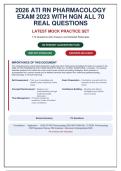
2026 ATI RN PHARMACOLOGY
EXAM 2023 WITH NGN ALL 70
REAL QUESTIONS
LATEST MOCK PRACTICE SET
174 Questions with Answers and Detailed Rationales
100 PERCENT GUARANTEED PASS
INSTANT DOWNLOAD ANSWERS INCLUDED
IMPORTANCE OF THIS DOCUMENT
This comprehensive examination preparation guide has been meticulously developed to help you succeed in the
2026 ATI RN PHARMACOLOGY EXAM 2023 WITH NGN ALL 70 REAL QUESTIONS. It contains 174 carefully
selected questions that reflect the most current exam content and testing strategies. Each question is
accompanied by a correct answer and a detailed rationale that explains the underlying pathophysiology,
pharmacology, or clinical reasoning.
Self-Assessment – Test your knowledge and Exam Preparation – Familiarize yourself with the
identify areas requiring further question format and content
study areas
Concept Reinforcement – Deepen your Confidence Building – Develop test-taking
understanding through strategies and reduce
evidence-based exam anxiety
rationales
Time Management – Practice answering
questions under simulated
exam conditions
Review Summary 174 Questions
Foundations - Application - 2026 ATI RN Pharmacology 2023 WITH NGN ALL 70 REAL Pharmacology
FOR Registered Nurses RN Graduate / Advanced Undergraduate BSN
All answers with rationales
,Table of Contents
Content Area Questions Key Topics
2026 ATI RN Pharmacology 1-29 Develops, Receiving, Appropriate, Infusion, Prescribed
2023 WITH NGN ALL 70
REAL Pharmacology FOR
Registered Nurses RN
Graduate / Advanced
Undergraduate BSN
Prescribed 30-58 Develops, Monitoring, Explains, Digoxin, Medication
Appropriate 59-87 Prescribed, Medication, Requires, Effect, Receiving
Digoxin 88-116 Prescribed, Develops, Receiving, Requires, Warfarin
Requires 117-145 Medication, Phenytoin, Chronic, Digoxin, Prescribed
Receiving 146-174 Appropriate, Develops, Heart, Started, Mechanism
TOTAL 174 All questions include answers and detailed rationales
,Section A - 2026 ATI RN Pharmacology 2023 WITH NGN
ALL 70 REAL Pharmacology FOR Registered Nurses RN
Graduate / Advanced Undergraduate BSN
Q1.
A patient on long-term phenytoin (Dilantin) for seizure control develops new-onset
gingival hyperplasia and mild ataxia. The provider orders a free phenytoin level, which
returns 1.8 mcg/mL (therapeutic total 10-20 mcg/mL). The patient's albumin is 2.2 g/dL
(normal 3.5-5.0). Which interpretation is correct?
A. The patient is subtherapeutic; the total B. The patient is toxic; the free level is
level is low despite the free level being elevated due to hypoalbuminemia, despite
normal. low total level.
C. The patient is therapeutic; the free level D. The patient is subtherapeutic; the free
is within normal range for phenytoin. level is low and requires a loading dose.
Correct: B - The patient is toxic; the free level is elevated due to hypoalbuminemia, despite
low total level.
Rationale:Phenytoin is highly protein-bound (90%). With hypoalbuminemia, more free
(active) drug is present, so a low total level can coexist with a therapeutic or toxic free level. A
free level of 1.8 mcg/mL is above the typical therapeutic free range (1-2 mcg/mL), indicating
toxicity, which explains the ataxia and gingival hyperplasia. Options A, C, and D misinterpret
the free level or the impact of albumin.
Q2.
A patient with a severe gram-negative infection is receiving gentamicin. The pharmacist
calculates an adjusted body weight and recommends a dose of 7 mg/kg/day. The patient's
serum creatinine is 1.8 mg/dL (baseline 0.9). Which of the following actions is most
appropriate regarding the prescribing of gentamicin?
A. Administer the full dose as ordered, as B. Hold the dose and request a renal
the dose is within standard range. function assessment and possible dose
adjustment.
C. Administer the dose but extend the D. Substitute with tobramycin, as it is less
interval to every 24 hours. nephrotoxic.
Correct: B - Hold the dose and request a renal function assessment and possible dose
adjustment.
Page 3
, Section A - 2026 ATI RN Pharmacology 2023 WITH NGN ALL 70 REAL Pharmacology FOR Registered Nurses RN Graduate / Advanced
Undergraduate BSN
Rationale: Gentamicin is renally eliminated and nephrotoxic. Elevated serum creatinine
indicates renal impairment, requiring dose adjustment or extended interval. Administering the
full dose risks further renal injury. Extending the interval alone without dose adjustment is
insufficient. Tobramycin has similar nephrotoxicity and is not a safer substitute.
Q3.
A patient is receiving a continuous infusion of norepinephrine for septic shock. The nurse
notes the infusion site is pale, cold, and the patient reports severe pain. What is the
priority nursing intervention?
A. Slow the infusion rate and re-assess in B. Stop the infusion immediately and notify
15 minutes. the provider.
C. Apply a warm compress to the site to D. Elevate the extremity to reduce swelling.
improve circulation.
Correct: B - Stop the infusion immediately and notify the provider.
Rationale:Extravasation of a potent vasoconstrictor like norepinephrine can cause tissue
ischemia and necrosis. The priority is to stop the infusion immediately to limit tissue damage.
Slowing the infusion or applying heat would not prevent necrosis. Elevation is not indicated;
the provider should be notified for possible antidote administration (phentolamine).
Q4.
A patient with type 2 diabetes and chronic kidney disease (eGFR 25 mL/min) is prescribed
metformin. Which of the following best explains why this prescription is problematic?
A. Metformin is contraindicated because it B. Metformin is safe but requires dose
increases the risk of lactic acidosis in renal reduction to 500 mg daily.
impairment.
C. Metformin should be avoided because it D. Metformin is contraindicated because it is
causes hypoglycemia in renal impairment. nephrotoxic and will worsen renal function.
Correct: A - Metformin is contraindicated because it increases the risk of lactic acidosis in
renal impairment.
Rationale:Metformin is contraindicated when eGFR is below 30 mL/min due to increased risk
of lactic acidosis, a rare but fatal complication. It is not nephrotoxic itself, but renal impairment
reduces clearance, increasing drug accumulation. Dose reduction is not sufficient at this level
of renal function. Hypoglycemia is not the primary concern with metformin monotherapy.
Q5.
A patient is receiving alteplase for acute ischemic stroke. Which of the following findings
would require immediate discontinuation of the infusion?
Page 4
EXAM 2023 WITH NGN ALL 70
REAL QUESTIONS
LATEST MOCK PRACTICE SET
174 Questions with Answers and Detailed Rationales
100 PERCENT GUARANTEED PASS
INSTANT DOWNLOAD ANSWERS INCLUDED
IMPORTANCE OF THIS DOCUMENT
This comprehensive examination preparation guide has been meticulously developed to help you succeed in the
2026 ATI RN PHARMACOLOGY EXAM 2023 WITH NGN ALL 70 REAL QUESTIONS. It contains 174 carefully
selected questions that reflect the most current exam content and testing strategies. Each question is
accompanied by a correct answer and a detailed rationale that explains the underlying pathophysiology,
pharmacology, or clinical reasoning.
Self-Assessment – Test your knowledge and Exam Preparation – Familiarize yourself with the
identify areas requiring further question format and content
study areas
Concept Reinforcement – Deepen your Confidence Building – Develop test-taking
understanding through strategies and reduce
evidence-based exam anxiety
rationales
Time Management – Practice answering
questions under simulated
exam conditions
Review Summary 174 Questions
Foundations - Application - 2026 ATI RN Pharmacology 2023 WITH NGN ALL 70 REAL Pharmacology
FOR Registered Nurses RN Graduate / Advanced Undergraduate BSN
All answers with rationales
,Table of Contents
Content Area Questions Key Topics
2026 ATI RN Pharmacology 1-29 Develops, Receiving, Appropriate, Infusion, Prescribed
2023 WITH NGN ALL 70
REAL Pharmacology FOR
Registered Nurses RN
Graduate / Advanced
Undergraduate BSN
Prescribed 30-58 Develops, Monitoring, Explains, Digoxin, Medication
Appropriate 59-87 Prescribed, Medication, Requires, Effect, Receiving
Digoxin 88-116 Prescribed, Develops, Receiving, Requires, Warfarin
Requires 117-145 Medication, Phenytoin, Chronic, Digoxin, Prescribed
Receiving 146-174 Appropriate, Develops, Heart, Started, Mechanism
TOTAL 174 All questions include answers and detailed rationales
,Section A - 2026 ATI RN Pharmacology 2023 WITH NGN
ALL 70 REAL Pharmacology FOR Registered Nurses RN
Graduate / Advanced Undergraduate BSN
Q1.
A patient on long-term phenytoin (Dilantin) for seizure control develops new-onset
gingival hyperplasia and mild ataxia. The provider orders a free phenytoin level, which
returns 1.8 mcg/mL (therapeutic total 10-20 mcg/mL). The patient's albumin is 2.2 g/dL
(normal 3.5-5.0). Which interpretation is correct?
A. The patient is subtherapeutic; the total B. The patient is toxic; the free level is
level is low despite the free level being elevated due to hypoalbuminemia, despite
normal. low total level.
C. The patient is therapeutic; the free level D. The patient is subtherapeutic; the free
is within normal range for phenytoin. level is low and requires a loading dose.
Correct: B - The patient is toxic; the free level is elevated due to hypoalbuminemia, despite
low total level.
Rationale:Phenytoin is highly protein-bound (90%). With hypoalbuminemia, more free
(active) drug is present, so a low total level can coexist with a therapeutic or toxic free level. A
free level of 1.8 mcg/mL is above the typical therapeutic free range (1-2 mcg/mL), indicating
toxicity, which explains the ataxia and gingival hyperplasia. Options A, C, and D misinterpret
the free level or the impact of albumin.
Q2.
A patient with a severe gram-negative infection is receiving gentamicin. The pharmacist
calculates an adjusted body weight and recommends a dose of 7 mg/kg/day. The patient's
serum creatinine is 1.8 mg/dL (baseline 0.9). Which of the following actions is most
appropriate regarding the prescribing of gentamicin?
A. Administer the full dose as ordered, as B. Hold the dose and request a renal
the dose is within standard range. function assessment and possible dose
adjustment.
C. Administer the dose but extend the D. Substitute with tobramycin, as it is less
interval to every 24 hours. nephrotoxic.
Correct: B - Hold the dose and request a renal function assessment and possible dose
adjustment.
Page 3
, Section A - 2026 ATI RN Pharmacology 2023 WITH NGN ALL 70 REAL Pharmacology FOR Registered Nurses RN Graduate / Advanced
Undergraduate BSN
Rationale: Gentamicin is renally eliminated and nephrotoxic. Elevated serum creatinine
indicates renal impairment, requiring dose adjustment or extended interval. Administering the
full dose risks further renal injury. Extending the interval alone without dose adjustment is
insufficient. Tobramycin has similar nephrotoxicity and is not a safer substitute.
Q3.
A patient is receiving a continuous infusion of norepinephrine for septic shock. The nurse
notes the infusion site is pale, cold, and the patient reports severe pain. What is the
priority nursing intervention?
A. Slow the infusion rate and re-assess in B. Stop the infusion immediately and notify
15 minutes. the provider.
C. Apply a warm compress to the site to D. Elevate the extremity to reduce swelling.
improve circulation.
Correct: B - Stop the infusion immediately and notify the provider.
Rationale:Extravasation of a potent vasoconstrictor like norepinephrine can cause tissue
ischemia and necrosis. The priority is to stop the infusion immediately to limit tissue damage.
Slowing the infusion or applying heat would not prevent necrosis. Elevation is not indicated;
the provider should be notified for possible antidote administration (phentolamine).
Q4.
A patient with type 2 diabetes and chronic kidney disease (eGFR 25 mL/min) is prescribed
metformin. Which of the following best explains why this prescription is problematic?
A. Metformin is contraindicated because it B. Metformin is safe but requires dose
increases the risk of lactic acidosis in renal reduction to 500 mg daily.
impairment.
C. Metformin should be avoided because it D. Metformin is contraindicated because it is
causes hypoglycemia in renal impairment. nephrotoxic and will worsen renal function.
Correct: A - Metformin is contraindicated because it increases the risk of lactic acidosis in
renal impairment.
Rationale:Metformin is contraindicated when eGFR is below 30 mL/min due to increased risk
of lactic acidosis, a rare but fatal complication. It is not nephrotoxic itself, but renal impairment
reduces clearance, increasing drug accumulation. Dose reduction is not sufficient at this level
of renal function. Hypoglycemia is not the primary concern with metformin monotherapy.
Q5.
A patient is receiving alteplase for acute ischemic stroke. Which of the following findings
would require immediate discontinuation of the infusion?
Page 4