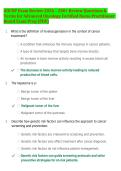
AOCNP Exam Review 2026 – 200+ Review Questions &
Terms for Advanced Oncology Certified Nurse Practitioner
Board Exam Prep (PDF)
1. What is the definition of myelosuppression in the context of cancer
treatment?
A condition that enhances the immune response in cancer patients.
A type of chemotherapy that targets bone marrow directly.
An increase in bone marrow activity resulting in excess blood cell
production.
The decrease in bone marrow activity leading to reduced
production of blood cells.
2. The hepatoma is a:
Benign tumor of the spleen
Benign tumor of the liver
Malignant tumor of the liver
Malignant tumor of the pancreas
3. Describe how genetic risk factors can influence the approach to cancer
screening and prevention.
Genetic risk factors are irrelevant to screening and prevention.
Genetic risk factors only affect treatment after cancer diagnosis.
Genetic risk factors do not influence patient management.
Genetic risk factors can guide screening protocols and tailor
preventive strategies for at-risk patients.
,4. Discuss how androgen therapy may contribute to the development of
hepatoma as a secondary malignancy.
Androgen therapy may promote liver cell proliferation, increasing
the risk of hepatoma.
Androgen therapy has no effect on liver cells.
Androgen therapy only affects muscle tissue.
Androgen therapy reduces the risk of all malignancies.
5. This has an 80% lifetime risk for development of colon cancers and increases
risk for other forms of cancer (80% for endometrial cancer)
familial andenomatous polyposis (FAP)
Li-fraumenti syndrome
HNPCC (lynch syndrome)
Cowden syndrome
6. What type of family history does the Claus model use to estimate breast
cancer risk?
Family history of heart disease.
Personal history of breast cancer only.
Family history of lung and colon cancer.
Family history of breast and ovarian cancer among first- and
second-degree relatives.
7. Which statement best describes the mechanism by which chemotherapy can
cure and increase survival time in individuals with cancer?
, Metastatic areas of cancer are difficult for chemotherapy to penetrate
effectively.
The killing effect on cancer cells is related to the ability to damage
DNA and interfere with cell division.
Fortunately, most chemotherapy agents have a special affinity for
cancer cells.
Slow-growing tumors are most sensitive to the DNA damage caused
by chemotherapy agents.
8. To diagnose dementia, most clinicians require that impairment be evident in
at least ___ of the functions associated with dementia (e.g., intellectual,
language, etc.).
1
2
3
4
5
9. In a scenario where a patient has a suspicious skin lesion, what would be the
rationale for choosing an incisional biopsy over a fine needle aspiration?
An incisional biopsy is less invasive than fine needle aspiration.
An incisional biopsy is quicker to perform than fine needle aspiration.
An incisional biopsy can be performed without anesthesia.
An incisional biopsy provides a larger tissue sample for a more
accurate diagnosis.
10. 247: What is a limitation of a PET scan?
, Difficult to evaluate certain diseases given some organs are
already metabolically active
Increased likelihood of false positives
Limited ability to assess blood flow in the organs
High sensitivity for detecting cancer
11. If a cancer patient has a CD4 count of 450/mm3, what preventive measures
should be considered to reduce the risk of opportunistic infections?
Delay all cancer treatments until the CD4 count improves.
Implement prophylactic treatments and closely monitor for
infections.
Advise the patient to avoid all medical care.
Increase the dosage of chemotherapy agents.
12. What type of therapy is identified as a potential etiologic factor for
hepatoma?
Androgen therapy
Radiation therapy
Chemotherapy
Immunotherapy
13. Which condition is a contraindication for performing a colonoscopy?
Irritable bowel syndrome
Acute diverticulitis
Mild abdominal pain
Chronic constipation
Terms for Advanced Oncology Certified Nurse Practitioner
Board Exam Prep (PDF)
1. What is the definition of myelosuppression in the context of cancer
treatment?
A condition that enhances the immune response in cancer patients.
A type of chemotherapy that targets bone marrow directly.
An increase in bone marrow activity resulting in excess blood cell
production.
The decrease in bone marrow activity leading to reduced
production of blood cells.
2. The hepatoma is a:
Benign tumor of the spleen
Benign tumor of the liver
Malignant tumor of the liver
Malignant tumor of the pancreas
3. Describe how genetic risk factors can influence the approach to cancer
screening and prevention.
Genetic risk factors are irrelevant to screening and prevention.
Genetic risk factors only affect treatment after cancer diagnosis.
Genetic risk factors do not influence patient management.
Genetic risk factors can guide screening protocols and tailor
preventive strategies for at-risk patients.
,4. Discuss how androgen therapy may contribute to the development of
hepatoma as a secondary malignancy.
Androgen therapy may promote liver cell proliferation, increasing
the risk of hepatoma.
Androgen therapy has no effect on liver cells.
Androgen therapy only affects muscle tissue.
Androgen therapy reduces the risk of all malignancies.
5. This has an 80% lifetime risk for development of colon cancers and increases
risk for other forms of cancer (80% for endometrial cancer)
familial andenomatous polyposis (FAP)
Li-fraumenti syndrome
HNPCC (lynch syndrome)
Cowden syndrome
6. What type of family history does the Claus model use to estimate breast
cancer risk?
Family history of heart disease.
Personal history of breast cancer only.
Family history of lung and colon cancer.
Family history of breast and ovarian cancer among first- and
second-degree relatives.
7. Which statement best describes the mechanism by which chemotherapy can
cure and increase survival time in individuals with cancer?
, Metastatic areas of cancer are difficult for chemotherapy to penetrate
effectively.
The killing effect on cancer cells is related to the ability to damage
DNA and interfere with cell division.
Fortunately, most chemotherapy agents have a special affinity for
cancer cells.
Slow-growing tumors are most sensitive to the DNA damage caused
by chemotherapy agents.
8. To diagnose dementia, most clinicians require that impairment be evident in
at least ___ of the functions associated with dementia (e.g., intellectual,
language, etc.).
1
2
3
4
5
9. In a scenario where a patient has a suspicious skin lesion, what would be the
rationale for choosing an incisional biopsy over a fine needle aspiration?
An incisional biopsy is less invasive than fine needle aspiration.
An incisional biopsy is quicker to perform than fine needle aspiration.
An incisional biopsy can be performed without anesthesia.
An incisional biopsy provides a larger tissue sample for a more
accurate diagnosis.
10. 247: What is a limitation of a PET scan?
, Difficult to evaluate certain diseases given some organs are
already metabolically active
Increased likelihood of false positives
Limited ability to assess blood flow in the organs
High sensitivity for detecting cancer
11. If a cancer patient has a CD4 count of 450/mm3, what preventive measures
should be considered to reduce the risk of opportunistic infections?
Delay all cancer treatments until the CD4 count improves.
Implement prophylactic treatments and closely monitor for
infections.
Advise the patient to avoid all medical care.
Increase the dosage of chemotherapy agents.
12. What type of therapy is identified as a potential etiologic factor for
hepatoma?
Androgen therapy
Radiation therapy
Chemotherapy
Immunotherapy
13. Which condition is a contraindication for performing a colonoscopy?
Irritable bowel syndrome
Acute diverticulitis
Mild abdominal pain
Chronic constipation