
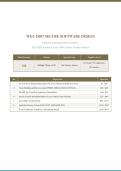
WGU D487 SECURE SOFTWARE DESIGN
Objective Assessment (OA) | Test Bank 2
2025-2026 Academic Year | 100% Correct Verified Answers
Total Questions Format Question Type Cognitive Level
25% Recall / 50% Application /
Multiple Choice (A-D) One Correct Answer
150 25% Analysis
Sec Topic Area Questions
1 Secure Software Design Fundamentals (CIA, IAAA, Defense-in-Depth, Zero Trust) Q1 - Q25
2 Threat Modeling and Risk Assessment (STRIDE, DREAD, PASTA, OCTAVE) Q26 - Q45
3 OWASP Top 10 and Web Application Vulnerabilities Q46 - Q70
4 Security Controls and Implementation (Access Control, Crypto, Sessions) Q71 - Q95
5 Secure SDLC and DevSecOps Q96 - Q115
6 Application Security Testing (SAST, DAST, IAST, RASP, SCA) Q116 - Q135
7 Secure Architecture, Compliance, and Emerging Threats Q136 - Q150
,WGU D487 Secure Software Design | OA Test Bank 2 | 2025-2026 150 Questions | Verified Answers
Q1: A financial application processes transactions with 256-bit AES encryption but adds 500ms of latency per
request. The security architect must reduce latency while maintaining compliance. Which principle best describes
this CIA Triad trade-off?
A. Maximize confidentiality at the cost of availability
B. Balance confidentiality and availability through performance optimization [CORRECT]
C. Prioritize integrity over both confidentiality and availability
D. Eliminate encryption to restore availability
Correct Answer: B
Rationale: The CIA Triad requires balancing confidentiality, integrity, and availability. Reducing encryption overhead while maintaining
compliance represents balancing confidentiality with availability, a common D487 scenario involving security-performance trade-offs.
Q2: An organization implements a system where users provide a username, then a password, then a fingerprint scan
before accessing classified data. Which IAAA component is the fingerprint scan primarily serving?
A. Identification
B. Authentication [CORRECT]
C. Authorization
D. Accountability
Correct Answer: B
Rationale: Authentication is the process of verifying a claimed identity. While the username provides identification and the fingerprint adds a
second authentication factor, the biometric scan itself is an authentication mechanism verifying the user is who they claim to be.
Q3: A security auditor discovers that a single database administrator can both create new user accounts and approve
their access permissions. Which security principle is being violated?
A. Least Privilege
B. Separation of Duties [CORRECT]
C. Defense-in-Depth
D. Fail-Safe Defaults
Correct Answer: B
Rationale: Separation of Duties requires that critical operations be divided among multiple individuals so no single person can complete a
sensitive action alone. Having one admin both create and approve accounts violates this core principle.
Q4: A developer is designing a web application that will be deployed in a Zero Trust environment. Which statement
best aligns with Zero Trust Architecture principles?
A. Internal network traffic is inherently trusted and bypasses authentication
B. Every access request is verified regardless of its network origin [CORRECT]
C. Micro-segmentation is optional and only applied at the network perimeter
D. Trust is established once during initial login and persisted for the session
Correct Answer: B
Rationale: Zero Trust Architecture operates on the principle of never trust, always verify. Every request must be authenticated and authorized
regardless of whether it originates from inside or outside the network boundary.
Q5: A web application returns detailed stack traces to users when an unhandled exception occurs. Which Saltzer and
Schroeder principle does this violate?
A. Economy of Mechanism
B. Fail-Safe Defaults [CORRECT]
C. Open Design
D. Psychological Acceptability
Correct Answer: B
Rationale: Psychological Acceptability requires that security mechanisms be easy to use and not interfere with user work. Exposing stack traces
creates confusion for end users and leaks implementation details to attackers, violating this principle.
Secure Software Design Objective Assessment Page 2
,WGU D487 Secure Software Design | OA Test Bank 2 | 2025-2026 150 Questions | Verified Answers
Q6: A cloud deployment uses a web application firewall, network segmentation, encrypted databases, and mandatory
access control on the OS level. Which security strategy is being demonstrated?
A. Attack Surface Minimization
B. Least Privilege
C. Defense-in-Depth [CORRECT]
D. Separation of Privilege
Correct Answer: C
Rationale: Defense-in-Depth uses multiple layered security controls so that if one control fails, others still provide protection. The combination
of WAF, segmentation, encryption, and MAC demonstrates this layered approach.
Q7: A system defaults to denying all network traffic unless explicitly allowed by a rule. Which Saltzer and Schroeder
design principle does this represent?
A. Fail-Safe Defaults [CORRECT]
B. Economy of Mechanism
C. Open Design
D. Least Common Mechanism
Correct Answer: A
Rationale: Fail-Safe Defaults means access should default to denied and conditions should fail securely. Default-deny firewall rules exemplify
this principle by ensuring that any unspecified traffic is blocked.
Q8: An application removes all unused APIs, disables unnecessary services, and consolidates functionality to reduce
exposure. Which principle is being applied?
A. Defense-in-Depth
B. Attack Surface Minimization [CORRECT]
C. Separation of Duties
D. Complete Mediation
Correct Answer: B
Rationale: Attack Surface Minimization involves reducing the number of entry points and exposed functionality an attacker could exploit.
Removing unused APIs and disabling unnecessary services directly reduces the attack surface.
Q9: In a micro-segmented Zero Trust deployment, which mechanism controls communication between two internal
services?
A. Network perimeter firewall rules based on IP ranges
B. Per-service identity-based access policies with mutual authentication [CORRECT]
C. A single shared service account with broad internal access
D. VLAN tagging with trunk port configuration
Correct Answer: B
Rationale: Zero Trust micro-segmentation enforces identity-based access policies between individual services rather than relying on network
perimeter boundaries. Each service-to-service communication requires mutual authentication and explicit authorization.
Q10: A security mechanism is designed with a simple, compact algorithm that is easy to verify for correctness. Which
Saltzer and Schroeder principle is being followed?
A. Economy of Mechanism [CORRECT]
B. Open Design
C. Least Common Mechanism
D. Separation of Privilege
Correct Answer: A
Rationale: Economy of Mechanism states that security designs should be simple and compact. Simpler designs have fewer attack vectors, are
easier to verify, and reduce the likelihood of implementation errors.
Secure Software Design Objective Assessment Page 3
, WGU D487 Secure Software Design | OA Test Bank 2 | 2025-2026 150 Questions | Verified Answers
Q11: A healthcare application must ensure that when a patient record is modified, the original value cannot be
forged. Which CIA Triad component is most directly addressed?
A. Confidentiality
B. Integrity [CORRECT]
C. Availability
D. Accountability
Correct Answer: B
Rationale: Integrity ensures that data is not altered in an unauthorized manner. Preventing forgery of original values in patient records directly
addresses the integrity component of the CIA Triad.
Q12: An e-commerce site logs every user action with a timestamp, user ID, and action description. This is primarily
an implementation of which IAAA component?
A. Identification
B. Authentication
C. Authorization
D. Accountability [CORRECT]
Correct Answer: D
Rationale: Accountability ensures that actions can be traced back to a specific entity. Comprehensive audit logging with user IDs and timestamps
enables forensic analysis and supports non-repudiation, which is the core of accountability.
Q13: A system requires two separate administrators to authorize a wire transfer exceeding $100,000. The first admin
initiates the transfer and the second approves it. Which principle is enforced?
A. Least Privilege
B. Separation of Duties [CORRECT]
C. Fail-Safe Defaults
D. Least Common Mechanism
Correct Answer: B
Rationale: Separation of Duties ensures that no single individual can execute a critical transaction alone. Requiring two administrators for large
wire transfers is a classic implementation of this principle.
Q14: A developer publishes the cryptographic algorithm used in an application but keeps the encryption keys secret.
Which Saltzer and Schroeder principle supports this approach?
A. Open Design [CORRECT]
B. Economy of Mechanism
C. Psychological Acceptability
D. Fail-Safe Defaults
Correct Answer: A
Rationale: The Open Design principle states that security should not depend on the secrecy of the design or algorithm. Cryptographic systems
should be secure even when the algorithm is public, relying only on key secrecy.
Q15: An application grants a user only read access to financial reports when their job role only requires viewing.
Which principle is demonstrated?
A. Separation of Duties
B. Least Privilege [CORRECT]
C. Defense-in-Depth
D. Open Design
Correct Answer: B
Rationale: Least Privilege dictates that users should only have the minimum permissions necessary to perform their job functions. Granting only
read access when viewing is sufficient demonstrates this principle.
Secure Software Design Objective Assessment Page 4
Objective Assessment (OA) | Test Bank 2
2025-2026 Academic Year | 100% Correct Verified Answers
Total Questions Format Question Type Cognitive Level
25% Recall / 50% Application /
Multiple Choice (A-D) One Correct Answer
150 25% Analysis
Sec Topic Area Questions
1 Secure Software Design Fundamentals (CIA, IAAA, Defense-in-Depth, Zero Trust) Q1 - Q25
2 Threat Modeling and Risk Assessment (STRIDE, DREAD, PASTA, OCTAVE) Q26 - Q45
3 OWASP Top 10 and Web Application Vulnerabilities Q46 - Q70
4 Security Controls and Implementation (Access Control, Crypto, Sessions) Q71 - Q95
5 Secure SDLC and DevSecOps Q96 - Q115
6 Application Security Testing (SAST, DAST, IAST, RASP, SCA) Q116 - Q135
7 Secure Architecture, Compliance, and Emerging Threats Q136 - Q150
,WGU D487 Secure Software Design | OA Test Bank 2 | 2025-2026 150 Questions | Verified Answers
Q1: A financial application processes transactions with 256-bit AES encryption but adds 500ms of latency per
request. The security architect must reduce latency while maintaining compliance. Which principle best describes
this CIA Triad trade-off?
A. Maximize confidentiality at the cost of availability
B. Balance confidentiality and availability through performance optimization [CORRECT]
C. Prioritize integrity over both confidentiality and availability
D. Eliminate encryption to restore availability
Correct Answer: B
Rationale: The CIA Triad requires balancing confidentiality, integrity, and availability. Reducing encryption overhead while maintaining
compliance represents balancing confidentiality with availability, a common D487 scenario involving security-performance trade-offs.
Q2: An organization implements a system where users provide a username, then a password, then a fingerprint scan
before accessing classified data. Which IAAA component is the fingerprint scan primarily serving?
A. Identification
B. Authentication [CORRECT]
C. Authorization
D. Accountability
Correct Answer: B
Rationale: Authentication is the process of verifying a claimed identity. While the username provides identification and the fingerprint adds a
second authentication factor, the biometric scan itself is an authentication mechanism verifying the user is who they claim to be.
Q3: A security auditor discovers that a single database administrator can both create new user accounts and approve
their access permissions. Which security principle is being violated?
A. Least Privilege
B. Separation of Duties [CORRECT]
C. Defense-in-Depth
D. Fail-Safe Defaults
Correct Answer: B
Rationale: Separation of Duties requires that critical operations be divided among multiple individuals so no single person can complete a
sensitive action alone. Having one admin both create and approve accounts violates this core principle.
Q4: A developer is designing a web application that will be deployed in a Zero Trust environment. Which statement
best aligns with Zero Trust Architecture principles?
A. Internal network traffic is inherently trusted and bypasses authentication
B. Every access request is verified regardless of its network origin [CORRECT]
C. Micro-segmentation is optional and only applied at the network perimeter
D. Trust is established once during initial login and persisted for the session
Correct Answer: B
Rationale: Zero Trust Architecture operates on the principle of never trust, always verify. Every request must be authenticated and authorized
regardless of whether it originates from inside or outside the network boundary.
Q5: A web application returns detailed stack traces to users when an unhandled exception occurs. Which Saltzer and
Schroeder principle does this violate?
A. Economy of Mechanism
B. Fail-Safe Defaults [CORRECT]
C. Open Design
D. Psychological Acceptability
Correct Answer: B
Rationale: Psychological Acceptability requires that security mechanisms be easy to use and not interfere with user work. Exposing stack traces
creates confusion for end users and leaks implementation details to attackers, violating this principle.
Secure Software Design Objective Assessment Page 2
,WGU D487 Secure Software Design | OA Test Bank 2 | 2025-2026 150 Questions | Verified Answers
Q6: A cloud deployment uses a web application firewall, network segmentation, encrypted databases, and mandatory
access control on the OS level. Which security strategy is being demonstrated?
A. Attack Surface Minimization
B. Least Privilege
C. Defense-in-Depth [CORRECT]
D. Separation of Privilege
Correct Answer: C
Rationale: Defense-in-Depth uses multiple layered security controls so that if one control fails, others still provide protection. The combination
of WAF, segmentation, encryption, and MAC demonstrates this layered approach.
Q7: A system defaults to denying all network traffic unless explicitly allowed by a rule. Which Saltzer and Schroeder
design principle does this represent?
A. Fail-Safe Defaults [CORRECT]
B. Economy of Mechanism
C. Open Design
D. Least Common Mechanism
Correct Answer: A
Rationale: Fail-Safe Defaults means access should default to denied and conditions should fail securely. Default-deny firewall rules exemplify
this principle by ensuring that any unspecified traffic is blocked.
Q8: An application removes all unused APIs, disables unnecessary services, and consolidates functionality to reduce
exposure. Which principle is being applied?
A. Defense-in-Depth
B. Attack Surface Minimization [CORRECT]
C. Separation of Duties
D. Complete Mediation
Correct Answer: B
Rationale: Attack Surface Minimization involves reducing the number of entry points and exposed functionality an attacker could exploit.
Removing unused APIs and disabling unnecessary services directly reduces the attack surface.
Q9: In a micro-segmented Zero Trust deployment, which mechanism controls communication between two internal
services?
A. Network perimeter firewall rules based on IP ranges
B. Per-service identity-based access policies with mutual authentication [CORRECT]
C. A single shared service account with broad internal access
D. VLAN tagging with trunk port configuration
Correct Answer: B
Rationale: Zero Trust micro-segmentation enforces identity-based access policies between individual services rather than relying on network
perimeter boundaries. Each service-to-service communication requires mutual authentication and explicit authorization.
Q10: A security mechanism is designed with a simple, compact algorithm that is easy to verify for correctness. Which
Saltzer and Schroeder principle is being followed?
A. Economy of Mechanism [CORRECT]
B. Open Design
C. Least Common Mechanism
D. Separation of Privilege
Correct Answer: A
Rationale: Economy of Mechanism states that security designs should be simple and compact. Simpler designs have fewer attack vectors, are
easier to verify, and reduce the likelihood of implementation errors.
Secure Software Design Objective Assessment Page 3
, WGU D487 Secure Software Design | OA Test Bank 2 | 2025-2026 150 Questions | Verified Answers
Q11: A healthcare application must ensure that when a patient record is modified, the original value cannot be
forged. Which CIA Triad component is most directly addressed?
A. Confidentiality
B. Integrity [CORRECT]
C. Availability
D. Accountability
Correct Answer: B
Rationale: Integrity ensures that data is not altered in an unauthorized manner. Preventing forgery of original values in patient records directly
addresses the integrity component of the CIA Triad.
Q12: An e-commerce site logs every user action with a timestamp, user ID, and action description. This is primarily
an implementation of which IAAA component?
A. Identification
B. Authentication
C. Authorization
D. Accountability [CORRECT]
Correct Answer: D
Rationale: Accountability ensures that actions can be traced back to a specific entity. Comprehensive audit logging with user IDs and timestamps
enables forensic analysis and supports non-repudiation, which is the core of accountability.
Q13: A system requires two separate administrators to authorize a wire transfer exceeding $100,000. The first admin
initiates the transfer and the second approves it. Which principle is enforced?
A. Least Privilege
B. Separation of Duties [CORRECT]
C. Fail-Safe Defaults
D. Least Common Mechanism
Correct Answer: B
Rationale: Separation of Duties ensures that no single individual can execute a critical transaction alone. Requiring two administrators for large
wire transfers is a classic implementation of this principle.
Q14: A developer publishes the cryptographic algorithm used in an application but keeps the encryption keys secret.
Which Saltzer and Schroeder principle supports this approach?
A. Open Design [CORRECT]
B. Economy of Mechanism
C. Psychological Acceptability
D. Fail-Safe Defaults
Correct Answer: A
Rationale: The Open Design principle states that security should not depend on the secrecy of the design or algorithm. Cryptographic systems
should be secure even when the algorithm is public, relying only on key secrecy.
Q15: An application grants a user only read access to financial reports when their job role only requires viewing.
Which principle is demonstrated?
A. Separation of Duties
B. Least Privilege [CORRECT]
C. Defense-in-Depth
D. Open Design
Correct Answer: B
Rationale: Least Privilege dictates that users should only have the minimum permissions necessary to perform their job functions. Granting only
read access when viewing is sufficient demonstrates this principle.
Secure Software Design Objective Assessment Page 4

