
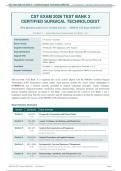
CST Exam 2026 Test Bank 3 — Certified Surgical Technologist (NBSTSA) 175 Questions | 7 Sections | Verified Correct Answers
CST EXAM 2026 TEST BANK 3
CERTIFIED SURGICAL TECHNOLOGIST
With Questions and Correct Verified Answers — NBSTSA CST Exam 2026/2027
Test Bank 3 — Unique Questions Complementing Test Banks 1 & 2
Total Questions 175 (across 7 sections)
Exam Format Multiple choice (4 options, 1 correct)
Cognitive Distribution 30% Recall | 50% Application | 20% Analysis
Style Distribution 75% Scenario-Based | 25% Direct Recall / Instrument ID / Procedural Steps
Aligned With NBSTSA CST Certification Exam Content Outline
Regulatory Coverage AORN Guidelines, OSHA Bloodborne Pathogens, TJC Universal Protocol &
NPSGs, HIPAA
Test Bank Test Bank 3 — unique questions (not duplicated in Test Bank 1 or 2)
Answer Verification 100% Correct Verified Answers with comprehensive NBSTSA exam-focused
rationales
This test bank (Test Bank 3) is organized into seven sections aligned with the NBSTSA Certified Surgical
Technologist (CST) Examination content outline. Each question includes the correct answer (highlighted in
[CORRECT]) and a detailed rationale grounded in surgical technology principles, aseptic technique,
instrumentation, surgical procedures, sterilization science, pharmacology, emergency protocols, and professional
practice standards. Questions are unique to Test Bank 3 and complement the content of Test Banks 1 and 2.
Candidates should study both the correct responses and the underlying reasoning to develop the integrated clinical
judgment required for success on the NBSTSA CST certification examination.
Exam Section Overview
Section Questions Topic Coverage
Section 1 Q1-Q25 Preoperative Preparation and Patient Safety
(25 Q) OR Setup, Sterile Field, Patient Preparation, Positioning, & Universal Protocol
Section 2 Q26-Q50 Aseptic Technique, Sterilization, and Disinfection
(25 Q) Principles of Asepsis, Sterilization Methods, Biological/Chemical Indicators, & Sterile Storage
Section 3 Q51-Q75 Surgical Instrumentation and Equipment
(25 Q) General Instrumentation, Specialty Instruments, Power Equipment, Endoscopic/Robotic Instruments, &
Equipment Maintenance
Section 4 Q76-Q110 Surgical Procedures and Applied Anatomy
(35 Q) General, OB/GYN, GU, Orthopedic, Neuro, Cardiac, Vascular, Ophthalmic, & Plastics Procedures
Section 5 Q111-Q140 Intraoperative Care and Emergency Management
(30 Q) Hemostasis, Wound Closure, Drains, Specimens, Surgical Counts, Malignant Hyperthermia,
Anaphylaxis, Fire Safety, & Hemorrhage
Section 6 Q141-Q160 Pharmacology, Anesthesia, and Postoperative Care
(20 Q) Anesthesia Agents, Emergency Drugs, Medication Safety, PACU Care, & Postoperative Complications
NBSTSA CST Exam 2026/2027 — Test Bank 3 Page 1
,CST Exam 2026 Test Bank 3 — Certified Surgical Technologist (NBSTSA) 175 Questions | 7 Sections | Verified Correct Answers
Section 7 Q161-Q175 Professional Practice, Legal, and Ethical Issues
(15 Q) Scope of Practice, HIPAA, Informed Consent, Documentation, AORN Standards, & Professionalism
Section 1: Preoperative Preparation and Patient Safety
OR Setup, Sterile Field, Patient Preparation, Positioning, & Universal Protocol
Q1. The operating room environment is maintained at specific temperature and humidity ranges to inhibit
microbial growth and minimize static electricity. Per AORN and ASHRAE 170 standards, the recommended OR
temperature and relative humidity ranges are:
A. Temperature 60-65°F, humidity 20-30%
B. Temperature 68-73°F, humidity 30-60% [CORRECT]
C. Temperature 75-80°F, humidity 50-70%
D. Temperature 65-70°F, humidity 10-20%
Correct Answer: B
Rationale: AORN and ASHRAE Standard 170 recommend maintaining the OR between 68-73°F (20-23°C) and 30-60% relative
humidity. This range balances patient normothermia considerations (which may require warming measures) with microbial growth
inhibition and control of static electricity buildup. Temperatures below 68°F increase patient hypothermia risk; humidity below
30% increases static discharge risk, and humidity above 60% promotes microbial proliferation.
Q2. The operating room suite is designed with positive air pressure relative to surrounding corridors. The primary
purpose of positive pressure is to:
A. Prevent escape of contaminated air from the OR into hallways
B. Prevent ingress of contaminated air from outside the OR into the sterile field [CORRECT]
C. Cool the operating room more efficiently
D. Reduce noise transmission between rooms
Correct Answer: B
Rationale: Positive air pressure (typically 0.05 inches of water gauge) ensures that when the OR door opens, air flows out of the
OR rather than into it, preventing ingress of contaminated corridor air into the sterile field. The OR also requires 15-25 air
exchanges per hour with at least 3 exchanges of outside air, and HEPA filtration. Negative pressure rooms (opposite design) are
used for airborne infection isolation.
Q3. A minimum of how many total air exchanges per hour are required in the operating room, with a specified
minimum of outdoor air exchanges?
A. 10 total, 2 outdoor
B. 15 total, 3 outdoor [CORRECT]
C. 25 total, 5 outdoor
D. 30 total, 10 outdoor
Correct Answer: B
Rationale: AORN and ASHRAE 170 require a minimum of 15 total air exchanges per hour in the OR, with at least 3 of those
being outdoor (fresh) air exchanges. New ORs are often designed for 20-25 total exchanges for improved air quality. The air is
HEPA-filtered and introduced at the ceiling with low-velocity laminar flow in critical zones, exhausting near the floor.
Q4. During a total hip arthroplasty, the surgical technologist notes visible condensation on the OR lights overhead.
The most appropriate action is to:
A. Continue the procedure; condensation on lights is normal
NBSTSA CST Exam 2026/2027 — Test Bank 3 Page 2
,CST Exam 2026 Test Bank 3 — Certified Surgical Technologist (NBSTSA) 175 Questions | 7 Sections | Verified Correct Answers
B. Notify the circulator and surgeon, and have housekeeping or facilities address the humidity before
proceeding if condensation could drip into the sterile field [CORRECT]
C. Wipe the lights with a sterile towel
D. Increase the room temperature to evaporate the condensation
Correct Answer: B
Rationale: Condensation on OR lights indicates humidity is above the recommended 30-60% range, risking drips into the sterile
field (contamination) and electrical malfunction. The surgical technologist must notify the circulator, who escalates to
facilities/housekeeping. If condensation could drip into the field, the procedure must pause until the humidity is corrected. Wiping
the lights with a sterile towel contaminates the towel; raising temperature does not address humidity (and worsens patient
hypothermia risk).
Q5. All personnel entering the semirestricted and restricted areas of the OR suite must wear surgical attire, which
includes:
A. Only scrub pants and a T-shirt
B. Scrubs, head coverings that cover all head and facial hair, and a face mask (in restricted areas)
[CORRECT]
C. Street clothes with a lab coat
D. Surgical gowns over street clothes
Correct Answer: B
Rationale: AORN guidelines require all personnel in semirestricted areas to wear facility-laundered scrubs and a head covering
that fully contains head and facial hair. In restricted areas (OR with sterile supplies open or procedures in progress), a face mask is
also required for all personnel. Coveralls or jumpsuits may be used for visitor coverage. Street clothes and lab coats are not
permitted in semirestricted or restricted areas. Personal scrubs laundered at home do not meet AORN standards.
Q6. When wearing a surgical mask in the restricted area, the mask should be:
A. Worn loosely to allow comfortable breathing
B. Fitted snugly over the nose and mouth, with the metal nosepiece contoured to the bridge of the nose,
and changed between procedures or when wet/soiled [CORRECT]
C. Removed when talking to the surgeon
D. Worn only during induction and emergence from anesthesia
Correct Answer: B
Rationale: The surgical mask must cover both nose and mouth, fit snugly with the metal nosepiece contoured to prevent eyeglass
fogging and air leakage, and be changed between patients, after each procedure, when wet or soiled, or every 2-4 hours during
extended cases. Masks filter expired air to prevent contamination of the sterile field and protect the wearer from splashes.
Loose-fitting or improperly worn masks fail both functions.
Q7. A surgical technologist with unsecured facial hair is preparing to enter the OR. The correct attire requirement
is to:
A. Tuck the hair into the scrub top
B. Wear a surgical hood that fully covers and contains the beard and all facial hair [CORRECT]
C. Wear two masks over the beard
D. Apply hair gel to flatten the beard
Correct Answer: B
Rationale: AORN requires that all head and facial hair be fully covered in semirestricted and restricted areas. Personnel with
beards must wear a surgical hood that completely covers and contains the beard and facial hair. Tucking hair into scrubs risks
contamination when bending. Two masks do not contain hair adequately, and hair gel does not prevent microbial shedding. Hood
coverage must be secured to prevent escape of hair or skin squames.
NBSTSA CST Exam 2026/2027 — Test Bank 3 Page 3
, CST Exam 2026 Test Bank 3 — Certified Surgical Technologist (NBSTSA) 175 Questions | 7 Sections | Verified Correct Answers
Q8. During a procedure using intraoperative fluoroscopy, all personnel within the radiation field must wear lead
protection. The minimum lead equivalent thickness for a lead apron worn during fluoroscopy is:
A. 0.25 mm lead equivalent
B. 0.5 mm lead equivalent [CORRECT]
C. 1.0 mm lead equivalent
D. 2.0 mm lead equivalent
Correct Answer: B
Rationale: The minimum lead equivalent for aprons worn during fluoroscopy is 0.5 mm, which attenuates approximately 90-95%
of scattered radiation at typical fluoroscopy energies. Thyroid shields (also 0.5 mm Pb equivalent) are required for personnel
whose thyroid is in the radiation field. Lead aprons must be inspected fluoroscopically or radiographically at least annually for
cracks. Personnel must also wear personal dosimeters to monitor cumulative exposure.
Q9. When performing preoperative skin antisepsis, which agent is contraindicated for use around the eyes, ears,
and mucous membranes due to risk of corneal damage and ototoxicity?
A. Chlorhexidine gluconate (CHG) [CORRECT]
B. Povidone-iodine
C. Isopropyl alcohol
D. DuraPrep (iodine povacrylex + isopropyl alcohol)
Correct Answer: A
Rationale: Chlorhexidine gluconate (CHG) is contraindicated for use on the face (especially around eyes and ears) due to risk of
corneal damage and ototoxicity if it enters the ear. CHG is the preferred agent for most skin preparation because of its persistent
activity and lower re-contamination rates, but povidone-iodine is used for facial, periocular, and peri-auricular procedures.
DuraPrep contains alcohol and is similarly avoided near mucous membranes and eyes.
Q10. A patient is scheduled for a craniotomy. Compared to shaving, the preferred method of hair removal prior to
surgery is:
A. Shaving with a razor the night before surgery
B. Clipping hair in the holding area or OR immediately before incision [CORRECT]
C. Using a depilatory cream 24 hours before surgery
D. No hair removal—tape the hair away from the site
Correct Answer: B
Rationale: AORN and CDC recommend clipping (not shaving) hair only when necessary, and only immediately before the
procedure. Shaving causes microscopic skin abrasions that increase SSI risk by 3-5x and is no longer recommended. Depilatory
creams can cause skin irritation. If hair does not interfere with the incision or draping, it should be left in place. When hair
removal is necessary, clippers with disposable heads are used in the prep area or OR, not the patient ward.
Q11. The surgical technologist is preparing to drape a patient for an abdominal procedure. The first sheet placed to
establish the sterile field is typically the:
A. Folded towel placed at the incision site [CORRECT]
B. Fenestrated sheet placed over the patient
C. Under buttocks drape
D. Stockinette placed over the foot
Correct Answer: A
Rationale: Draping follows a specific sequence: the surgical technologist places four folded towels (square drapes) around the
incision site to outline the sterile field, working from the incision outward to the periphery. These towels are placed without flipping
or dragging. After the towels, the fenestrated sheet is placed over the patient, with the fenestration aligned to the incision.
Stockinettes and under-buttocks drapes are procedure-specific additions.
NBSTSA CST Exam 2026/2027 — Test Bank 3 Page 4
CST EXAM 2026 TEST BANK 3
CERTIFIED SURGICAL TECHNOLOGIST
With Questions and Correct Verified Answers — NBSTSA CST Exam 2026/2027
Test Bank 3 — Unique Questions Complementing Test Banks 1 & 2
Total Questions 175 (across 7 sections)
Exam Format Multiple choice (4 options, 1 correct)
Cognitive Distribution 30% Recall | 50% Application | 20% Analysis
Style Distribution 75% Scenario-Based | 25% Direct Recall / Instrument ID / Procedural Steps
Aligned With NBSTSA CST Certification Exam Content Outline
Regulatory Coverage AORN Guidelines, OSHA Bloodborne Pathogens, TJC Universal Protocol &
NPSGs, HIPAA
Test Bank Test Bank 3 — unique questions (not duplicated in Test Bank 1 or 2)
Answer Verification 100% Correct Verified Answers with comprehensive NBSTSA exam-focused
rationales
This test bank (Test Bank 3) is organized into seven sections aligned with the NBSTSA Certified Surgical
Technologist (CST) Examination content outline. Each question includes the correct answer (highlighted in
[CORRECT]) and a detailed rationale grounded in surgical technology principles, aseptic technique,
instrumentation, surgical procedures, sterilization science, pharmacology, emergency protocols, and professional
practice standards. Questions are unique to Test Bank 3 and complement the content of Test Banks 1 and 2.
Candidates should study both the correct responses and the underlying reasoning to develop the integrated clinical
judgment required for success on the NBSTSA CST certification examination.
Exam Section Overview
Section Questions Topic Coverage
Section 1 Q1-Q25 Preoperative Preparation and Patient Safety
(25 Q) OR Setup, Sterile Field, Patient Preparation, Positioning, & Universal Protocol
Section 2 Q26-Q50 Aseptic Technique, Sterilization, and Disinfection
(25 Q) Principles of Asepsis, Sterilization Methods, Biological/Chemical Indicators, & Sterile Storage
Section 3 Q51-Q75 Surgical Instrumentation and Equipment
(25 Q) General Instrumentation, Specialty Instruments, Power Equipment, Endoscopic/Robotic Instruments, &
Equipment Maintenance
Section 4 Q76-Q110 Surgical Procedures and Applied Anatomy
(35 Q) General, OB/GYN, GU, Orthopedic, Neuro, Cardiac, Vascular, Ophthalmic, & Plastics Procedures
Section 5 Q111-Q140 Intraoperative Care and Emergency Management
(30 Q) Hemostasis, Wound Closure, Drains, Specimens, Surgical Counts, Malignant Hyperthermia,
Anaphylaxis, Fire Safety, & Hemorrhage
Section 6 Q141-Q160 Pharmacology, Anesthesia, and Postoperative Care
(20 Q) Anesthesia Agents, Emergency Drugs, Medication Safety, PACU Care, & Postoperative Complications
NBSTSA CST Exam 2026/2027 — Test Bank 3 Page 1
,CST Exam 2026 Test Bank 3 — Certified Surgical Technologist (NBSTSA) 175 Questions | 7 Sections | Verified Correct Answers
Section 7 Q161-Q175 Professional Practice, Legal, and Ethical Issues
(15 Q) Scope of Practice, HIPAA, Informed Consent, Documentation, AORN Standards, & Professionalism
Section 1: Preoperative Preparation and Patient Safety
OR Setup, Sterile Field, Patient Preparation, Positioning, & Universal Protocol
Q1. The operating room environment is maintained at specific temperature and humidity ranges to inhibit
microbial growth and minimize static electricity. Per AORN and ASHRAE 170 standards, the recommended OR
temperature and relative humidity ranges are:
A. Temperature 60-65°F, humidity 20-30%
B. Temperature 68-73°F, humidity 30-60% [CORRECT]
C. Temperature 75-80°F, humidity 50-70%
D. Temperature 65-70°F, humidity 10-20%
Correct Answer: B
Rationale: AORN and ASHRAE Standard 170 recommend maintaining the OR between 68-73°F (20-23°C) and 30-60% relative
humidity. This range balances patient normothermia considerations (which may require warming measures) with microbial growth
inhibition and control of static electricity buildup. Temperatures below 68°F increase patient hypothermia risk; humidity below
30% increases static discharge risk, and humidity above 60% promotes microbial proliferation.
Q2. The operating room suite is designed with positive air pressure relative to surrounding corridors. The primary
purpose of positive pressure is to:
A. Prevent escape of contaminated air from the OR into hallways
B. Prevent ingress of contaminated air from outside the OR into the sterile field [CORRECT]
C. Cool the operating room more efficiently
D. Reduce noise transmission between rooms
Correct Answer: B
Rationale: Positive air pressure (typically 0.05 inches of water gauge) ensures that when the OR door opens, air flows out of the
OR rather than into it, preventing ingress of contaminated corridor air into the sterile field. The OR also requires 15-25 air
exchanges per hour with at least 3 exchanges of outside air, and HEPA filtration. Negative pressure rooms (opposite design) are
used for airborne infection isolation.
Q3. A minimum of how many total air exchanges per hour are required in the operating room, with a specified
minimum of outdoor air exchanges?
A. 10 total, 2 outdoor
B. 15 total, 3 outdoor [CORRECT]
C. 25 total, 5 outdoor
D. 30 total, 10 outdoor
Correct Answer: B
Rationale: AORN and ASHRAE 170 require a minimum of 15 total air exchanges per hour in the OR, with at least 3 of those
being outdoor (fresh) air exchanges. New ORs are often designed for 20-25 total exchanges for improved air quality. The air is
HEPA-filtered and introduced at the ceiling with low-velocity laminar flow in critical zones, exhausting near the floor.
Q4. During a total hip arthroplasty, the surgical technologist notes visible condensation on the OR lights overhead.
The most appropriate action is to:
A. Continue the procedure; condensation on lights is normal
NBSTSA CST Exam 2026/2027 — Test Bank 3 Page 2
,CST Exam 2026 Test Bank 3 — Certified Surgical Technologist (NBSTSA) 175 Questions | 7 Sections | Verified Correct Answers
B. Notify the circulator and surgeon, and have housekeeping or facilities address the humidity before
proceeding if condensation could drip into the sterile field [CORRECT]
C. Wipe the lights with a sterile towel
D. Increase the room temperature to evaporate the condensation
Correct Answer: B
Rationale: Condensation on OR lights indicates humidity is above the recommended 30-60% range, risking drips into the sterile
field (contamination) and electrical malfunction. The surgical technologist must notify the circulator, who escalates to
facilities/housekeeping. If condensation could drip into the field, the procedure must pause until the humidity is corrected. Wiping
the lights with a sterile towel contaminates the towel; raising temperature does not address humidity (and worsens patient
hypothermia risk).
Q5. All personnel entering the semirestricted and restricted areas of the OR suite must wear surgical attire, which
includes:
A. Only scrub pants and a T-shirt
B. Scrubs, head coverings that cover all head and facial hair, and a face mask (in restricted areas)
[CORRECT]
C. Street clothes with a lab coat
D. Surgical gowns over street clothes
Correct Answer: B
Rationale: AORN guidelines require all personnel in semirestricted areas to wear facility-laundered scrubs and a head covering
that fully contains head and facial hair. In restricted areas (OR with sterile supplies open or procedures in progress), a face mask is
also required for all personnel. Coveralls or jumpsuits may be used for visitor coverage. Street clothes and lab coats are not
permitted in semirestricted or restricted areas. Personal scrubs laundered at home do not meet AORN standards.
Q6. When wearing a surgical mask in the restricted area, the mask should be:
A. Worn loosely to allow comfortable breathing
B. Fitted snugly over the nose and mouth, with the metal nosepiece contoured to the bridge of the nose,
and changed between procedures or when wet/soiled [CORRECT]
C. Removed when talking to the surgeon
D. Worn only during induction and emergence from anesthesia
Correct Answer: B
Rationale: The surgical mask must cover both nose and mouth, fit snugly with the metal nosepiece contoured to prevent eyeglass
fogging and air leakage, and be changed between patients, after each procedure, when wet or soiled, or every 2-4 hours during
extended cases. Masks filter expired air to prevent contamination of the sterile field and protect the wearer from splashes.
Loose-fitting or improperly worn masks fail both functions.
Q7. A surgical technologist with unsecured facial hair is preparing to enter the OR. The correct attire requirement
is to:
A. Tuck the hair into the scrub top
B. Wear a surgical hood that fully covers and contains the beard and all facial hair [CORRECT]
C. Wear two masks over the beard
D. Apply hair gel to flatten the beard
Correct Answer: B
Rationale: AORN requires that all head and facial hair be fully covered in semirestricted and restricted areas. Personnel with
beards must wear a surgical hood that completely covers and contains the beard and facial hair. Tucking hair into scrubs risks
contamination when bending. Two masks do not contain hair adequately, and hair gel does not prevent microbial shedding. Hood
coverage must be secured to prevent escape of hair or skin squames.
NBSTSA CST Exam 2026/2027 — Test Bank 3 Page 3
, CST Exam 2026 Test Bank 3 — Certified Surgical Technologist (NBSTSA) 175 Questions | 7 Sections | Verified Correct Answers
Q8. During a procedure using intraoperative fluoroscopy, all personnel within the radiation field must wear lead
protection. The minimum lead equivalent thickness for a lead apron worn during fluoroscopy is:
A. 0.25 mm lead equivalent
B. 0.5 mm lead equivalent [CORRECT]
C. 1.0 mm lead equivalent
D. 2.0 mm lead equivalent
Correct Answer: B
Rationale: The minimum lead equivalent for aprons worn during fluoroscopy is 0.5 mm, which attenuates approximately 90-95%
of scattered radiation at typical fluoroscopy energies. Thyroid shields (also 0.5 mm Pb equivalent) are required for personnel
whose thyroid is in the radiation field. Lead aprons must be inspected fluoroscopically or radiographically at least annually for
cracks. Personnel must also wear personal dosimeters to monitor cumulative exposure.
Q9. When performing preoperative skin antisepsis, which agent is contraindicated for use around the eyes, ears,
and mucous membranes due to risk of corneal damage and ototoxicity?
A. Chlorhexidine gluconate (CHG) [CORRECT]
B. Povidone-iodine
C. Isopropyl alcohol
D. DuraPrep (iodine povacrylex + isopropyl alcohol)
Correct Answer: A
Rationale: Chlorhexidine gluconate (CHG) is contraindicated for use on the face (especially around eyes and ears) due to risk of
corneal damage and ototoxicity if it enters the ear. CHG is the preferred agent for most skin preparation because of its persistent
activity and lower re-contamination rates, but povidone-iodine is used for facial, periocular, and peri-auricular procedures.
DuraPrep contains alcohol and is similarly avoided near mucous membranes and eyes.
Q10. A patient is scheduled for a craniotomy. Compared to shaving, the preferred method of hair removal prior to
surgery is:
A. Shaving with a razor the night before surgery
B. Clipping hair in the holding area or OR immediately before incision [CORRECT]
C. Using a depilatory cream 24 hours before surgery
D. No hair removal—tape the hair away from the site
Correct Answer: B
Rationale: AORN and CDC recommend clipping (not shaving) hair only when necessary, and only immediately before the
procedure. Shaving causes microscopic skin abrasions that increase SSI risk by 3-5x and is no longer recommended. Depilatory
creams can cause skin irritation. If hair does not interfere with the incision or draping, it should be left in place. When hair
removal is necessary, clippers with disposable heads are used in the prep area or OR, not the patient ward.
Q11. The surgical technologist is preparing to drape a patient for an abdominal procedure. The first sheet placed to
establish the sterile field is typically the:
A. Folded towel placed at the incision site [CORRECT]
B. Fenestrated sheet placed over the patient
C. Under buttocks drape
D. Stockinette placed over the foot
Correct Answer: A
Rationale: Draping follows a specific sequence: the surgical technologist places four folded towels (square drapes) around the
incision site to outline the sterile field, working from the incision outward to the periphery. These towels are placed without flipping
or dragging. After the towels, the fenestrated sheet is placed over the patient, with the fenestration aligned to the incision.
Stockinettes and under-buttocks drapes are procedure-specific additions.
NBSTSA CST Exam 2026/2027 — Test Bank 3 Page 4


