

8/23/26, 1:35 PM Module 6: Homework: BCH 463: Biophysical Chemistry (2026 Spring C)
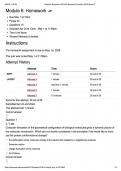
Module 6: Homework av
Due May 1 at 12pm
Points 30
Questions 15
Available Apr 24 at 12pm - May 1 at 11:59pm
Time Limit None
Allowed Attempts Unlimited
Instructions
The homework assignment is due on May 1st, 2026.
This quiz was locked May 1 at 11:59pm.
Attempt History
Attempt Time Score
KEPT Attempt 4 1 minute 30 out of 30
LATEST Attempt 4 1 minute 30 out of 30
Attempt 3 less than 1 minute 28 out of 30
Attempt 2 1 minute 28 out of 30
Attempt 1 15 minutes 26 out of 30
Score for this attempt: 30 out of 30
Submitted Apr 24 at 2:25pm
This attempt took 1 minute.
Correct answer
Question 1
2/2pts
Computer simulation of the geometrical configuration of biological molecules gives a dynamic picture of
the molecular movements. Which are not usually considered in the simulation if we would like to know
just the protein conformational change?
the deformation of the molecular orbitals in the electric field created by a neighboring molecule.
Brownian motion
charge fluctuation of the molecule
All of above
Correct answer
https://canvas.asu.edu/courses/249173/quizzes/1910914?module_item_id=18713495 1/5
, 8/23/26, 1:35 PM Module 6: Homework: BCH 463: Biophysical Chemistry (2026 Spring C)
Question 2
2/2pts
For the AMBER force field parameters, which is not included in the calculation?
bond length and bond angle
dihedral angle
hydrogen bond
metal chelation
Correct answer
Question 3
2/2pts
Which is correct when performing molecular simulation on the biological molecules?
Brownian motion can be correctly included in the calculations
the precise values of the charge and permittivity can not be precisely determined
the fluctuation of the dielectric constant of solvent is small and can be ignored
None of above
Correct answer
Question 4
2/2pts
In addition to the bond parameters and non-bonded interactions, there are some constraints that will also
affect the potential calculation on the proteins. They are:
Disulfide bonds
Dielectric constant of the solvent
Metal coordination
All of above
Correct answer
Question 5
2 /2 pts
Which of the following contributes to the free energy of a protein?
the degrees of freedom of the peptide bond
the rotameric state of the side chain
hydrogen bonding and van der Waal interaction
all of above
Correct answer
https://canvas.asu.edu/courses/249173/quizzes/1910914?module_item_id=18713495 2/5
Module 6: Homework av
Due May 1 at 12pm
Points 30
Questions 15
Available Apr 24 at 12pm - May 1 at 11:59pm
Time Limit None
Allowed Attempts Unlimited
Instructions
The homework assignment is due on May 1st, 2026.
This quiz was locked May 1 at 11:59pm.
Attempt History
Attempt Time Score
KEPT Attempt 4 1 minute 30 out of 30
LATEST Attempt 4 1 minute 30 out of 30
Attempt 3 less than 1 minute 28 out of 30
Attempt 2 1 minute 28 out of 30
Attempt 1 15 minutes 26 out of 30
Score for this attempt: 30 out of 30
Submitted Apr 24 at 2:25pm
This attempt took 1 minute.
Correct answer
Question 1
2/2pts
Computer simulation of the geometrical configuration of biological molecules gives a dynamic picture of
the molecular movements. Which are not usually considered in the simulation if we would like to know
just the protein conformational change?
the deformation of the molecular orbitals in the electric field created by a neighboring molecule.
Brownian motion
charge fluctuation of the molecule
All of above
Correct answer
https://canvas.asu.edu/courses/249173/quizzes/1910914?module_item_id=18713495 1/5
, 8/23/26, 1:35 PM Module 6: Homework: BCH 463: Biophysical Chemistry (2026 Spring C)
Question 2
2/2pts
For the AMBER force field parameters, which is not included in the calculation?
bond length and bond angle
dihedral angle
hydrogen bond
metal chelation
Correct answer
Question 3
2/2pts
Which is correct when performing molecular simulation on the biological molecules?
Brownian motion can be correctly included in the calculations
the precise values of the charge and permittivity can not be precisely determined
the fluctuation of the dielectric constant of solvent is small and can be ignored
None of above
Correct answer
Question 4
2/2pts
In addition to the bond parameters and non-bonded interactions, there are some constraints that will also
affect the potential calculation on the proteins. They are:
Disulfide bonds
Dielectric constant of the solvent
Metal coordination
All of above
Correct answer
Question 5
2 /2 pts
Which of the following contributes to the free energy of a protein?
the degrees of freedom of the peptide bond
the rotameric state of the side chain
hydrogen bonding and van der Waal interaction
all of above
Correct answer
https://canvas.asu.edu/courses/249173/quizzes/1910914?module_item_id=18713495 2/5

