
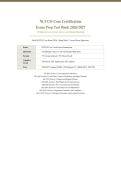
NCCCO Core Certification
Exam Prep Test Bank 2026/2027
120 Questions with Correct Answers and Detailed Rationales
Real NCCCO Core Exam 2026 - Brand New!! | Actual Exam Questions
Exam NCCCO Core Certification Examination
Questions 120 Multiple Choice (A-D) with Detailed Rationales
Format 75% Scenario-Based / 25% Direct Recall
Cognitive
30% Recall, 50% Application, 20% Analysis
Levels
Year 2026/2027 Updated (OSHA 1926 Subpart CC, ASME B30.5, NCCCO)
Q1-Q20: Section 1: Crane Operations and Safety
Q21-Q40: Section 2: Load Charts, Capacity Calculations, and Range Diagrams
Q41-Q55: Section 3: Rigging and Rigging Hardware
Q56-Q65: Section 4: Hand Signals and Communications
Q66-Q80: Section 5: Site Assessment and Lift Planning
Q81-Q95: Section 6: Crane Inspections and Maintenance
Q96-Q110: Section 7: Regulations, Standards, and Compliance
Q111-Q120: Section 8: Emergency Procedures and Accident Prevention
, NCCCO Core Certification Exam Prep Test Bank | 2026/2027
Section 1: Crane Operations and Safety
Q1: A crane operator is setting up a truck-mounted crane on outriggers. The ground appears firm but has recently been
excavated and backfilled. Which of the following is the MOST appropriate action before extending the outriggers?
A. Extend the outriggers fully and begin lifting operations since the ground appears stable
B. Have a qualified person assess the ground bearing capacity and provide adequate blocking or matting under the outrigger floats
C. Place the outrigger pads on the ground surface as-is and reduce the rated capacity by 50%
D. Drive the crane to a different location without assessing the current site further
B. Have a qualified person assess the ground bearing capacity and provide adequate blocking or matting under the outrigger floats
**[CORRECT]**
Correct Answer: B - Have a qualified person assess the ground bearing capacity and provide adequate blocking or matting
under the outrigger floats
Rationale: OSHA 1926.1402 requires that ground conditions must be firm, drained, and adequately graded to support the crane, and that
supporting materials (blocking/matting) must be used when necessary. Recently excavated and backfilled areas have unknown and likely
insufficient bearing capacity. A qualified person must assess the ground and determine appropriate blocking/matting. Simply extending
outriggers (A) or reducing capacity (C) without proper assessment violates OSHA requirements. Moving without assessment (D) does not
solve the underlying safety concern. This is a core NCCCO setup and safety competency.
Q2: According to OSHA 1926 Subpart CC and NCCCO standards, at what degree of levelness must a crane be set up
before lifting operations can begin?
A. Within 1% of level (approximately 1/8 inch per foot)
B. Within 2% of level (approximately 1/4 inch per foot)
C. Within 3% of level (approximately 3/8 inch per foot)
D. Level is only recommended, not required, for most crane operations
A. Within 1% of level (approximately 1/8 inch per foot) **[CORRECT]**
Correct Answer: A - Within 1% of level (approximately 1/8 inch per foot)
Rationale: Most crane manufacturers and OSHA 1926 Subpart CC require the crane to be level within 1% (1/8 inch per foot) before lifting
operations. Exceeding this tolerance significantly affects the crane's stability and rated capacity. Operating a crane that is not properly level
can cause the load moment to exceed the stability triangle, leading to a tip-over. The 1% standard is a fundamental NCCCO knowledge point.
Options B and C are too lenient. Leveling is required (D is incorrect), not merely recommended.
Q3: An operator is lifting a load and notices the Load Moment Indicator (LMI) alarm sounds and the warning light
illuminates. The LMI shows the load is at 95% of rated capacity. Which of the following is the MOST appropriate
action?
A. Continue the lift slowly since the load is still under 100% capacity
B. Stop all load-handling operations immediately and take corrective action before proceeding
C. Increase boom length slightly to reduce the load moment and clear the alarm
D. Add counterweight to the crane to increase the rated capacity for the lift
B. Stop all load-handling operations immediately and take corrective action before proceeding **[CORRECT]**
Correct Answer: B - Stop all load-handling operations immediately and take corrective action before proceeding
Rationale: When the LMI alarm activates, the operator must STOP all load-handling operations immediately and determine the cause. The
LMI is a critical safety device that warns of approaching the rated capacity limit. Continuing to lift (A) risks exceeding capacity. Increasing
boom length (C) would INCREASE the load moment (longer boom = greater radius = less capacity), making the situation more dangerous.
Adding counterweight (D) without manufacturer approval is unsafe and violates OSHA requirements. LMI alarms must never be ignored; this
is a critical NCCCO safety principle.
Q4: Which of the following best describes the stability triangle of a mobile crane?
A. The area formed by the crane's tracks or outrigger pads on the ground surface
B. The triangular area formed by connecting the two rear tipping axes and the point directly beneath the boom tip
C. The area beneath the crane's center of gravity extending 15 feet in all directions
D. The space between the load hook and the boom tip at maximum extension
A. The area formed by the crane's tracks or outrigger pads on the ground surface **[CORRECT]**
Correct Answer: A - The area formed by the crane's tracks or outrigger pads on the ground surface
Rationale: The stability triangle is defined by the crane's support points on the ground: for a crawler crane, it is formed by the two tracks; for
a truck-mounted crane on outriggers, it is formed by the four outrigger floats (or the contact area of the tires if operating on rubber). The
Page 2
, NCCCO Core Certification Exam Prep Test Bank | 2026/2027
crane remains stable as long as the combined center of gravity of the crane and load stays within this triangle. Options B, C, and D do not
correctly define the stability triangle. Understanding the stability triangle is fundamental to NCCCO crane operation and preventing tip-over
accidents.
Q5: A crane operator is performing a lift near an overhead power line. The line voltage is 350 kV. According to OSHA
1926.1408, what is the minimum approach distance (MAD) that must be maintained between any part of the crane/load
and the power line?
A. 10 feet
B. 15 feet
C. 20 feet
D. 25 feet
C. 20 feet **[CORRECT]**
Correct Answer: C - 20 feet
Rationale: Per OSHA 1926.1408 Table A, for power lines rated at 350 kV, the minimum approach distance is 20 feet. The MAD increases
with voltage: lines up to 50 kV require 10 feet, 50-200 kV require 15 feet, 200-350 kV require 20 feet, and over 350 kV require 25 feet (plus
0.4 inches for each additional kV over 350). These distances are mandatory unless the line is de-energized, visibly grounded, and a designated
person confirms the line is de-energized. Power line safety and MAD values are frequently tested on the NCCCO Core exam.
Q6: A tower crane is being climbed by a person using the built-in ladder. Which of the following safety requirements
must be met according to OSHA and ASME B30.3?
A. A safety harness and lanyard must be worn and attached to the crane structure at all times during the climb
B. Fall protection is only required when climbing above 30 feet
C. The climber must maintain three points of contact but fall protection is not required if the ladder has a cage
D. A tag line must be attached to the climber from the ground
A. A safety harness and lanyard must be worn and attached to the crane structure at all times during the climb **[CORRECT]**
Correct Answer: A - A safety harness and lanyard must be worn and attached to the crane structure at all times during the
climb
Rationale: OSHA requires 100% fall protection when climbing any crane structure. A full body harness with a lanyard (or other fall arrest
system) attached to the crane structure is required at all times during the climb. The 30-foot threshold (B) does not apply to crane climbing.
Even with a ladder cage (C), fall protection is still required on crane structures. A tag line (D) is used for loads, not personnel. This is a critical
safety requirement that appears frequently on NCCCO exams.
Q7: During a lift, the anti-two-block device activates. What does this device prevent, and what is the MOST appropriate
operator response?
A. It prevents the hook block from colliding with the boom tip; the operator should stop hoisting immediately
B. It prevents the load from swinging; the operator should continue hoisting at a reduced speed
C. It prevents the crane from traveling too fast; the operator should apply the service brake
D. It prevents the boom from lowering past horizontal; the operator should raise the boom
A. It prevents the hook block from colliding with the boom tip; the operator should stop hoisting immediately **[CORRECT]**
Correct Answer: A - It prevents the hook block from colliding with the boom tip; the operator should stop hoisting
immediately
Rationale: The anti-two-block device prevents the hook block (or load block) from contacting the boom tip sheave (two-blocking), which can
cause structural damage to the boom, rope failure, or the load to drop. When the device activates, the operator must stop hoisting immediately
and take corrective action. The device does not prevent swinging (B), control travel speed (C), or limit boom lowering (D). Two-blocking is a
dangerous condition that can cause catastrophic failure, making anti-two-block devices a critical safety feature tested on the NCCCO exam.
Q8: An operator is using a rough-terrain crane with the boom at a 60-degree angle and the load at a 40-foot radius. The
load chart shows a capacity of 12,000 pounds at this configuration. The rigging weighs 800 pounds. What is the
maximum load weight that can be lifted?
A. 12,000 pounds
B. 12,800 pounds
C. 11,200 pounds
D. 11,500 pounds
C. 11,200 pounds **[CORRECT]**
Correct Answer: C - 11,200 pounds
Page 3
, NCCCO Core Certification Exam Prep Test Bank | 2026/2027
Rationale: The rated capacity on a load chart includes the weight of the load AND the rigging (slings, hooks, blocks, and any other
below-the-hook lifting device). Therefore, the maximum load weight equals the rated capacity minus the rigging weight: 12,000 - 800 =
11,200 pounds. This is a fundamental load chart calculation that appears consistently on NCCCO exams. The operator must always account
for rigging weight when determining whether a lift is within the crane's rated capacity. Options A and B fail to subtract rigging weight
correctly.
Q9: A crawler crane is positioned on a slope for a lift. According to NCCCO standards and manufacturer requirements,
which of the following statements is CORRECT regarding crane operation on slopes?
A. Crawler cranes may operate on slopes up to 5% as long as the LMI shows adequate capacity
B. Crawler cranes must be operated on level ground unless the manufacturer specifically permits otherwise and provides slope
ratings
C. Slope operation is acceptable if the operator reduces the load by 25% per degree of slope
D. The stability triangle compensates for slopes automatically, so no special precautions are needed
B. Crawler cranes must be operated on level ground unless the manufacturer specifically permits otherwise and provides slope
ratings **[CORRECT]**
Correct Answer: B - Crawler cranes must be operated on level ground unless the manufacturer specifically permits otherwise
and provides slope ratings
Rationale: Crawler cranes must be set up and operated on level ground unless the manufacturer has specifically rated the crane for slope
operation and provided slope capacity data. Operating on an unapproved slope can shift the center of gravity outside the stability triangle and
cause a tip-over. The LMI (A) may not account for the effects of a slope on stability. The 25% reduction rule (C) is not an NCCCO or OSHA
standard. The stability triangle (D) does NOT compensate for slopes. This is a critical setup and safety question on the NCCCO Core exam.
Q10: Which of the following statements about crane assembly and disassembly is CORRECT according to OSHA 1926
Subpart CC?
A. Assembly and disassembly must be directed by a qualified person who has reviewed the manufacturer's procedures
B. The crane operator alone is responsible for all assembly and disassembly operations
C. Assembly can be performed by any competent person as long as the operator supervises from the cab
D. Disassembly does not require any specific planning as long as the components are removed in reverse order of assembly
A. Assembly and disassembly must be directed by a qualified person who has reviewed the manufacturer's procedures
**[CORRECT]**
Correct Answer: A - Assembly and disassembly must be directed by a qualified person who has reviewed the manufacturer's
procedures
Rationale: OSHA 1926.1404 requires that assembly and disassembly be directed by a person who meets the definition of a 'qualified person'
and who is familiar with the manufacturer's procedures for the specific crane. The operator (B) may not be qualified to direct A/D operations.
A competent person (C) does not necessarily meet the qualified person standard for A/D operations. Disassembly (D) requires planning just as
much as assembly, including consideration of component weights, balance points, and rigging requirements. A/D director requirements are a
frequently tested NCCCO topic.
Q11: A crane is lifting a load and the operator needs to determine the total load weight. The load itself weighs 8,500
pounds, the main hook block weighs 650 pounds, the slings weigh 400 pounds, and a spreader bar weighs 300 pounds.
What is the total load that must be within the crane's rated capacity?
A. 8,500 pounds (only the actual load matters)
B. 9,550 pounds (load plus hook block and slings)
C. 9,850 pounds (load plus all rigging below the hook)
D. 10,150 pounds (load plus all rigging and an estimated 10% safety factor)
C. 9,850 pounds (load plus all rigging below the hook) **[CORRECT]**
Correct Answer: C - 9,850 pounds (load plus all rigging below the hook)
Rationale: The total load that must be within the crane's rated capacity includes the actual load weight PLUS the weight of ALL rigging and
below-the-hook devices: 8,500 + 650 (hook block) + 400 (slings) + 300 (spreader bar) = 9,850 pounds. The load chart capacity must be equal
to or greater than this total. Only counting the load (A) or omitting the spreader bar (B) underestimates the actual load on the crane. Adding an
arbitrary 10% safety factor (D) is not a standard NCCCO calculation method. This is a fundamental load weight calculation tested on every
NCCCO exam.
Q12: A truck crane is operating on rubber (outriggers not fully extended) in accordance with the on-rubber load chart.
Which of the following is an important operational consideration?
A. The on-rubber capacity is typically the same as the on-outrigger capacity
B. The crane must not travel while a load is suspended on the hook
Page 4
Exam Prep Test Bank 2026/2027
120 Questions with Correct Answers and Detailed Rationales
Real NCCCO Core Exam 2026 - Brand New!! | Actual Exam Questions
Exam NCCCO Core Certification Examination
Questions 120 Multiple Choice (A-D) with Detailed Rationales
Format 75% Scenario-Based / 25% Direct Recall
Cognitive
30% Recall, 50% Application, 20% Analysis
Levels
Year 2026/2027 Updated (OSHA 1926 Subpart CC, ASME B30.5, NCCCO)
Q1-Q20: Section 1: Crane Operations and Safety
Q21-Q40: Section 2: Load Charts, Capacity Calculations, and Range Diagrams
Q41-Q55: Section 3: Rigging and Rigging Hardware
Q56-Q65: Section 4: Hand Signals and Communications
Q66-Q80: Section 5: Site Assessment and Lift Planning
Q81-Q95: Section 6: Crane Inspections and Maintenance
Q96-Q110: Section 7: Regulations, Standards, and Compliance
Q111-Q120: Section 8: Emergency Procedures and Accident Prevention
, NCCCO Core Certification Exam Prep Test Bank | 2026/2027
Section 1: Crane Operations and Safety
Q1: A crane operator is setting up a truck-mounted crane on outriggers. The ground appears firm but has recently been
excavated and backfilled. Which of the following is the MOST appropriate action before extending the outriggers?
A. Extend the outriggers fully and begin lifting operations since the ground appears stable
B. Have a qualified person assess the ground bearing capacity and provide adequate blocking or matting under the outrigger floats
C. Place the outrigger pads on the ground surface as-is and reduce the rated capacity by 50%
D. Drive the crane to a different location without assessing the current site further
B. Have a qualified person assess the ground bearing capacity and provide adequate blocking or matting under the outrigger floats
**[CORRECT]**
Correct Answer: B - Have a qualified person assess the ground bearing capacity and provide adequate blocking or matting
under the outrigger floats
Rationale: OSHA 1926.1402 requires that ground conditions must be firm, drained, and adequately graded to support the crane, and that
supporting materials (blocking/matting) must be used when necessary. Recently excavated and backfilled areas have unknown and likely
insufficient bearing capacity. A qualified person must assess the ground and determine appropriate blocking/matting. Simply extending
outriggers (A) or reducing capacity (C) without proper assessment violates OSHA requirements. Moving without assessment (D) does not
solve the underlying safety concern. This is a core NCCCO setup and safety competency.
Q2: According to OSHA 1926 Subpart CC and NCCCO standards, at what degree of levelness must a crane be set up
before lifting operations can begin?
A. Within 1% of level (approximately 1/8 inch per foot)
B. Within 2% of level (approximately 1/4 inch per foot)
C. Within 3% of level (approximately 3/8 inch per foot)
D. Level is only recommended, not required, for most crane operations
A. Within 1% of level (approximately 1/8 inch per foot) **[CORRECT]**
Correct Answer: A - Within 1% of level (approximately 1/8 inch per foot)
Rationale: Most crane manufacturers and OSHA 1926 Subpart CC require the crane to be level within 1% (1/8 inch per foot) before lifting
operations. Exceeding this tolerance significantly affects the crane's stability and rated capacity. Operating a crane that is not properly level
can cause the load moment to exceed the stability triangle, leading to a tip-over. The 1% standard is a fundamental NCCCO knowledge point.
Options B and C are too lenient. Leveling is required (D is incorrect), not merely recommended.
Q3: An operator is lifting a load and notices the Load Moment Indicator (LMI) alarm sounds and the warning light
illuminates. The LMI shows the load is at 95% of rated capacity. Which of the following is the MOST appropriate
action?
A. Continue the lift slowly since the load is still under 100% capacity
B. Stop all load-handling operations immediately and take corrective action before proceeding
C. Increase boom length slightly to reduce the load moment and clear the alarm
D. Add counterweight to the crane to increase the rated capacity for the lift
B. Stop all load-handling operations immediately and take corrective action before proceeding **[CORRECT]**
Correct Answer: B - Stop all load-handling operations immediately and take corrective action before proceeding
Rationale: When the LMI alarm activates, the operator must STOP all load-handling operations immediately and determine the cause. The
LMI is a critical safety device that warns of approaching the rated capacity limit. Continuing to lift (A) risks exceeding capacity. Increasing
boom length (C) would INCREASE the load moment (longer boom = greater radius = less capacity), making the situation more dangerous.
Adding counterweight (D) without manufacturer approval is unsafe and violates OSHA requirements. LMI alarms must never be ignored; this
is a critical NCCCO safety principle.
Q4: Which of the following best describes the stability triangle of a mobile crane?
A. The area formed by the crane's tracks or outrigger pads on the ground surface
B. The triangular area formed by connecting the two rear tipping axes and the point directly beneath the boom tip
C. The area beneath the crane's center of gravity extending 15 feet in all directions
D. The space between the load hook and the boom tip at maximum extension
A. The area formed by the crane's tracks or outrigger pads on the ground surface **[CORRECT]**
Correct Answer: A - The area formed by the crane's tracks or outrigger pads on the ground surface
Rationale: The stability triangle is defined by the crane's support points on the ground: for a crawler crane, it is formed by the two tracks; for
a truck-mounted crane on outriggers, it is formed by the four outrigger floats (or the contact area of the tires if operating on rubber). The
Page 2
, NCCCO Core Certification Exam Prep Test Bank | 2026/2027
crane remains stable as long as the combined center of gravity of the crane and load stays within this triangle. Options B, C, and D do not
correctly define the stability triangle. Understanding the stability triangle is fundamental to NCCCO crane operation and preventing tip-over
accidents.
Q5: A crane operator is performing a lift near an overhead power line. The line voltage is 350 kV. According to OSHA
1926.1408, what is the minimum approach distance (MAD) that must be maintained between any part of the crane/load
and the power line?
A. 10 feet
B. 15 feet
C. 20 feet
D. 25 feet
C. 20 feet **[CORRECT]**
Correct Answer: C - 20 feet
Rationale: Per OSHA 1926.1408 Table A, for power lines rated at 350 kV, the minimum approach distance is 20 feet. The MAD increases
with voltage: lines up to 50 kV require 10 feet, 50-200 kV require 15 feet, 200-350 kV require 20 feet, and over 350 kV require 25 feet (plus
0.4 inches for each additional kV over 350). These distances are mandatory unless the line is de-energized, visibly grounded, and a designated
person confirms the line is de-energized. Power line safety and MAD values are frequently tested on the NCCCO Core exam.
Q6: A tower crane is being climbed by a person using the built-in ladder. Which of the following safety requirements
must be met according to OSHA and ASME B30.3?
A. A safety harness and lanyard must be worn and attached to the crane structure at all times during the climb
B. Fall protection is only required when climbing above 30 feet
C. The climber must maintain three points of contact but fall protection is not required if the ladder has a cage
D. A tag line must be attached to the climber from the ground
A. A safety harness and lanyard must be worn and attached to the crane structure at all times during the climb **[CORRECT]**
Correct Answer: A - A safety harness and lanyard must be worn and attached to the crane structure at all times during the
climb
Rationale: OSHA requires 100% fall protection when climbing any crane structure. A full body harness with a lanyard (or other fall arrest
system) attached to the crane structure is required at all times during the climb. The 30-foot threshold (B) does not apply to crane climbing.
Even with a ladder cage (C), fall protection is still required on crane structures. A tag line (D) is used for loads, not personnel. This is a critical
safety requirement that appears frequently on NCCCO exams.
Q7: During a lift, the anti-two-block device activates. What does this device prevent, and what is the MOST appropriate
operator response?
A. It prevents the hook block from colliding with the boom tip; the operator should stop hoisting immediately
B. It prevents the load from swinging; the operator should continue hoisting at a reduced speed
C. It prevents the crane from traveling too fast; the operator should apply the service brake
D. It prevents the boom from lowering past horizontal; the operator should raise the boom
A. It prevents the hook block from colliding with the boom tip; the operator should stop hoisting immediately **[CORRECT]**
Correct Answer: A - It prevents the hook block from colliding with the boom tip; the operator should stop hoisting
immediately
Rationale: The anti-two-block device prevents the hook block (or load block) from contacting the boom tip sheave (two-blocking), which can
cause structural damage to the boom, rope failure, or the load to drop. When the device activates, the operator must stop hoisting immediately
and take corrective action. The device does not prevent swinging (B), control travel speed (C), or limit boom lowering (D). Two-blocking is a
dangerous condition that can cause catastrophic failure, making anti-two-block devices a critical safety feature tested on the NCCCO exam.
Q8: An operator is using a rough-terrain crane with the boom at a 60-degree angle and the load at a 40-foot radius. The
load chart shows a capacity of 12,000 pounds at this configuration. The rigging weighs 800 pounds. What is the
maximum load weight that can be lifted?
A. 12,000 pounds
B. 12,800 pounds
C. 11,200 pounds
D. 11,500 pounds
C. 11,200 pounds **[CORRECT]**
Correct Answer: C - 11,200 pounds
Page 3
, NCCCO Core Certification Exam Prep Test Bank | 2026/2027
Rationale: The rated capacity on a load chart includes the weight of the load AND the rigging (slings, hooks, blocks, and any other
below-the-hook lifting device). Therefore, the maximum load weight equals the rated capacity minus the rigging weight: 12,000 - 800 =
11,200 pounds. This is a fundamental load chart calculation that appears consistently on NCCCO exams. The operator must always account
for rigging weight when determining whether a lift is within the crane's rated capacity. Options A and B fail to subtract rigging weight
correctly.
Q9: A crawler crane is positioned on a slope for a lift. According to NCCCO standards and manufacturer requirements,
which of the following statements is CORRECT regarding crane operation on slopes?
A. Crawler cranes may operate on slopes up to 5% as long as the LMI shows adequate capacity
B. Crawler cranes must be operated on level ground unless the manufacturer specifically permits otherwise and provides slope
ratings
C. Slope operation is acceptable if the operator reduces the load by 25% per degree of slope
D. The stability triangle compensates for slopes automatically, so no special precautions are needed
B. Crawler cranes must be operated on level ground unless the manufacturer specifically permits otherwise and provides slope
ratings **[CORRECT]**
Correct Answer: B - Crawler cranes must be operated on level ground unless the manufacturer specifically permits otherwise
and provides slope ratings
Rationale: Crawler cranes must be set up and operated on level ground unless the manufacturer has specifically rated the crane for slope
operation and provided slope capacity data. Operating on an unapproved slope can shift the center of gravity outside the stability triangle and
cause a tip-over. The LMI (A) may not account for the effects of a slope on stability. The 25% reduction rule (C) is not an NCCCO or OSHA
standard. The stability triangle (D) does NOT compensate for slopes. This is a critical setup and safety question on the NCCCO Core exam.
Q10: Which of the following statements about crane assembly and disassembly is CORRECT according to OSHA 1926
Subpart CC?
A. Assembly and disassembly must be directed by a qualified person who has reviewed the manufacturer's procedures
B. The crane operator alone is responsible for all assembly and disassembly operations
C. Assembly can be performed by any competent person as long as the operator supervises from the cab
D. Disassembly does not require any specific planning as long as the components are removed in reverse order of assembly
A. Assembly and disassembly must be directed by a qualified person who has reviewed the manufacturer's procedures
**[CORRECT]**
Correct Answer: A - Assembly and disassembly must be directed by a qualified person who has reviewed the manufacturer's
procedures
Rationale: OSHA 1926.1404 requires that assembly and disassembly be directed by a person who meets the definition of a 'qualified person'
and who is familiar with the manufacturer's procedures for the specific crane. The operator (B) may not be qualified to direct A/D operations.
A competent person (C) does not necessarily meet the qualified person standard for A/D operations. Disassembly (D) requires planning just as
much as assembly, including consideration of component weights, balance points, and rigging requirements. A/D director requirements are a
frequently tested NCCCO topic.
Q11: A crane is lifting a load and the operator needs to determine the total load weight. The load itself weighs 8,500
pounds, the main hook block weighs 650 pounds, the slings weigh 400 pounds, and a spreader bar weighs 300 pounds.
What is the total load that must be within the crane's rated capacity?
A. 8,500 pounds (only the actual load matters)
B. 9,550 pounds (load plus hook block and slings)
C. 9,850 pounds (load plus all rigging below the hook)
D. 10,150 pounds (load plus all rigging and an estimated 10% safety factor)
C. 9,850 pounds (load plus all rigging below the hook) **[CORRECT]**
Correct Answer: C - 9,850 pounds (load plus all rigging below the hook)
Rationale: The total load that must be within the crane's rated capacity includes the actual load weight PLUS the weight of ALL rigging and
below-the-hook devices: 8,500 + 650 (hook block) + 400 (slings) + 300 (spreader bar) = 9,850 pounds. The load chart capacity must be equal
to or greater than this total. Only counting the load (A) or omitting the spreader bar (B) underestimates the actual load on the crane. Adding an
arbitrary 10% safety factor (D) is not a standard NCCCO calculation method. This is a fundamental load weight calculation tested on every
NCCCO exam.
Q12: A truck crane is operating on rubber (outriggers not fully extended) in accordance with the on-rubber load chart.
Which of the following is an important operational consideration?
A. The on-rubber capacity is typically the same as the on-outrigger capacity
B. The crane must not travel while a load is suspended on the hook
Page 4

