

ecology : the study of the relationships between living organisms , including humans & their physical environment
•
seeks to understand the connections between plants & animals & the world around them
•
provides information on benefits of ecosystems
•
how we can use Earth 's resources in ways that keep the environment healthy
population :
all the members of one species in a habitat at once
community : all organisms in a particular habitat at one time
the
habitat :
geographical area within an ecosystem where an
organism lives
all the communities 1 biotic factors and environmental lab lotic factors
ecosystem living I
:
organisms
in a particular area
environment : all the factors in a habitat which affect an organism ; living ( biotic ) or non -
living ( abiotic )
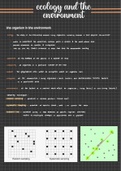
sampling techniques
:
random sampling -
quadrat in random positions ( avoids bias )
systematic sampling -
quadrat at specific points ,
each - m across the area
transect line -
quadrat along a tape measure at specific regular intervals
useful to investigate changes in populations over a
gradient
, measuring of
population organisms
I place quadrat randomly within sampling area
2 count number of members of the same species within the quadrat
3 repeat this within sampling area using same size quadrat -
4
repeat process in another area
population size = ( total area I sampled area ) x no .
of organisms
biodiversity
:
a measure of the range of species living within an ecosystem
investigate distribution of organisms in their habitats
•
use same method as above
•
count the populations of different species instead of counting how many of a
single organism is found
improved placing quadrat randomly quadrat & of
•
reliability by , using same size increase number
samples taken in each area
Abiotic factors ( non -
living ) biotic factors ( living )
of food
*
•
light intensity avail .
less light = less photosynthesis = b rate of growth less food = animals struggle =
less likely to breed
affects no . of herri bores that can live there
predators
'
new
•
temperature animals may have no defense against new
low temp
=
less photosynthesis = b rate of growth predators
limit no . of hervibores that can live there
during
winter .
new pathogens +
parasites
organisms have no resistance against new pathogens
levels
•
moisture
needs water to survive -
less pd A in deserts .
competition
if one species better adapted to environment ,
•
soil pH & mineral content it will outcompete it until numbers of lesser
limit in soil =
limit in
plant growth adapted species are insufficient to breed .
needs nitrates to grow
low pH = slows rate of decay = slows down
release of mineral ions
wind intensity R direction
•
more wind =
T rate of transpiration
:
•
avail . of Oz for live below water
-
avail . of CO2 : for photosynthesis
•
seeks to understand the connections between plants & animals & the world around them
•
provides information on benefits of ecosystems
•
how we can use Earth 's resources in ways that keep the environment healthy
population :
all the members of one species in a habitat at once
community : all organisms in a particular habitat at one time
the
habitat :
geographical area within an ecosystem where an
organism lives
all the communities 1 biotic factors and environmental lab lotic factors
ecosystem living I
:
organisms
in a particular area
environment : all the factors in a habitat which affect an organism ; living ( biotic ) or non -
living ( abiotic )
sampling techniques
:
random sampling -
quadrat in random positions ( avoids bias )
systematic sampling -
quadrat at specific points ,
each - m across the area
transect line -
quadrat along a tape measure at specific regular intervals
useful to investigate changes in populations over a
gradient
, measuring of
population organisms
I place quadrat randomly within sampling area
2 count number of members of the same species within the quadrat
3 repeat this within sampling area using same size quadrat -
4
repeat process in another area
population size = ( total area I sampled area ) x no .
of organisms
biodiversity
:
a measure of the range of species living within an ecosystem
investigate distribution of organisms in their habitats
•
use same method as above
•
count the populations of different species instead of counting how many of a
single organism is found
improved placing quadrat randomly quadrat & of
•
reliability by , using same size increase number
samples taken in each area
Abiotic factors ( non -
living ) biotic factors ( living )
of food
*
•
light intensity avail .
less light = less photosynthesis = b rate of growth less food = animals struggle =
less likely to breed
affects no . of herri bores that can live there
predators
'
new
•
temperature animals may have no defense against new
low temp
=
less photosynthesis = b rate of growth predators
limit no . of hervibores that can live there
during
winter .
new pathogens +
parasites
organisms have no resistance against new pathogens
levels
•
moisture
needs water to survive -
less pd A in deserts .
competition
if one species better adapted to environment ,
•
soil pH & mineral content it will outcompete it until numbers of lesser
limit in soil =
limit in
plant growth adapted species are insufficient to breed .
needs nitrates to grow
low pH = slows rate of decay = slows down
release of mineral ions
wind intensity R direction
•
more wind =
T rate of transpiration
:
•
avail . of Oz for live below water
-
avail . of CO2 : for photosynthesis

