
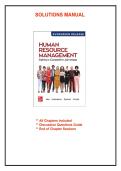
SOLUTIONS MANUAL
** All Chapters included
** Discussion Questions Guide
** End of Chapter Sections
,Table of Contents are given below
1. Human Resource Management: Gaining a Competitive
2. Strategic Human Resource Management
3. The Legal Environment: Equal Employment Opportunity and Safety
4. The Analysis and Design of Work
5. Human Resource Planning and Recruitment
6. Selection and Placement
7. Training
8. Performance Management
9. Employee Development
10. Employee Separation and Retention
11. Pay Structure Decisions
12. Recognizing Employee Contributions with Pay
13. Employee Benefits
14. Collective Bargaining and Labor Relations
15. Managing Human Resources Globally
16. Strategically Managing the HRM Function
,Human Resource Management: Gaining a Competitive Advantage, 2025 Release Instructor’s Manual
Chapter 1
Human Resource Management:
Gaining a Competitive Advantage
This chapter discusses the role of Human Resource Management (HRM) in gaining a competitive
advantage. It provides a foundation for the rest of the chapters by describing the role HRM plays
within organizations and the skills HRM practitioners need for any company to be competitive.
Within this chapter are the competitive challenges that U.S. companies currently face, which
influence their ability to meet the needs of shareholders, customers, employees, and other
stakeholders and support as to how these competitive challenges are influencing HRM.
At the end of this chapter, instructors should ensure students understand HRM and its role within
organizations (LO1-1, LO1-7). Further, students should be able to discuss the different HRM
practices (LO1-8), which are outlined towards the end of the chapter. Accomplishing both tasks will
help support students in subsequent chapters; however, it can be a difficult task given the
perceptions of HRM and HR departments, as well as the potential for students who lack exposure to
such ideas and practices.
The instructor may wish to ensure (and continue to revisit throughout the course) the student
continually focuses on how they are the ones making the decisions (i.e. managers). However, their
own experiences such as being interviewed can lend to great course discussion and reflection.
Instructors may also find students, especially those with little interest in HRM or within other
majors, experiencing difficulty in recognizing the importance of this topic and practice. Instructors
may wish to emphasize that although HRM is a separate practice, much of what will be studied
directly applies to the business acumen of managers and leaders in all facets of business
management.
Once the above is considered, instructors may then wish to discuss the remainder of the LOs. If
students have had a previous Introduction to Business/ Management or similar course, then
discussion of these LOs from the perspective of strategic management and internal/external
analysis (i.e. SWOT analysis) may help students connect the concepts. Specifically, if a general
understanding of strategic management exists, then instructors may discuss how HRM practices
can contribute to the strategic advantage of organizations, and how HR departments and
professionals hold a specific role and may contribute to this process. It would be helpful to draw
students’ attention to Table 1.15, which shows the outline of the textbook. These topics can help
further demonstrate the different areas within HRM, and what students may expect from the
remainder of the course.
Learning Objectives
LO 1-1: Discuss the roles and activities of a company’s human resource management function.
LO 1-2: Discuss the implications of the economy, the makeup of the labor force, and ethics for
company sustainability.
LO 1-3: Discuss how human resource management affects a company’s balanced scorecard.
1-1
, Human Resource Management: Gaining a Competitive Advantage, 2025 Release Instructor’s Manual
LO 1-4: Discuss what companies should do to compete in the global marketplace.
LO 1-5: Identify how social networking, artificial intelligence, and robotics is influencing human
resource management.
LO 1-6: Describe how automation using artificial intelligence and robotics has the potential to
change jobs.
LO 1-7: Discuss human resource management practices that support high-performance work
systems.
LO 1-8: Provide a brief description of human resource management practices.
Society for Human Resource Management Body of Competency &
Knowledge
This chapter contains content which may be identified within the following content areas identified
in HR Expertise:
• HR Strategic Planning
• Talent Acquisition
• Employee Engagement & Retention
• Learning & Development
• Total Rewards
• Structure of the HR Function
• Organizational Effectiveness & Development
• Workforce Management
• Employee & Labor Relations
• Technology Management
• HR in the Global Context
• Inclusion & Belongingness
• Risk Management
• Corporate Social Responsibility
• U.S. Employment Law & Regulations
Human Resource Certification Institute’s A Guide to the HR Body of
Knowledge
This chapter contains content which may be identified within the following content areas:
• Business Management & Strategy
• Workforce Planning and Employment
• Human Resource Development
• Compensation and Benefits
• Employee and Labor Relations
• Risk Management
1-2
** All Chapters included
** Discussion Questions Guide
** End of Chapter Sections
,Table of Contents are given below
1. Human Resource Management: Gaining a Competitive
2. Strategic Human Resource Management
3. The Legal Environment: Equal Employment Opportunity and Safety
4. The Analysis and Design of Work
5. Human Resource Planning and Recruitment
6. Selection and Placement
7. Training
8. Performance Management
9. Employee Development
10. Employee Separation and Retention
11. Pay Structure Decisions
12. Recognizing Employee Contributions with Pay
13. Employee Benefits
14. Collective Bargaining and Labor Relations
15. Managing Human Resources Globally
16. Strategically Managing the HRM Function
,Human Resource Management: Gaining a Competitive Advantage, 2025 Release Instructor’s Manual
Chapter 1
Human Resource Management:
Gaining a Competitive Advantage
This chapter discusses the role of Human Resource Management (HRM) in gaining a competitive
advantage. It provides a foundation for the rest of the chapters by describing the role HRM plays
within organizations and the skills HRM practitioners need for any company to be competitive.
Within this chapter are the competitive challenges that U.S. companies currently face, which
influence their ability to meet the needs of shareholders, customers, employees, and other
stakeholders and support as to how these competitive challenges are influencing HRM.
At the end of this chapter, instructors should ensure students understand HRM and its role within
organizations (LO1-1, LO1-7). Further, students should be able to discuss the different HRM
practices (LO1-8), which are outlined towards the end of the chapter. Accomplishing both tasks will
help support students in subsequent chapters; however, it can be a difficult task given the
perceptions of HRM and HR departments, as well as the potential for students who lack exposure to
such ideas and practices.
The instructor may wish to ensure (and continue to revisit throughout the course) the student
continually focuses on how they are the ones making the decisions (i.e. managers). However, their
own experiences such as being interviewed can lend to great course discussion and reflection.
Instructors may also find students, especially those with little interest in HRM or within other
majors, experiencing difficulty in recognizing the importance of this topic and practice. Instructors
may wish to emphasize that although HRM is a separate practice, much of what will be studied
directly applies to the business acumen of managers and leaders in all facets of business
management.
Once the above is considered, instructors may then wish to discuss the remainder of the LOs. If
students have had a previous Introduction to Business/ Management or similar course, then
discussion of these LOs from the perspective of strategic management and internal/external
analysis (i.e. SWOT analysis) may help students connect the concepts. Specifically, if a general
understanding of strategic management exists, then instructors may discuss how HRM practices
can contribute to the strategic advantage of organizations, and how HR departments and
professionals hold a specific role and may contribute to this process. It would be helpful to draw
students’ attention to Table 1.15, which shows the outline of the textbook. These topics can help
further demonstrate the different areas within HRM, and what students may expect from the
remainder of the course.
Learning Objectives
LO 1-1: Discuss the roles and activities of a company’s human resource management function.
LO 1-2: Discuss the implications of the economy, the makeup of the labor force, and ethics for
company sustainability.
LO 1-3: Discuss how human resource management affects a company’s balanced scorecard.
1-1
, Human Resource Management: Gaining a Competitive Advantage, 2025 Release Instructor’s Manual
LO 1-4: Discuss what companies should do to compete in the global marketplace.
LO 1-5: Identify how social networking, artificial intelligence, and robotics is influencing human
resource management.
LO 1-6: Describe how automation using artificial intelligence and robotics has the potential to
change jobs.
LO 1-7: Discuss human resource management practices that support high-performance work
systems.
LO 1-8: Provide a brief description of human resource management practices.
Society for Human Resource Management Body of Competency &
Knowledge
This chapter contains content which may be identified within the following content areas identified
in HR Expertise:
• HR Strategic Planning
• Talent Acquisition
• Employee Engagement & Retention
• Learning & Development
• Total Rewards
• Structure of the HR Function
• Organizational Effectiveness & Development
• Workforce Management
• Employee & Labor Relations
• Technology Management
• HR in the Global Context
• Inclusion & Belongingness
• Risk Management
• Corporate Social Responsibility
• U.S. Employment Law & Regulations
Human Resource Certification Institute’s A Guide to the HR Body of
Knowledge
This chapter contains content which may be identified within the following content areas:
• Business Management & Strategy
• Workforce Planning and Employment
• Human Resource Development
• Compensation and Benefits
• Employee and Labor Relations
• Risk Management
1-2

