

microeconomics : the study of individual markets
e.
g. studying the effect of the demand for good
a price change on a
↳ makers markets
desicion are producers and consumers who directly operate in
macroeconomics : the study of an entire economy as a whole
e.
g. studying the total size of the
economy or
unemployment rate , among other things
↳ deslcion maker is the government of the particular economy ( town / state / country )
basic economic questions :
what to produce
-
how to produce
-
who gets the product
-
market :
the exchange of goods and services that takes place as a result of buyers and sellers being in
contact with one another
•
producers will produce the good that is cost efficient ,
and produced for those who are willing to buy
^
p
s
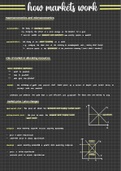
equilibrium price : the price at which the demand and supply curves meet
disequilibrium price : the price at which the demand and supply curves ← equilibrium
dont meet
D
>
Q
surplus : when quantity supplied exceeds quantity demanded
equilibrium
•
price is above
•
decrease price to reach equilibrium -
surplus
5
2.5
shortage :
when quantity demanded is greater than quantity supplied
•
price is below equilibrium 1.5
increase to reach equilibrium shortage
price
•
☐
>
4 10
, •
the want and willingness of consumers to by a good or service at a given price
effective demand :
when willingness to buy is backed by the ability to pay ( can afford )
individual demand : demand from one consumer
1
market demand : total aggregate demand sum of all individual demands of consumers
•
an increase in price → decrease In demand
→ inverse relationship
•
a decrease in price → increase in demand
•
increase in demand → increase in price
•
decrease in demand → decrease in price
~ ~
p p
" "
contraction in
extension in r
s ^ demand
a
demand
-
s
n
n
T
o A → B T B → A
o
extension : increase in s
- "
•
n contraction : decrease in
° B B
demand due to - •
due
demand to
changes in price
changes in price
> >
> <
Q decrease
Q
increase
~ ~
p p
rise in demand fall in demand
7
A → B B → A
rise / increase in demand A B ha B fall / decrease in demand
go go
= curve shifts right = curve shifts left
☐ , Dz Dz Di
500 600
> 500 600
7
Q Q
factors affecting shifts in a demand curve
•
consumer incomes : T income = shift right ,
b income = shift left
•
taxes on income : b income tax =
shift right ,
f income tax = shift left
•
price of substitutes : T price = shift right ,
b price
=
shift left
•
price of complements :b
price =
shift right ,
T price = shift left
•
changes in taste / trends
•
advertising
:
good advertising =
shift right ,
bad advertising =
shift left
•
changes in population : T population =
shift right
,
b population = shift left
•
expectations of future prices : T price = shift right ,
I price = shift left
e.
g. studying the effect of the demand for good
a price change on a
↳ makers markets
desicion are producers and consumers who directly operate in
macroeconomics : the study of an entire economy as a whole
e.
g. studying the total size of the
economy or
unemployment rate , among other things
↳ deslcion maker is the government of the particular economy ( town / state / country )
basic economic questions :
what to produce
-
how to produce
-
who gets the product
-
market :
the exchange of goods and services that takes place as a result of buyers and sellers being in
contact with one another
•
producers will produce the good that is cost efficient ,
and produced for those who are willing to buy
^
p
s
equilibrium price : the price at which the demand and supply curves meet
disequilibrium price : the price at which the demand and supply curves ← equilibrium
dont meet
D
>
Q
surplus : when quantity supplied exceeds quantity demanded
equilibrium
•
price is above
•
decrease price to reach equilibrium -
surplus
5
2.5
shortage :
when quantity demanded is greater than quantity supplied
•
price is below equilibrium 1.5
increase to reach equilibrium shortage
price
•
☐
>
4 10
, •
the want and willingness of consumers to by a good or service at a given price
effective demand :
when willingness to buy is backed by the ability to pay ( can afford )
individual demand : demand from one consumer
1
market demand : total aggregate demand sum of all individual demands of consumers
•
an increase in price → decrease In demand
→ inverse relationship
•
a decrease in price → increase in demand
•
increase in demand → increase in price
•
decrease in demand → decrease in price
~ ~
p p
" "
contraction in
extension in r
s ^ demand
a
demand
-
s
n
n
T
o A → B T B → A
o
extension : increase in s
- "
•
n contraction : decrease in
° B B
demand due to - •
due
demand to
changes in price
changes in price
> >
> <
Q decrease
Q
increase
~ ~
p p
rise in demand fall in demand
7
A → B B → A
rise / increase in demand A B ha B fall / decrease in demand
go go
= curve shifts right = curve shifts left
☐ , Dz Dz Di
500 600
> 500 600
7
Q Q
factors affecting shifts in a demand curve
•
consumer incomes : T income = shift right ,
b income = shift left
•
taxes on income : b income tax =
shift right ,
f income tax = shift left
•
price of substitutes : T price = shift right ,
b price
=
shift left
•
price of complements :b
price =
shift right ,
T price = shift left
•
changes in taste / trends
•
advertising
:
good advertising =
shift right ,
bad advertising =
shift left
•
changes in population : T population =
shift right
,
b population = shift left
•
expectations of future prices : T price = shift right ,
I price = shift left

