

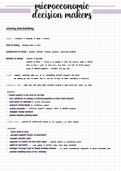
money : a medium of exchange of goods & services
form of money :
currency notes & coins
characteristics of money
:
durable ,
uniform , divisible , portable , generally accepted
functions of
money
: medium of exchange
measure of value -
allows us to compare a state the worth of goods d services
for future
store of value holds its value for a
long time can save purposes
-
,
means of deferred payment
-
consumer can
pay later
banks : financial institutions that act as an intermediary between borrowers and Savers
the money we save at banks that is lent out as loans to other individuals & businesses
commercial banks : banks that have many retail branches located in most cities and towns e. g . HSBC
functions :
•
accepts deposit in the form of savings
•
aid customers in
making a
receiving payments via their bank accounts
give loans
°
to businesses & private individuals
•
buying & selling shares on customer 's behalf
•
provide insurance -
protection against damage 1 theft of personal property
foreign currencies
•
exchange
provide financial advice
•
planning
central banks governs all commercial banks bank rakyat
: in the country e. g .
functions
•
issues notes & coins
•
manages payments related to government
•
manages national debt
supervises d controls all the other banks holding deposits & transferring funds
•
-
•
lender of last resort -
lend money to prevent banks from going bankrupt
•
manages country 's gold & foreign currency reserves -
to make international payments & adjust exchange rate
•
operates monetary policy in an
economy
, spending
disposable disposable income = T spending
•
income -
more
•
wealth T
more wealthy spending
-
=
consumer confidence if future T
confident keeping jobs & income =
spending
° -
in
•
interest rate -
high interest rate =
want to save more to earn interest = t
spending
saving
°
saving for consumption -
want to make big purchases = T saving
disposable income T disposable income T saving ( rich people than poor )
• -
= save more
Interest rate T interest rate T
saving
° -
=
confidence if not confident job security d future T
in
saving
=
•
consumer -
income
°
availability of saving schemes -
more beneficial schemes = T savings
borrowing
•
interest rate : t interest rate =
exp to borrow = b
borrowing
wealth 1 wealthy likely loan ( bc repay ) T borrowing for rich
=
banks more
"
income : more = to can
•
consumer confidence : if they think prices will rise = T burrowing to make purchases now
•
ways of borrowing
•
richer will spend , save and borrow more than poor
•
the poor spends higher percentage of disposable income than the rich
the save lesser proportions of their disposable income in companion to rich
•
poor
form of money :
currency notes & coins
characteristics of money
:
durable ,
uniform , divisible , portable , generally accepted
functions of
money
: medium of exchange
measure of value -
allows us to compare a state the worth of goods d services
for future
store of value holds its value for a
long time can save purposes
-
,
means of deferred payment
-
consumer can
pay later
banks : financial institutions that act as an intermediary between borrowers and Savers
the money we save at banks that is lent out as loans to other individuals & businesses
commercial banks : banks that have many retail branches located in most cities and towns e. g . HSBC
functions :
•
accepts deposit in the form of savings
•
aid customers in
making a
receiving payments via their bank accounts
give loans
°
to businesses & private individuals
•
buying & selling shares on customer 's behalf
•
provide insurance -
protection against damage 1 theft of personal property
foreign currencies
•
exchange
provide financial advice
•
planning
central banks governs all commercial banks bank rakyat
: in the country e. g .
functions
•
issues notes & coins
•
manages payments related to government
•
manages national debt
supervises d controls all the other banks holding deposits & transferring funds
•
-
•
lender of last resort -
lend money to prevent banks from going bankrupt
•
manages country 's gold & foreign currency reserves -
to make international payments & adjust exchange rate
•
operates monetary policy in an
economy
, spending
disposable disposable income = T spending
•
income -
more
•
wealth T
more wealthy spending
-
=
consumer confidence if future T
confident keeping jobs & income =
spending
° -
in
•
interest rate -
high interest rate =
want to save more to earn interest = t
spending
saving
°
saving for consumption -
want to make big purchases = T saving
disposable income T disposable income T saving ( rich people than poor )
• -
= save more
Interest rate T interest rate T
saving
° -
=
confidence if not confident job security d future T
in
saving
=
•
consumer -
income
°
availability of saving schemes -
more beneficial schemes = T savings
borrowing
•
interest rate : t interest rate =
exp to borrow = b
borrowing
wealth 1 wealthy likely loan ( bc repay ) T borrowing for rich
=
banks more
"
income : more = to can
•
consumer confidence : if they think prices will rise = T burrowing to make purchases now
•
ways of borrowing
•
richer will spend , save and borrow more than poor
•
the poor spends higher percentage of disposable income than the rich
the save lesser proportions of their disposable income in companion to rich
•
poor

