

CLTM Exam 2026/2027 - Certified in Long Term Monitoring (ABRET) ABRET Certification Preparation
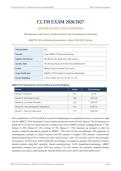
CLTM EXAM 2026/2027
CERTIFIED IN LONG TERM MONITORING
200 Questions with Correct, Verified Answers and Comprehensive Rationales
ABRET CLTM Certification Examination | Latest 2026/2027 Version
Total Questions 200
Domains 5 (per ABRET CLTM Content Outline)
Cognitive Distribution 30% Recall | 50% Application | 20% Analysis
Question Style 75% Scenario-based | 25% Direct Recall/Identification
Format Multiple Choice (4 options, one correct)
Target Certification ABRET CLTM (Certified in Long Term Monitoring)
Domain Weighting I: 10% | II: 49% | III: 15% | IV: 9% | V: 17%
ABRET CLTM Examination Content Outline & Domain Weighting
Domain Weight Question Range
Domain I - Preparation 10% Q1-36
Domain II - Performing the Study 49% Q37-148
Domain III - Post-Study Procedures 15% Q149-175
Domain IV - Data and Equipment Management 9% Q176-191
Domain V - Ethics and Safety Issues 17% Q192-200
This comprehensive CLTM (Certified in Long Term Monitoring) exam preparation resource is structured to align
with the ABRET CLTM Examination Content Outline and the most recent Job Task Analysis. The 200 questions are
distributed across the five content domains according to the official ABRET blueprint weighting (Domain I: 10%,
Domain II: 49%, Domain III: 15%, Domain IV: 9%, Domain V: 17%). Questions are designed to reflect the
cognitive complexity distribution required by ABRET - 30% recall of facts and definitions, 50% application of
neurodiagnostic principles to clinical scenarios, and 20% analysis of complex LTM situations. Scenario-based
questions predominate (75%) to mirror real-world clinical practice, while 25% test direct recall of EEG principles,
neuroanatomy, 10-20 System, ACNS standardized terminology, and regulatory standards. Each question includes a
detailed rationale citing EEG principles, clinical neurophysiology, ACNS standardized terminology, ABRET
professional standards, and current LTM best practices. Use this resource for systematic domain-by-domain
preparation, focusing on understanding the rationale behind each correct answer rather than memorization.
ABRET CLTM Exam Preparation - 200 Questions with Verified Answers & Rationales Page 1
,CLTM Exam 2026/2027 - Certified in Long Term Monitoring (ABRET) ABRET Certification Preparation
SECTION 1:
DOMAIN I - Preparation (Planning Recording Strategy, Patient/Family Communication, & Medical Record
This domain covers pre-study planning including recording strategy selection based on clinical indication, patient and
family education, informed consent, medical record review, structural and functional neuroanatomy relevant to long-term
monitoring, and the International 10-20 System of electrode placement. Approximately 10% of the CLTM examination
covers this domain.
Q1: A 28-year-old patient is referred for long-term video EEG monitoring to characterize recurrent episodes
of altered awareness. The ordering physician documents "rule out seizures" with no further detail. Which
recording strategy is MOST appropriate for this indication?
A. Routine 30-minute outpatient EEG with photic stimulation and hyperventilation
B. Admission to the epilepsy monitoring unit (EMU) for prolonged video-EEG monitoring with
antiseizure medication modification per neurologist protocol [CORRECT]
C. 24-hour ambulatory EEG without video to maximize patient comfort
D. Sleep-deprived outpatient EEG with nap opportunity
Correct Answer: B
Rationale: For characterization of recurrent episodes of altered awareness where seizure is in the differential,
prolonged video-EEG monitoring in the EMU is the gold standard because it allows correlation of the clinical
semiology with EEG changes during the habitual event, and medication tapering increases the likelihood of
capturing events. Routine EEG (Option A) is too short and rarely captures the events. Ambulatory EEG without
video (Option C) loses the critical semiology correlation. Sleep-deprived EEG (Option D) may increase yield but
lacks the prolonged recording and video needed for event characterization. ABRET CLTM candidates must
understand recording strategy selection based on clinical indication.
Q2: A patient is scheduled for continuous EEG (cEEG) monitoring in the ICU for management of status
epilepticus. When reviewing the medical record, the technologist notes the patient is on a midazolam infusion.
What is the MOST important implication of this for the recording strategy?
A. The infusion will eliminate all EEG activity, making the recording unnecessary
B. The infusion may produce excessive beta activity and diffusely suppress background, requiring careful
review for electrographic seizures that may be subtle or non-convulsive [CORRECT]
C. The infusion will have no effect on the EEG interpretation
D. The infusion requires using fewer electrodes to reduce artifact
Correct Answer: B
Rationale: Midazolam, a benzodiazepine, characteristically produces excessive beta activity (especially frontal)
and may diffusely suppress the EEG background, masking subtle electrographic seizure patterns and
complicating detection of non-convulsive seizures. The technologist should document the infusion rate and time
of changes, as drug effect evolves. The recording remains essential for detecting non-convulsive seizures.
Reducing electrode count (Option D) compromises localization. ABRET CLTM candidates must understand how
pharmacologic interventions affect EEG interpretation in ICU settings.
ABRET CLTM Exam Preparation - 200 Questions with Verified Answers & Rationales Page 2
,CLTM Exam 2026/2027 - Certified in Long Term Monitoring (ABRET) ABRET Certification Preparation
Q3: When educating a pediatric patient and family about admission to the epilepsy monitoring unit, which
statement represents appropriate technologist communication?
A. Promise the family that the recording will definitely capture a seizure
B. Explain that the goal is to record typical events while maintaining safety, that seizure precautions will
be in place, and that the camera and EEG will record continuously during the admission [CORRECT]
C. Tell the family they cannot stay with the patient during the admission
D. Explain that the patient will need to remain completely still throughout the recording
Correct Answer: B
Rationale: Appropriate EMU education includes explaining the recording goal (capturing typical events), safety
measures (seizure precautions, fall prevention, suction availability), and the continuous nature of video-EEG
recording. Promising seizure capture (Option A) is misleading and inappropriate - events may not occur. Families
are typically encouraged to stay (Option C is wrong). Patients are encouraged to perform normal activities within
safety parameters, not remain still (Option D is wrong). The ACNS and ABRET emphasize clear patient
education for safe and effective LTM studies.
Q4: A technologist is preparing to apply the International 10-20 System of electrode placement. Which
measurement technique correctly identifies the vertex (Cz) position?
A. Measure 50% of the distance from the nasion to inion along the midline
B. Measure 50% of the distance from the preauricular point to preauricular point along the coronal
midline; Cz is at the intersection of this measurement and the nasion-inion midpoint [CORRECT]
C. Measure 20% posterior from the glabella
D. Measure 10% above the external auditory meatus bilaterally
Correct Answer: B
Rationale: Cz (vertex) is identified at the intersection of two midline measurements: 50% of the nasion-to-inion
distance along the sagittal midline, and 50% of the preauricular-to-preauricular distance along the coronal
midline. Option A is incomplete - it only identifies one plane. Option C and D are not part of the 10-20 System
measurement methodology. The 10-20 System uses percentages of total head measurements (10% and 20%
intervals) to standardize electrode placement relative to underlying cortical anatomy regardless of head size.
Mastery of the 10-20 System is fundamental to ABRET CLTM practice.
Q5: In the International 10-20 System, which electrode is located 30% of the distance from the preauricular
point to the vertex along the coronal midline?
A. T3 (left mid-temporal)
B. C3 (left central) [CORRECT]
C. C4 (right central)
D. P3 (left parietal)
Correct Answer: B
Rationale: C3 is located 30% of the distance from the left preauricular point toward the vertex (Cz) along the
coronal midline, with Cz being 50% of this distance. The coronal line includes T3 (left, 10% from preauricular),
C3 (30%), Cz (50%, midline), C4 (70%, or 30% from right preauricular), and T4 (right, 90%, or 10% from right
preauricular). T4 is on the right. P3 is on the parietal line, not the central coronal line. The 10-20 System ensures
consistent electrode localization corresponding to underlying cortical regions.
ABRET CLTM Exam Preparation - 200 Questions with Verified Answers & Rationales Page 3
, CLTM Exam 2026/2027 - Certified in Long Term Monitoring (ABRET) ABRET Certification Preparation
Q6: A technologist is measuring a patient's head for 10-20 System electrode placement. The nasion-to-inion
distance measures 36 cm and the preauricular-to-preauricular distance measures 30 cm. At what distance
from the nasion should Fz be placed along the midline?
A. 3.6 cm
B. 7.2 cm
C. 10.8 cm [CORRECT]
D. 18.0 cm
Correct Answer: C
Rationale: Fz is located 30% of the distance from the nasion to Cz along the midline (Cz is at 50% from nasion).
The nasion-to-inion distance is 36 cm. The midline measurements are: Fpz at 10% (3.6 cm from nasion), Fz at
30% (10.8 cm from nasion, but on the midline), Cz at 50% (18.0 cm from nasion), Pz at 70% (25.2 cm), and Oz at
90% (32.4 cm). Therefore Fz is at 10.8 cm from the nasion along the midline. The 10-20 System places Fz and Pz
at 20% intervals from Cz, with Fpz and Oz at the extremes. ABRET requires precise measurement calculation.
Q7: When applying electrodes using the 10-20 System, which skull landmark is used to establish the
anterior-posterior midline reference?
A. The glabella and the external occipital protuberance
B. The nasion (midpoint between the glabella and the bridge of the nose) and the inion (external occipital
protuberance) [CORRECT]
C. The bregma and lambda
D. The preauricular points
Correct Answer: B
Rationale: The nasion (the indentation at the bridge of the nose, between the eyes) and the inion (the bony
prominence at the lower back of the skull, external occipital protuberance) are the anterior-posterior midline
landmarks in the 10-20 System. The preauricular points (depressions just anterior to the ear openings) establish
the lateral (coronal) reference. The bregma and lambda (Option C) are skull fontanelle landmarks in infants, not
used in the 10-20 System measurement. ABRET requires precise identification of these landmarks for accurate
electrode placement.
ABRET CLTM Exam Preparation - 200 Questions with Verified Answers & Rationales Page 4
CLTM EXAM 2026/2027
CERTIFIED IN LONG TERM MONITORING
200 Questions with Correct, Verified Answers and Comprehensive Rationales
ABRET CLTM Certification Examination | Latest 2026/2027 Version
Total Questions 200
Domains 5 (per ABRET CLTM Content Outline)
Cognitive Distribution 30% Recall | 50% Application | 20% Analysis
Question Style 75% Scenario-based | 25% Direct Recall/Identification
Format Multiple Choice (4 options, one correct)
Target Certification ABRET CLTM (Certified in Long Term Monitoring)
Domain Weighting I: 10% | II: 49% | III: 15% | IV: 9% | V: 17%
ABRET CLTM Examination Content Outline & Domain Weighting
Domain Weight Question Range
Domain I - Preparation 10% Q1-36
Domain II - Performing the Study 49% Q37-148
Domain III - Post-Study Procedures 15% Q149-175
Domain IV - Data and Equipment Management 9% Q176-191
Domain V - Ethics and Safety Issues 17% Q192-200
This comprehensive CLTM (Certified in Long Term Monitoring) exam preparation resource is structured to align
with the ABRET CLTM Examination Content Outline and the most recent Job Task Analysis. The 200 questions are
distributed across the five content domains according to the official ABRET blueprint weighting (Domain I: 10%,
Domain II: 49%, Domain III: 15%, Domain IV: 9%, Domain V: 17%). Questions are designed to reflect the
cognitive complexity distribution required by ABRET - 30% recall of facts and definitions, 50% application of
neurodiagnostic principles to clinical scenarios, and 20% analysis of complex LTM situations. Scenario-based
questions predominate (75%) to mirror real-world clinical practice, while 25% test direct recall of EEG principles,
neuroanatomy, 10-20 System, ACNS standardized terminology, and regulatory standards. Each question includes a
detailed rationale citing EEG principles, clinical neurophysiology, ACNS standardized terminology, ABRET
professional standards, and current LTM best practices. Use this resource for systematic domain-by-domain
preparation, focusing on understanding the rationale behind each correct answer rather than memorization.
ABRET CLTM Exam Preparation - 200 Questions with Verified Answers & Rationales Page 1
,CLTM Exam 2026/2027 - Certified in Long Term Monitoring (ABRET) ABRET Certification Preparation
SECTION 1:
DOMAIN I - Preparation (Planning Recording Strategy, Patient/Family Communication, & Medical Record
This domain covers pre-study planning including recording strategy selection based on clinical indication, patient and
family education, informed consent, medical record review, structural and functional neuroanatomy relevant to long-term
monitoring, and the International 10-20 System of electrode placement. Approximately 10% of the CLTM examination
covers this domain.
Q1: A 28-year-old patient is referred for long-term video EEG monitoring to characterize recurrent episodes
of altered awareness. The ordering physician documents "rule out seizures" with no further detail. Which
recording strategy is MOST appropriate for this indication?
A. Routine 30-minute outpatient EEG with photic stimulation and hyperventilation
B. Admission to the epilepsy monitoring unit (EMU) for prolonged video-EEG monitoring with
antiseizure medication modification per neurologist protocol [CORRECT]
C. 24-hour ambulatory EEG without video to maximize patient comfort
D. Sleep-deprived outpatient EEG with nap opportunity
Correct Answer: B
Rationale: For characterization of recurrent episodes of altered awareness where seizure is in the differential,
prolonged video-EEG monitoring in the EMU is the gold standard because it allows correlation of the clinical
semiology with EEG changes during the habitual event, and medication tapering increases the likelihood of
capturing events. Routine EEG (Option A) is too short and rarely captures the events. Ambulatory EEG without
video (Option C) loses the critical semiology correlation. Sleep-deprived EEG (Option D) may increase yield but
lacks the prolonged recording and video needed for event characterization. ABRET CLTM candidates must
understand recording strategy selection based on clinical indication.
Q2: A patient is scheduled for continuous EEG (cEEG) monitoring in the ICU for management of status
epilepticus. When reviewing the medical record, the technologist notes the patient is on a midazolam infusion.
What is the MOST important implication of this for the recording strategy?
A. The infusion will eliminate all EEG activity, making the recording unnecessary
B. The infusion may produce excessive beta activity and diffusely suppress background, requiring careful
review for electrographic seizures that may be subtle or non-convulsive [CORRECT]
C. The infusion will have no effect on the EEG interpretation
D. The infusion requires using fewer electrodes to reduce artifact
Correct Answer: B
Rationale: Midazolam, a benzodiazepine, characteristically produces excessive beta activity (especially frontal)
and may diffusely suppress the EEG background, masking subtle electrographic seizure patterns and
complicating detection of non-convulsive seizures. The technologist should document the infusion rate and time
of changes, as drug effect evolves. The recording remains essential for detecting non-convulsive seizures.
Reducing electrode count (Option D) compromises localization. ABRET CLTM candidates must understand how
pharmacologic interventions affect EEG interpretation in ICU settings.
ABRET CLTM Exam Preparation - 200 Questions with Verified Answers & Rationales Page 2
,CLTM Exam 2026/2027 - Certified in Long Term Monitoring (ABRET) ABRET Certification Preparation
Q3: When educating a pediatric patient and family about admission to the epilepsy monitoring unit, which
statement represents appropriate technologist communication?
A. Promise the family that the recording will definitely capture a seizure
B. Explain that the goal is to record typical events while maintaining safety, that seizure precautions will
be in place, and that the camera and EEG will record continuously during the admission [CORRECT]
C. Tell the family they cannot stay with the patient during the admission
D. Explain that the patient will need to remain completely still throughout the recording
Correct Answer: B
Rationale: Appropriate EMU education includes explaining the recording goal (capturing typical events), safety
measures (seizure precautions, fall prevention, suction availability), and the continuous nature of video-EEG
recording. Promising seizure capture (Option A) is misleading and inappropriate - events may not occur. Families
are typically encouraged to stay (Option C is wrong). Patients are encouraged to perform normal activities within
safety parameters, not remain still (Option D is wrong). The ACNS and ABRET emphasize clear patient
education for safe and effective LTM studies.
Q4: A technologist is preparing to apply the International 10-20 System of electrode placement. Which
measurement technique correctly identifies the vertex (Cz) position?
A. Measure 50% of the distance from the nasion to inion along the midline
B. Measure 50% of the distance from the preauricular point to preauricular point along the coronal
midline; Cz is at the intersection of this measurement and the nasion-inion midpoint [CORRECT]
C. Measure 20% posterior from the glabella
D. Measure 10% above the external auditory meatus bilaterally
Correct Answer: B
Rationale: Cz (vertex) is identified at the intersection of two midline measurements: 50% of the nasion-to-inion
distance along the sagittal midline, and 50% of the preauricular-to-preauricular distance along the coronal
midline. Option A is incomplete - it only identifies one plane. Option C and D are not part of the 10-20 System
measurement methodology. The 10-20 System uses percentages of total head measurements (10% and 20%
intervals) to standardize electrode placement relative to underlying cortical anatomy regardless of head size.
Mastery of the 10-20 System is fundamental to ABRET CLTM practice.
Q5: In the International 10-20 System, which electrode is located 30% of the distance from the preauricular
point to the vertex along the coronal midline?
A. T3 (left mid-temporal)
B. C3 (left central) [CORRECT]
C. C4 (right central)
D. P3 (left parietal)
Correct Answer: B
Rationale: C3 is located 30% of the distance from the left preauricular point toward the vertex (Cz) along the
coronal midline, with Cz being 50% of this distance. The coronal line includes T3 (left, 10% from preauricular),
C3 (30%), Cz (50%, midline), C4 (70%, or 30% from right preauricular), and T4 (right, 90%, or 10% from right
preauricular). T4 is on the right. P3 is on the parietal line, not the central coronal line. The 10-20 System ensures
consistent electrode localization corresponding to underlying cortical regions.
ABRET CLTM Exam Preparation - 200 Questions with Verified Answers & Rationales Page 3
, CLTM Exam 2026/2027 - Certified in Long Term Monitoring (ABRET) ABRET Certification Preparation
Q6: A technologist is measuring a patient's head for 10-20 System electrode placement. The nasion-to-inion
distance measures 36 cm and the preauricular-to-preauricular distance measures 30 cm. At what distance
from the nasion should Fz be placed along the midline?
A. 3.6 cm
B. 7.2 cm
C. 10.8 cm [CORRECT]
D. 18.0 cm
Correct Answer: C
Rationale: Fz is located 30% of the distance from the nasion to Cz along the midline (Cz is at 50% from nasion).
The nasion-to-inion distance is 36 cm. The midline measurements are: Fpz at 10% (3.6 cm from nasion), Fz at
30% (10.8 cm from nasion, but on the midline), Cz at 50% (18.0 cm from nasion), Pz at 70% (25.2 cm), and Oz at
90% (32.4 cm). Therefore Fz is at 10.8 cm from the nasion along the midline. The 10-20 System places Fz and Pz
at 20% intervals from Cz, with Fpz and Oz at the extremes. ABRET requires precise measurement calculation.
Q7: When applying electrodes using the 10-20 System, which skull landmark is used to establish the
anterior-posterior midline reference?
A. The glabella and the external occipital protuberance
B. The nasion (midpoint between the glabella and the bridge of the nose) and the inion (external occipital
protuberance) [CORRECT]
C. The bregma and lambda
D. The preauricular points
Correct Answer: B
Rationale: The nasion (the indentation at the bridge of the nose, between the eyes) and the inion (the bony
prominence at the lower back of the skull, external occipital protuberance) are the anterior-posterior midline
landmarks in the 10-20 System. The preauricular points (depressions just anterior to the ear openings) establish
the lateral (coronal) reference. The bregma and lambda (Option C) are skull fontanelle landmarks in infants, not
used in the 10-20 System measurement. ABRET requires precise identification of these landmarks for accurate
electrode placement.
ABRET CLTM Exam Preparation - 200 Questions with Verified Answers & Rationales Page 4

