
https://www.stuvia.com/user/gabrielucky https://www.stuvia.com/user/gabrielucky https://www.stuvia.com/user/gabrielucky
Solution Manual Engineering 1
Mechanics: Dynamics, 15th Edition
Author: R.C. Hibbeler!!!
12–1.
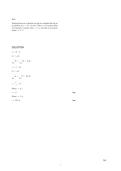
Starting from rest, a particle moving in a straight line has an
acceleration of a = (2t - 6) m>s2, where t is in seconds. What
is the particle’s velocity when t = 6 s, and what is its position
when t = 11 s?
SOLUTION
a = 2t - 6
dv = a dt
v t
dv = (2t - 6) dt
L0 L0
v = t2 - 6t
ds = v dt
s t
ds = (t2 - 6t) dt
L0 L0
t3
s = - 3t 2
3
When t = 6 s,
v= 0 Ans.
When t = 11 s,
s = 80.7 m Ans.
Ans:
1
https://www.stuvia.com/user/gabrielucky https://www.stuvia.com/user/gabrielucky https://www.stuvia.com/user/gabrielucky
,https://www.stuvia.com/user/gabrielucky https://www.stuvia.com/user/gabrielucky https://www.stuvia.com/user/gabrielucky
v = 0
s = 80.7 m
2
https://www.stuvia.com/user/gabrielucky https://www.stuvia.com/user/gabrielucky https://www.stuvia.com/user/gabrielucky
,https://www.stuvia.com/user/gabrielucky https://www.stuvia.com/user/gabrielucky https://www.stuvia.com/user/gabrielucky
Solution Manual Engineering 3
Mechanics: Dynamics, 15th Edition
Author: R.C. Hibbeler!!!
12–2.
If a particle has an initial velocity of v 0 = 12 ft>s to the
right, at s0 = 0, determine its position when t = 10 s, if
a = 2 ft>s2 to the left.
SOLUTION 1
+2
1S s = s0 + v0 t + a t2
c
2
1
= 0 + 12(10) + ( -2)(10)2
2
= 20 ft Ans.
Ans:
3
https://www.stuvia.com/user/gabrielucky https://www.stuvia.com/user/gabrielucky https://www.stuvia.com/user/gabrielucky
, https://www.stuvia.com/user/gabrielucky https://www.stuvia.com/user/gabrielucky https://www.stuvia.com/user/gabrielucky
s = 20 ft
4
https://www.stuvia.com/user/gabrielucky https://www.stuvia.com/user/gabrielucky https://www.stuvia.com/user/gabrielucky

