Anatomy & Physiology I Exam 1 2026/2027
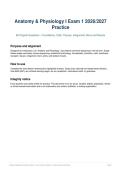
Practice
60 Original Questions - Foundations, Cells, Tissues, Integument, Bone and Muscle
Purpose and alignment
Designed for introductory U.S. Anatomy and Physiology I coursework commonly beginning in the fall term. Scope
follows widely used early-course sequencing: anatomical terminology, homeostasis, chemistry, cells, membrane
transport, tissues, integument, bone, joints, and skeletal muscle.
How to use
Complete the items before reviewing the highlighted answers. Study every rationale and repeat weak domains.
Use 48/60 (80%) as a B-level learning target, not as a prediction, institutional cutoff, or guarantee.
Integrity notice
Every question was newly written for practice. This document is not an actual, recalled, leaked, proprietary, official,
or school-issued examination and is not endorsed by any school, publisher, or testing organization.
Original independent practice material - not an official, recalled, or school-issued examination Page 1
, FOUNDATIONS
Question 1 of 60: Anatomy is the study of:
A. Body structures and their relationships
B. Body functions only
C. Disease treatment
D. Drug metabolism
Correct answer: A - Body structures and their relationships
Rationale: Anatomy focuses on form, location, and structural relationships.
FOUNDATIONS
Question 2 of 60: Physiology is the study of:
A. Only microscopic structure
B. How body parts function
C. Only disease names
D. Medical billing
Correct answer: B - How body parts function
Rationale: Physiology explains the mechanisms by which cells, tissues, organs, and systems work.
Original independent practice material - not an official, recalled, or school-issued examination Page 2
, FOUNDATIONS
Question 3 of 60: Which sequence moves from simplest to most complex?
A. Tissue, chemical, organ, cell, organism
B. Organism, system, organ, tissue, cell
C. Chemical, cellular, tissue, organ, organ system, organism
D. Cell, chemical, organ, tissue, system
Correct answer: C - Chemical, cellular, tissue, organ, organ system, organism
Rationale: Atoms and molecules form cells; similar cells form tissues; tissues build organs and systems.
HOMEOSTASIS
Question 4 of 60: A negative-feedback mechanism generally:
A. Amplifies every change
B. Stops receptor activity permanently
C. Works only during childbirth
D. Opposes deviation from a set range
Correct answer: D - Opposes deviation from a set range
Rationale: Negative feedback reduces the initiating disturbance and stabilizes internal conditions.
Original independent practice material - not an official, recalled, or school-issued examination Page 3
, HOMEOSTASIS
Question 5 of 60: Which is a classic positive-feedback process?
A. Oxytocin-driven intensification of labor contractions
B. Blood glucose regulation
C. Thermoregulation
D. Blood pressure stabilization
Correct answer: A - Oxytocin-driven intensification of labor contractions
Rationale: Cervical stretch promotes oxytocin, which increases contraction and further stretch until birth.
TERMINOLOGY
Question 6 of 60: In anatomical position, the palms face:
A. Posteriorly
B. Anteriorly
C. Medially
D. Inferiorly
Correct answer: B - Anteriorly
Rationale: The standard reference position is upright with arms at the sides and palms forward.
Original independent practice material - not an official, recalled, or school-issued examination Page 4
Practice
60 Original Questions - Foundations, Cells, Tissues, Integument, Bone and Muscle
Purpose and alignment
Designed for introductory U.S. Anatomy and Physiology I coursework commonly beginning in the fall term. Scope
follows widely used early-course sequencing: anatomical terminology, homeostasis, chemistry, cells, membrane
transport, tissues, integument, bone, joints, and skeletal muscle.
How to use
Complete the items before reviewing the highlighted answers. Study every rationale and repeat weak domains.
Use 48/60 (80%) as a B-level learning target, not as a prediction, institutional cutoff, or guarantee.
Integrity notice
Every question was newly written for practice. This document is not an actual, recalled, leaked, proprietary, official,
or school-issued examination and is not endorsed by any school, publisher, or testing organization.
Original independent practice material - not an official, recalled, or school-issued examination Page 1
, FOUNDATIONS
Question 1 of 60: Anatomy is the study of:
A. Body structures and their relationships
B. Body functions only
C. Disease treatment
D. Drug metabolism
Correct answer: A - Body structures and their relationships
Rationale: Anatomy focuses on form, location, and structural relationships.
FOUNDATIONS
Question 2 of 60: Physiology is the study of:
A. Only microscopic structure
B. How body parts function
C. Only disease names
D. Medical billing
Correct answer: B - How body parts function
Rationale: Physiology explains the mechanisms by which cells, tissues, organs, and systems work.
Original independent practice material - not an official, recalled, or school-issued examination Page 2
, FOUNDATIONS
Question 3 of 60: Which sequence moves from simplest to most complex?
A. Tissue, chemical, organ, cell, organism
B. Organism, system, organ, tissue, cell
C. Chemical, cellular, tissue, organ, organ system, organism
D. Cell, chemical, organ, tissue, system
Correct answer: C - Chemical, cellular, tissue, organ, organ system, organism
Rationale: Atoms and molecules form cells; similar cells form tissues; tissues build organs and systems.
HOMEOSTASIS
Question 4 of 60: A negative-feedback mechanism generally:
A. Amplifies every change
B. Stops receptor activity permanently
C. Works only during childbirth
D. Opposes deviation from a set range
Correct answer: D - Opposes deviation from a set range
Rationale: Negative feedback reduces the initiating disturbance and stabilizes internal conditions.
Original independent practice material - not an official, recalled, or school-issued examination Page 3
, HOMEOSTASIS
Question 5 of 60: Which is a classic positive-feedback process?
A. Oxytocin-driven intensification of labor contractions
B. Blood glucose regulation
C. Thermoregulation
D. Blood pressure stabilization
Correct answer: A - Oxytocin-driven intensification of labor contractions
Rationale: Cervical stretch promotes oxytocin, which increases contraction and further stretch until birth.
TERMINOLOGY
Question 6 of 60: In anatomical position, the palms face:
A. Posteriorly
B. Anteriorly
C. Medially
D. Inferiorly
Correct answer: B - Anteriorly
Rationale: The standard reference position is upright with arms at the sides and palms forward.
Original independent practice material - not an official, recalled, or school-issued examination Page 4