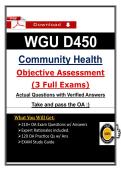
WGU D450
Community Health
Objective Assessment
(3 Full Exams)
Actual Questions with Verified Answers
Take and pass the OA :)
What You Will Get:
➢210+ OA Exam Questions w/ Answers
➢Expert Rationales included.
➢120 OA Practice Qs w/ Ans
➢EXAM Study Guide
, DIGITAL STUDY RESOURCE PREVIEW
Preview Pages Below
Get the Complete PDF After Purchase
If you require further clarification or in need of any study resources, feel
free to Message me.
,Table of Contents
D450 OA EXAM SET 1 ......................................................................... 2
D450 OA EXAM SET 2 ....................................................................... 41
D450 OA EXAM SET 3 ....................................................................... 94
D450 OA Practice Qs w/ Ans .......................................................... 161
D450 EXAM STUDY GUIDE .............................................................. 207
D450 OA EXAM SET 1
Question 1
A community health nurse responds to a call about an unconscious individual
found in a park. Upon arrival, the nurse observes slow respiratory depression,
gurgling sounds, blue/gray skin color, inability to talk, disorientation, and
pinpoint pupils. What is the most likely cause of these signs and symptoms?
A. Hypoglycemic crisis
B. Opioid drug overdose
C. Acute myocardial infarction
D. Severe allergic reaction
Correct Answer:
B. Opioid drug overdose
Rationale: The classic triad for opioid overdose includes respiratory depression,
pinpoint pupils (miosis), and altered mental status. The gurgling sounds (often called the
"death rattle") result from decreased gag reflex and fluid accumulation. Blue/gray skin
color (cyanosis) indicates severe hypoxia from respiratory depression. These findings
are pathognomonic for opioid toxicity and require immediate administration of naloxone
(Narcan).
,Question 2
A nurse is educating community members about emergency response to opioid
overdose. What is naloxone, and what is its primary function?
A. A sedative that calms the patient during withdrawal
B. Narcan — a medication that rapidly reverses the effects of opioid overdose
C. An antibiotic that treats secondary infections from IV drug use
D. A long-acting opioid that prevents withdrawal symptoms
Correct Answer:
B. Narcan — a medication that rapidly reverses the effects of opioid overdose
Rationale: Naloxone (brand name Narcan) is a competitive opioid antagonist that
displaces opioids from mu-receptors in the brain. It rapidly reverses respiratory
depression and sedation caused by opioid overdose. It has no effect on non-opioid
substances and does not produce euphoria or respiratory depression itself, making it
safe for bystander administration.
Question 3
A bystander has just administered naloxone to a person experiencing an opioid
overdose. Which sequence of actions should the bystander follow next?
A. Place patient in prone position, administer CPR, wait 10 minutes for response
B. Lay patient on back, spray naloxone into nose, place patient on side, monitor for
response within 2–3 minutes, call 911
C. Sit patient upright, give oral naloxone, encourage walking to stimulate circulation
D. Immediately begin chest compressions regardless of breathing status
Correct Answer:
B. Lay patient on back, spray naloxone into nose, place patient on side, monitor
for response within 2–3 minutes, call 911
Rationale: The correct sequence for naloxone administration is: (1) Lay the patient
supine to ensure proper nasal spray delivery; (2) Administer intranasal spray (half in
each nostril); (3) Place in recovery (lateral) position to prevent aspiration if vomiting
occurs; (4) Monitor for response — breathing should improve within 2–3 minutes; (5)
Call 911 immediately, as naloxone's effects last 30–90 minutes while opioids may last
longer, risking re-sedation.
,Question 4
A mother is concerned because her 4-year-old child is showing jealousy toward
her newborn sibling who is breastfeeding. What is the most appropriate nursing
intervention to help the older child adjust?
A. Discourage the child from being present during breastfeeding to reduce stimulation
B. Validate the child's feelings and allow them to participate in baby care activities
C. Tell the child that jealousy is unacceptable and will result in punishment
D. Immediately stop breastfeeding to eliminate the source of jealousy
Correct Answer:
B. Validate the child's feelings and allow them to participate in baby care
activities
Rationale: Sibling jealousy is a normal developmental response to a new baby.
Validation helps the child feel heard and understood, reducing acting-out behaviors.
Involvement in age-appropriate baby care (fetching diapers, singing to baby) fosters
bonding and gives the older child a sense of importance. Excluding the child or punitive
approaches increase resentment and behavioral regression.
Question 5
A community health nurse is developing a presentation on osteoporosis
prevention for a senior center. Which recommendations should be included?
(Select all that apply)
A. Weight-bearing and strength-training exercises
B. Foods high in calcium and vitamin D
C. Prolonged bed rest to preserve bone density
D. Avoidance of all dairy products
E. Regular sun exposure without sunscreen
Correct Answers: A, B
Rationale: Osteoporosis prevention focuses on: (1) Weight-bearing exercises
(walking, jogging, resistance training) stimulate osteoblast activity and bone remodeling;
(2) Strength training improves muscle mass and balance, reducing fall risk; (3)
Calcium (1,200 mg/day for adults >50) and Vitamin D (800–1,000 IU/day) are essential
for bone mineralization. Prolonged bed rest accelerates bone loss. Dairy is a primary
calcium source. Sun exposure should be balanced with skin cancer prevention.
,Question 6
During a home visit, a nurse identifies peeling paint in a house built in 1965. The
family has a 2-year-old child. What is the primary health risk associated with this
environmental hazard?
A. Asbestos exposure leading to mesothelioma
B. Lead poisoning from lead-based paint
C. Carbon monoxide poisoning from old heating systems
D. Mold-related respiratory allergies
Correct Answer:
B. Lead poisoning from lead-based paint
Rationale: Homes built before 1978 are likely to contain lead-based paint. When paint
peels or deteriorates, it creates lead dust and chips that young children can ingest
through hand-to-mouth behavior. Lead is a potent neurotoxin that causes irreversible
cognitive impairment, developmental delays, and behavioral problems in children. The
2-year-old is at highest risk due to normal mouthing behaviors and rapid neurological
development.
Question 7
A child has been diagnosed with elevated blood lead levels. What is the standard
pharmacological treatment for significant lead poisoning?
A. Oral iron supplements only
B. Chelation therapy
C. Vitamin C megadoses
D. Activated charcoal administration
Correct Answer:
B. Chelation therapy
Rationale: Chelation therapy (using agents such as succimer/DMSA, edetate calcium
disodium/EDTA, or dimercaprol/BAL) binds lead in the bloodstream, forming a complex
that is excreted in urine. It is indicated for blood lead levels ≥45 μg/dL in children.
Chelation does not remove lead from bone stores but reduces circulating levels and
ongoing neurotoxic effects. Treatment must occur in a hospital setting with careful
monitoring of renal function and electrolytes.
Question 8
, D450 OA EXAM SET 2
Question 1
A community health nurse is conducting a well-child clinic at a local WIC
(Women, Infants, and Children) program. The nurse identifies several toddlers
with early signs of dental caries. Where is the most appropriate setting to initiate
preventive measures for children with dental caries?
A. Emergency department
B. WIC Program
C. Inpatient pediatric unit
D. Specialty dental clinic only
Correct Answer:
B. WIC Program
Rationale: The WIC Program is an ideal setting for initiating preventive dental
measures because it provides: (1) Early access to at-risk children during routine
nutrition visits; (2) Integrated care — nutrition counseling, health screenings, and
referrals occur simultaneously; (3) High-risk population reach — WIC serves low-
income families who often lack dental insurance and have limited access to dental care;
(4) Opportunity for parent education on oral hygiene, bottle-feeding practices, and
fluoride use. Community-based prevention in WIC reduces barriers to specialty care
and addresses social determinants of health.
Question 2
A home health nurse has provided numerous teaching sessions to a man with
Parkinson's disease about how to instill his eye drops for glaucoma. Despite
repeated instruction, the patient still cannot perform the task independently due
to tremors and rigidity. What is the nurse's most appropriate next action?
A. Continue daily teaching until the patient masters the technique
B. Ask a family member to assist with eye drop instillation
,C. Discontinue the eye drops and contact the physician
D. Recommend surgical treatment for glaucoma instead
Correct Answer:
B. Ask a family member to assist with eye drop instillation
Rationale: Parkinson's disease causes bradykinesia, rigidity, and tremor that impair
fine motor skills required for eye drop instillation. When a patient cannot safely perform
a critical self-care task despite adequate teaching, the nurse must: (1) Assess
caregiver availability and willingness; (2) Teach the caregiver proper technique; (3)
Document the need for assistance in the care plan. Continuing futile teaching (A)
wastes resources and risks vision loss from untreated glaucoma. Discontinuing drops
(C) or recommending surgery (D) are not nursing decisions and jeopardize patient
outcomes.
Question 3
A school nurse wants to initiate a presentation to parents regarding the fact that
25% of the school's children are obese. Before developing the program, what
should the nurse assess first?
A. The school's budget for health education materials
B. Determine the parents' involvement and how much they are concerned about their
children's health
C. The availability of the school gymnasium for presentations
D. National statistics on childhood obesity rates
Correct Answer:
B. Determine the parents' involvement and how much they are concerned about
their children's health
Rationale: Community health program planning follows the precede-proceed model,
which begins with social assessment — understanding the community's perceived
needs, readiness for change, and cultural context. Assessing parental involvement and
concern: (1) Identifies motivation barriers; (2) Reveals cultural beliefs about weight
and nutrition; (3) Determines appropriate messaging (fear-based vs. empowerment-
based); (4) Guides program design (parent-child activities vs. parent-only sessions).
Without this assessment, the program may fail due to low attendance or cultural
mismatch regardless of excellent content.
Question 4
,A school nurse wants to develop a program about children's health risks. Which
assessment data should the nurse prioritize when identifying at-risk students?
A. Academic performance records
B. Height and weight measurements
C. Attendance records
D. Standardized test scores
Correct Answer:
B. Height and weight measurements
Rationale: Height and weight allow calculation of BMI-for-age, the standard screening
tool for identifying children who are underweight, overweight, or obese. These
measurements directly inform health risk assessment for: type 2 diabetes,
cardiovascular disease, sleep apnea, joint problems, and psychosocial issues. While
academic performance (A), attendance (C), and test scores (D) may correlate with
health status, they are indirect measures. BMI screening is a recommended
component of school health services per the American Academy of Pediatrics and
enables targeted intervention for the highest-risk students.
Question 5
In the emergency department triage area, the nurse must prioritize which patient
to see first:
A. A woman with a sprained ankle and mild swelling
B. A man with a gunshot wound and a pulse oximetry reading of 90%
C. An elderly man with a chronic cough waiting for a routine chest X-ray
D. A teenager with a rash that developed after starting antibiotics
Correct Answer:
B. A man with a gunshot wound and a pulse oximetry reading of 90%
Rationale: Triage prioritization follows the ABC framework and life-threat
assessment. A gunshot wound with SpO2 90% indicates: (1) Hemorrhagic shock
(blood loss from trauma); (2) Hypoxemia (compromised oxygenation, likely from lung
injury, tension pneumothorax, or blood loss reducing oxygen-carrying capacity); (3)
Imminent risk of cardiac arrest if not addressed immediately. Normal SpO2 is 95–
100%; 90% represents severe hypoxemia. This patient requires immediate trauma team
activation, hemorrhage control, and supplemental oxygen. All other options are non-life-
threatening.
, D450 OA EXAM SET 3
Question 1
During a two-week postoperative follow-up home visit, a female client who had
gastric bypass surgery exhibits abdominal tenderness, shoulder pain, and
describes feelings of malaise. Her vital signs are: temperature 101.8°F, blood
pressure 100/50, heart rate 104 beats/minute, and respirations 18 breaths/minute.
Which action should the nurse take?
a. Determine the client's current oxygen saturation rate
b. Instruct the client to drive to the hospital for admission
c. Recheck the client's vital signs in 30 minutes
d. Have the client transported via ambulance to the hospital
Correct Answer:
D — Have the client transported via ambulance to the hospital
Table
Assessment Finding Clinical Significance
Temperature 101.8°F Indicates infection (fever)
BP 100/50 Hypotension — sign of shock/sepsis
HR 104 bpm Tachycardia — compensatory response to
hypotension
Abdominal tenderness + Classic sign of peritonitis/visceral irritation (referred
shoulder pain pain to shoulder from diaphragmatic irritation)
Community Health
Objective Assessment
(3 Full Exams)
Actual Questions with Verified Answers
Take and pass the OA :)
What You Will Get:
➢210+ OA Exam Questions w/ Answers
➢Expert Rationales included.
➢120 OA Practice Qs w/ Ans
➢EXAM Study Guide
, DIGITAL STUDY RESOURCE PREVIEW
Preview Pages Below
Get the Complete PDF After Purchase
If you require further clarification or in need of any study resources, feel
free to Message me.
,Table of Contents
D450 OA EXAM SET 1 ......................................................................... 2
D450 OA EXAM SET 2 ....................................................................... 41
D450 OA EXAM SET 3 ....................................................................... 94
D450 OA Practice Qs w/ Ans .......................................................... 161
D450 EXAM STUDY GUIDE .............................................................. 207
D450 OA EXAM SET 1
Question 1
A community health nurse responds to a call about an unconscious individual
found in a park. Upon arrival, the nurse observes slow respiratory depression,
gurgling sounds, blue/gray skin color, inability to talk, disorientation, and
pinpoint pupils. What is the most likely cause of these signs and symptoms?
A. Hypoglycemic crisis
B. Opioid drug overdose
C. Acute myocardial infarction
D. Severe allergic reaction
Correct Answer:
B. Opioid drug overdose
Rationale: The classic triad for opioid overdose includes respiratory depression,
pinpoint pupils (miosis), and altered mental status. The gurgling sounds (often called the
"death rattle") result from decreased gag reflex and fluid accumulation. Blue/gray skin
color (cyanosis) indicates severe hypoxia from respiratory depression. These findings
are pathognomonic for opioid toxicity and require immediate administration of naloxone
(Narcan).
,Question 2
A nurse is educating community members about emergency response to opioid
overdose. What is naloxone, and what is its primary function?
A. A sedative that calms the patient during withdrawal
B. Narcan — a medication that rapidly reverses the effects of opioid overdose
C. An antibiotic that treats secondary infections from IV drug use
D. A long-acting opioid that prevents withdrawal symptoms
Correct Answer:
B. Narcan — a medication that rapidly reverses the effects of opioid overdose
Rationale: Naloxone (brand name Narcan) is a competitive opioid antagonist that
displaces opioids from mu-receptors in the brain. It rapidly reverses respiratory
depression and sedation caused by opioid overdose. It has no effect on non-opioid
substances and does not produce euphoria or respiratory depression itself, making it
safe for bystander administration.
Question 3
A bystander has just administered naloxone to a person experiencing an opioid
overdose. Which sequence of actions should the bystander follow next?
A. Place patient in prone position, administer CPR, wait 10 minutes for response
B. Lay patient on back, spray naloxone into nose, place patient on side, monitor for
response within 2–3 minutes, call 911
C. Sit patient upright, give oral naloxone, encourage walking to stimulate circulation
D. Immediately begin chest compressions regardless of breathing status
Correct Answer:
B. Lay patient on back, spray naloxone into nose, place patient on side, monitor
for response within 2–3 minutes, call 911
Rationale: The correct sequence for naloxone administration is: (1) Lay the patient
supine to ensure proper nasal spray delivery; (2) Administer intranasal spray (half in
each nostril); (3) Place in recovery (lateral) position to prevent aspiration if vomiting
occurs; (4) Monitor for response — breathing should improve within 2–3 minutes; (5)
Call 911 immediately, as naloxone's effects last 30–90 minutes while opioids may last
longer, risking re-sedation.
,Question 4
A mother is concerned because her 4-year-old child is showing jealousy toward
her newborn sibling who is breastfeeding. What is the most appropriate nursing
intervention to help the older child adjust?
A. Discourage the child from being present during breastfeeding to reduce stimulation
B. Validate the child's feelings and allow them to participate in baby care activities
C. Tell the child that jealousy is unacceptable and will result in punishment
D. Immediately stop breastfeeding to eliminate the source of jealousy
Correct Answer:
B. Validate the child's feelings and allow them to participate in baby care
activities
Rationale: Sibling jealousy is a normal developmental response to a new baby.
Validation helps the child feel heard and understood, reducing acting-out behaviors.
Involvement in age-appropriate baby care (fetching diapers, singing to baby) fosters
bonding and gives the older child a sense of importance. Excluding the child or punitive
approaches increase resentment and behavioral regression.
Question 5
A community health nurse is developing a presentation on osteoporosis
prevention for a senior center. Which recommendations should be included?
(Select all that apply)
A. Weight-bearing and strength-training exercises
B. Foods high in calcium and vitamin D
C. Prolonged bed rest to preserve bone density
D. Avoidance of all dairy products
E. Regular sun exposure without sunscreen
Correct Answers: A, B
Rationale: Osteoporosis prevention focuses on: (1) Weight-bearing exercises
(walking, jogging, resistance training) stimulate osteoblast activity and bone remodeling;
(2) Strength training improves muscle mass and balance, reducing fall risk; (3)
Calcium (1,200 mg/day for adults >50) and Vitamin D (800–1,000 IU/day) are essential
for bone mineralization. Prolonged bed rest accelerates bone loss. Dairy is a primary
calcium source. Sun exposure should be balanced with skin cancer prevention.
,Question 6
During a home visit, a nurse identifies peeling paint in a house built in 1965. The
family has a 2-year-old child. What is the primary health risk associated with this
environmental hazard?
A. Asbestos exposure leading to mesothelioma
B. Lead poisoning from lead-based paint
C. Carbon monoxide poisoning from old heating systems
D. Mold-related respiratory allergies
Correct Answer:
B. Lead poisoning from lead-based paint
Rationale: Homes built before 1978 are likely to contain lead-based paint. When paint
peels or deteriorates, it creates lead dust and chips that young children can ingest
through hand-to-mouth behavior. Lead is a potent neurotoxin that causes irreversible
cognitive impairment, developmental delays, and behavioral problems in children. The
2-year-old is at highest risk due to normal mouthing behaviors and rapid neurological
development.
Question 7
A child has been diagnosed with elevated blood lead levels. What is the standard
pharmacological treatment for significant lead poisoning?
A. Oral iron supplements only
B. Chelation therapy
C. Vitamin C megadoses
D. Activated charcoal administration
Correct Answer:
B. Chelation therapy
Rationale: Chelation therapy (using agents such as succimer/DMSA, edetate calcium
disodium/EDTA, or dimercaprol/BAL) binds lead in the bloodstream, forming a complex
that is excreted in urine. It is indicated for blood lead levels ≥45 μg/dL in children.
Chelation does not remove lead from bone stores but reduces circulating levels and
ongoing neurotoxic effects. Treatment must occur in a hospital setting with careful
monitoring of renal function and electrolytes.
Question 8
, D450 OA EXAM SET 2
Question 1
A community health nurse is conducting a well-child clinic at a local WIC
(Women, Infants, and Children) program. The nurse identifies several toddlers
with early signs of dental caries. Where is the most appropriate setting to initiate
preventive measures for children with dental caries?
A. Emergency department
B. WIC Program
C. Inpatient pediatric unit
D. Specialty dental clinic only
Correct Answer:
B. WIC Program
Rationale: The WIC Program is an ideal setting for initiating preventive dental
measures because it provides: (1) Early access to at-risk children during routine
nutrition visits; (2) Integrated care — nutrition counseling, health screenings, and
referrals occur simultaneously; (3) High-risk population reach — WIC serves low-
income families who often lack dental insurance and have limited access to dental care;
(4) Opportunity for parent education on oral hygiene, bottle-feeding practices, and
fluoride use. Community-based prevention in WIC reduces barriers to specialty care
and addresses social determinants of health.
Question 2
A home health nurse has provided numerous teaching sessions to a man with
Parkinson's disease about how to instill his eye drops for glaucoma. Despite
repeated instruction, the patient still cannot perform the task independently due
to tremors and rigidity. What is the nurse's most appropriate next action?
A. Continue daily teaching until the patient masters the technique
B. Ask a family member to assist with eye drop instillation
,C. Discontinue the eye drops and contact the physician
D. Recommend surgical treatment for glaucoma instead
Correct Answer:
B. Ask a family member to assist with eye drop instillation
Rationale: Parkinson's disease causes bradykinesia, rigidity, and tremor that impair
fine motor skills required for eye drop instillation. When a patient cannot safely perform
a critical self-care task despite adequate teaching, the nurse must: (1) Assess
caregiver availability and willingness; (2) Teach the caregiver proper technique; (3)
Document the need for assistance in the care plan. Continuing futile teaching (A)
wastes resources and risks vision loss from untreated glaucoma. Discontinuing drops
(C) or recommending surgery (D) are not nursing decisions and jeopardize patient
outcomes.
Question 3
A school nurse wants to initiate a presentation to parents regarding the fact that
25% of the school's children are obese. Before developing the program, what
should the nurse assess first?
A. The school's budget for health education materials
B. Determine the parents' involvement and how much they are concerned about their
children's health
C. The availability of the school gymnasium for presentations
D. National statistics on childhood obesity rates
Correct Answer:
B. Determine the parents' involvement and how much they are concerned about
their children's health
Rationale: Community health program planning follows the precede-proceed model,
which begins with social assessment — understanding the community's perceived
needs, readiness for change, and cultural context. Assessing parental involvement and
concern: (1) Identifies motivation barriers; (2) Reveals cultural beliefs about weight
and nutrition; (3) Determines appropriate messaging (fear-based vs. empowerment-
based); (4) Guides program design (parent-child activities vs. parent-only sessions).
Without this assessment, the program may fail due to low attendance or cultural
mismatch regardless of excellent content.
Question 4
,A school nurse wants to develop a program about children's health risks. Which
assessment data should the nurse prioritize when identifying at-risk students?
A. Academic performance records
B. Height and weight measurements
C. Attendance records
D. Standardized test scores
Correct Answer:
B. Height and weight measurements
Rationale: Height and weight allow calculation of BMI-for-age, the standard screening
tool for identifying children who are underweight, overweight, or obese. These
measurements directly inform health risk assessment for: type 2 diabetes,
cardiovascular disease, sleep apnea, joint problems, and psychosocial issues. While
academic performance (A), attendance (C), and test scores (D) may correlate with
health status, they are indirect measures. BMI screening is a recommended
component of school health services per the American Academy of Pediatrics and
enables targeted intervention for the highest-risk students.
Question 5
In the emergency department triage area, the nurse must prioritize which patient
to see first:
A. A woman with a sprained ankle and mild swelling
B. A man with a gunshot wound and a pulse oximetry reading of 90%
C. An elderly man with a chronic cough waiting for a routine chest X-ray
D. A teenager with a rash that developed after starting antibiotics
Correct Answer:
B. A man with a gunshot wound and a pulse oximetry reading of 90%
Rationale: Triage prioritization follows the ABC framework and life-threat
assessment. A gunshot wound with SpO2 90% indicates: (1) Hemorrhagic shock
(blood loss from trauma); (2) Hypoxemia (compromised oxygenation, likely from lung
injury, tension pneumothorax, or blood loss reducing oxygen-carrying capacity); (3)
Imminent risk of cardiac arrest if not addressed immediately. Normal SpO2 is 95–
100%; 90% represents severe hypoxemia. This patient requires immediate trauma team
activation, hemorrhage control, and supplemental oxygen. All other options are non-life-
threatening.
, D450 OA EXAM SET 3
Question 1
During a two-week postoperative follow-up home visit, a female client who had
gastric bypass surgery exhibits abdominal tenderness, shoulder pain, and
describes feelings of malaise. Her vital signs are: temperature 101.8°F, blood
pressure 100/50, heart rate 104 beats/minute, and respirations 18 breaths/minute.
Which action should the nurse take?
a. Determine the client's current oxygen saturation rate
b. Instruct the client to drive to the hospital for admission
c. Recheck the client's vital signs in 30 minutes
d. Have the client transported via ambulance to the hospital
Correct Answer:
D — Have the client transported via ambulance to the hospital
Table
Assessment Finding Clinical Significance
Temperature 101.8°F Indicates infection (fever)
BP 100/50 Hypotension — sign of shock/sepsis
HR 104 bpm Tachycardia — compensatory response to
hypotension
Abdominal tenderness + Classic sign of peritonitis/visceral irritation (referred
shoulder pain pain to shoulder from diaphragmatic irritation)