

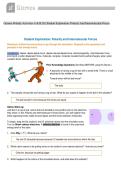
Gizmos Polarity Activities A & B.26 | Student Exploration: Polarity And Intermolecular Forces
Student Exploration: Polarity and Intermolecular Forces
Directions: Follow the instructions to go through the simulation. Respond to the questions and
prompts in the orange boxes.
Vocabulary: dipole, dipole-dipole force, dipole-induced dipole force, electronegativity, intermolecular force,
ionic bond, London dispersion force, molecule, nonpolar, nonpolar covalent bond, partial charges, polar, polar
covalent bond, valence electron
Prior Knowledge Questions (Do these BEFORE using the Gizmo.)
1. A big bully is having a tug-of-war with a small child. There is a ball
attached to the middle of the rope.
Toward whom will the ball move?
The bully
2. Two equally strong kids are having a tug-of-war. What do you expect to happen to the ball in this situation?
The ball wouldn’t move because the forces are equal
Gizmo Warm-up
Just like in a tug-of-war, atoms that are bonded to one another pull on the electrons
they share. In the Polarity and Intermolecular Forces Gizmo, you will explore how
these opposing forces relate to bond types and the forces between molecules.
To begin, drag the Na (sodium) and Cl (chlorine) atoms into the simulation area.
Turn on Show valence electrons. A valence electron is found in the outermost
energy level of the atom.
1. Click Play ( ). What do you notice?
Na and CI attracted because because CI needed one more electron which Na had
2. Which atom seems to be pulling more on the sodium’s one valence electron? How do you know?
Chlorine, because its getting bigger
3. What happens to the colors of the simulated atoms, and what does this indicate?
, Na got pulled to Cl because Cl has a higher electronegativity
Student Exploration: Polarity and Intermolecular Forces
Directions: Follow the instructions to go through the simulation. Respond to the questions and
prompts in the orange boxes.
Vocabulary: dipole, dipole-dipole force, dipole-induced dipole force, electronegativity, intermolecular force,
ionic bond, London dispersion force, molecule, nonpolar, nonpolar covalent bond, partial charges, polar, polar
covalent bond, valence electron
Prior Knowledge Questions (Do these BEFORE using the Gizmo.)
1. A big bully is having a tug-of-war with a small child. There is a ball
attached to the middle of the rope.
Toward whom will the ball move?
The bully
2. Two equally strong kids are having a tug-of-war. What do you expect to happen to the ball in this situation?
The ball wouldn’t move because the forces are equal
Gizmo Warm-up
Just like in a tug-of-war, atoms that are bonded to one another pull on the electrons
they share. In the Polarity and Intermolecular Forces Gizmo, you will explore how
these opposing forces relate to bond types and the forces between molecules.
To begin, drag the Na (sodium) and Cl (chlorine) atoms into the simulation area.
Turn on Show valence electrons. A valence electron is found in the outermost
energy level of the atom.
1. Click Play ( ). What do you notice?
Na and CI attracted because because CI needed one more electron which Na had
2. Which atom seems to be pulling more on the sodium’s one valence electron? How do you know?
Chlorine, because its getting bigger
3. What happens to the colors of the simulated atoms, and what does this indicate?
, Na got pulled to Cl because Cl has a higher electronegativity

