

NIHSS Group C
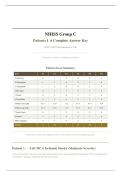
Patients 1–6 Complete Answer Key
Examination Cycle
66 Questions · 6 Patients · 11 NIHSS Items per Patient
Patient Score Summary
Item P1 P2 P3 P4 P5 P6
1a Alertness 0 1 0 0 2 0
1b Orientation 1 2 0 2 2 0
1c Commands 1 2 0 0 2 0
2 Best Gaze 0 1 1 0 3 0
3 Visual 0 2 0 1 3 0
4 Facial Palsy 1 2 0 2 3 0
5 Motor Arm (L/R) 0/1 3/0 1/2 0/3 0/4 1/0
6 Motor Leg (L/R) 0/2 2/0 1/2 0/2 0/4 0/0
7 Limb Ataxia 0 1 2 0 0 0
8 Sensory 1 2 0 1 2 0
9 Best Language 0 3 0 2 3 1
TOTAL 6 21 7 13 28 2
This document contains the complete answer key with rationales for all 66 examination questions.
Patient 1 — Left MCA Ischemic Stroke (Moderate Severity)
A 68-year-old female with acute onset right-sided weakness (arm > leg) and mild facial asymmetry. Preserved language and
consciousness. Imaging confirms left MCA territory infarct.
,Item 1a: Level of Consciousness - Alertness
Q1: A 68-year-old female presents with acute right-sided weakness. She is fully awake, eyes open spontaneously,
and makes appropriate eye contact when the examiner approaches. She responds immediately to questions without
any delay. What is the NIHSS score for Item 1a?
A. 0 - Alert
B. 1 - Not alert, but arousable by minor stimulation
C. 2 - Not alert, requires repeated stimulation to attend
D. 3 - Unresponsive (coma)
Correct Answer: A — 0 - Alert
Rationale: The patient is fully alert with eyes open spontaneously and responds immediately to the examiner, meeting the
criteria for a score of 0. A score of 1 would require the patient to be drowsy and needing minor stimulation, which is not the
case here. Scores of 2 and 3 indicate progressively deeper levels of impaired consciousness that are clearly absent in this
scenario, as she demonstrates no fluctuation in arousal.
Item 1b: Level of Consciousness - Orientation Questions
Q2: The examiner asks the patient her age and the current month. She correctly states she is 68 years old but
incorrectly reports the month as 'March' when it is actually August. What is the NIHSS score for Item 1b?
A. 0 - Answers both questions correctly
B. 1 - Answers one question correctly
C. 2 - Answers neither question correctly
D. 3 - Intubated or other physical barrier to communication
Correct Answer: B — 1 - Answers one question correctly
Rationale: The patient answered only one of the two orientation questions correctly (age correct, month incorrect), earning a
score of 1. Per NIHSS protocol, the examiner must initially ask about the patient's age and the current month; if the patient is
unable to answer, alternative questions about the date, day of the week, or location may be substituted only after the initial
pair is attempted. A score of 0 requires both initial questions to be answered correctly without substitution.
Item 1c: Level of Consciousness - Commands
Q3: The examiner asks the patient to open and close her eyes and then to grip and release her non-paretic hand.
She successfully opens and closes her eyes but only partially grips the hand, not completing the full release cycle.
What is the NIHSS score for Item 1c?
A. 0 - Performs both tasks correctly
B. 1 - Performs one task correctly
C. 2 - Performs neither task correctly
D. 3 - Intubated or other physical barrier to communication
Correct Answer: B — 1 - Performs one task correctly
Rationale: The patient successfully performed one of the two commanded tasks (eye open/close), but failed to complete the
grip and release command fully, earning a score of 1. Per NIHSS protocol, partial performance of a command still counts as
failure to perform that task correctly. If the patient cannot perform the hand command due to weakness, the examiner may
substitute a different command to assess comprehension separately from motor execution.
Item 2: Best Gaze
Q4: The patient's eyes are conjugate and track the examiner's finger smoothly through the full horizontal range in
both directions. There is no evidence of forced gaze deviation or gaze palsy on oculocephalic testing. What is the
NIHSS score for Item 2?
A. 0 - Normal
B. 1 - Partial gaze palsy
, C. 2 - Forced deviation, but overcomes with effort
D. 3 - Complete gaze palsy or forced deviation that cannot be overcome
Correct Answer: A — 0 - Normal
Rationale: The patient demonstrates normal horizontal eye movements in both directions without any gaze preference or palsy,
warranting a score of 0. A score of 1 requires a partial gaze palsy with incomplete conjugate movement, and a score of 2
indicates forced deviation that the patient can partially overcome. The distinction between gaze preference and partial gaze
palsy is important: gaze preference resolves with oculocephalic (doll's eye) maneuver, while a true gaze palsy does not.
Item 3: Visual Fields
Q5: Visual field testing reveals that the patient can perceive finger movement in all four quadrants bilaterally
when each visual field is tested individually. When bilateral simultaneous stimulation is performed, she identifies
all stimuli correctly without extinction. What is the NIHSS score for Item 3?
A. 0 - No visual loss
B. 1 - Partial hemianopia
C. 2 - Complete hemianopia
D. 3 - Bilateral hemianopia (blind)
Correct Answer: A — 0 - No visual loss
Rationale: The patient has intact visual fields in all quadrants with no evidence of hemianopia or quadrantanopia, scoring 0.
Even with bilateral simultaneous stimulation, she correctly identifies all stimuli, ruling out any subtle extinction. A score of 1
would require partial hemianopia or an isolated quadrant deficit (quadrantanopia) detectable on confrontation testing. The
extinction phenomenon observed during bilateral simultaneous stimulation is scored separately under Item 11, not Item 3.
Item 4: Facial Palsy
Q6: The patient's face appears symmetric at rest. When asked to show her teeth or raise her eyebrows, there is
slight flattening of the nasolabial fold on the right side, but the forehead furrows symmetrically and eye closure is
complete bilaterally. What is the NIHSS score for Item 4?
A. 0 - Normal symmetrical movements
B. 1 - Minor paralysis (flattened nasolabial fold, asymmetry on smiling)
C. 2 - Partial paralysis (lower face)
D. 3 - Complete paralysis of one or both sides
Correct Answer: B — 1 - Minor paralysis (flattened nasolabial fold, asymmetry on smiling)
Rationale: The patient demonstrates minor facial paralysis with slight flattening of the right nasolabial fold while maintaining
symmetric forehead movement and complete eye closure. This pattern represents an upper motor neuron lesion (sparing the
upper face due to bilateral cortical innervation) and is scored as 1. A score of 2 would require more obvious lower facial
weakness such as marked asymmetry with significant drooping, while a score of 3 indicates complete unilateral or bilateral
facial paralysis including the upper face.
Item 5: Motor Arm - Left and Right
Q7: The patient is asked to hold each arm outstretched at 90 degrees for 10 seconds. The left arm maintains the
position without any drift. The right arm drifts downward within 5 seconds but does not hit the bed within the
10-second observation period. What are the correct NIHSS scores for Items 5a (left arm) and 5b (right arm)?
A. 5a = 0, 5b = 0
B. 5a = 0, 5b = 1
C. 5a = 0, 5b = 2
D. 5a = 1, 5b = 1
Correct Answer: B — 5a = 0, 5b = 1
Rationale: The left arm maintains position for 10 seconds without drift (score 0), while the right arm drifts but does not
contact the bed within the observation period (score 1). The critical NIHSS distinction is between drift without bed contact
Patients 1–6 Complete Answer Key
Examination Cycle
66 Questions · 6 Patients · 11 NIHSS Items per Patient
Patient Score Summary
Item P1 P2 P3 P4 P5 P6
1a Alertness 0 1 0 0 2 0
1b Orientation 1 2 0 2 2 0
1c Commands 1 2 0 0 2 0
2 Best Gaze 0 1 1 0 3 0
3 Visual 0 2 0 1 3 0
4 Facial Palsy 1 2 0 2 3 0
5 Motor Arm (L/R) 0/1 3/0 1/2 0/3 0/4 1/0
6 Motor Leg (L/R) 0/2 2/0 1/2 0/2 0/4 0/0
7 Limb Ataxia 0 1 2 0 0 0
8 Sensory 1 2 0 1 2 0
9 Best Language 0 3 0 2 3 1
TOTAL 6 21 7 13 28 2
This document contains the complete answer key with rationales for all 66 examination questions.
Patient 1 — Left MCA Ischemic Stroke (Moderate Severity)
A 68-year-old female with acute onset right-sided weakness (arm > leg) and mild facial asymmetry. Preserved language and
consciousness. Imaging confirms left MCA territory infarct.
,Item 1a: Level of Consciousness - Alertness
Q1: A 68-year-old female presents with acute right-sided weakness. She is fully awake, eyes open spontaneously,
and makes appropriate eye contact when the examiner approaches. She responds immediately to questions without
any delay. What is the NIHSS score for Item 1a?
A. 0 - Alert
B. 1 - Not alert, but arousable by minor stimulation
C. 2 - Not alert, requires repeated stimulation to attend
D. 3 - Unresponsive (coma)
Correct Answer: A — 0 - Alert
Rationale: The patient is fully alert with eyes open spontaneously and responds immediately to the examiner, meeting the
criteria for a score of 0. A score of 1 would require the patient to be drowsy and needing minor stimulation, which is not the
case here. Scores of 2 and 3 indicate progressively deeper levels of impaired consciousness that are clearly absent in this
scenario, as she demonstrates no fluctuation in arousal.
Item 1b: Level of Consciousness - Orientation Questions
Q2: The examiner asks the patient her age and the current month. She correctly states she is 68 years old but
incorrectly reports the month as 'March' when it is actually August. What is the NIHSS score for Item 1b?
A. 0 - Answers both questions correctly
B. 1 - Answers one question correctly
C. 2 - Answers neither question correctly
D. 3 - Intubated or other physical barrier to communication
Correct Answer: B — 1 - Answers one question correctly
Rationale: The patient answered only one of the two orientation questions correctly (age correct, month incorrect), earning a
score of 1. Per NIHSS protocol, the examiner must initially ask about the patient's age and the current month; if the patient is
unable to answer, alternative questions about the date, day of the week, or location may be substituted only after the initial
pair is attempted. A score of 0 requires both initial questions to be answered correctly without substitution.
Item 1c: Level of Consciousness - Commands
Q3: The examiner asks the patient to open and close her eyes and then to grip and release her non-paretic hand.
She successfully opens and closes her eyes but only partially grips the hand, not completing the full release cycle.
What is the NIHSS score for Item 1c?
A. 0 - Performs both tasks correctly
B. 1 - Performs one task correctly
C. 2 - Performs neither task correctly
D. 3 - Intubated or other physical barrier to communication
Correct Answer: B — 1 - Performs one task correctly
Rationale: The patient successfully performed one of the two commanded tasks (eye open/close), but failed to complete the
grip and release command fully, earning a score of 1. Per NIHSS protocol, partial performance of a command still counts as
failure to perform that task correctly. If the patient cannot perform the hand command due to weakness, the examiner may
substitute a different command to assess comprehension separately from motor execution.
Item 2: Best Gaze
Q4: The patient's eyes are conjugate and track the examiner's finger smoothly through the full horizontal range in
both directions. There is no evidence of forced gaze deviation or gaze palsy on oculocephalic testing. What is the
NIHSS score for Item 2?
A. 0 - Normal
B. 1 - Partial gaze palsy
, C. 2 - Forced deviation, but overcomes with effort
D. 3 - Complete gaze palsy or forced deviation that cannot be overcome
Correct Answer: A — 0 - Normal
Rationale: The patient demonstrates normal horizontal eye movements in both directions without any gaze preference or palsy,
warranting a score of 0. A score of 1 requires a partial gaze palsy with incomplete conjugate movement, and a score of 2
indicates forced deviation that the patient can partially overcome. The distinction between gaze preference and partial gaze
palsy is important: gaze preference resolves with oculocephalic (doll's eye) maneuver, while a true gaze palsy does not.
Item 3: Visual Fields
Q5: Visual field testing reveals that the patient can perceive finger movement in all four quadrants bilaterally
when each visual field is tested individually. When bilateral simultaneous stimulation is performed, she identifies
all stimuli correctly without extinction. What is the NIHSS score for Item 3?
A. 0 - No visual loss
B. 1 - Partial hemianopia
C. 2 - Complete hemianopia
D. 3 - Bilateral hemianopia (blind)
Correct Answer: A — 0 - No visual loss
Rationale: The patient has intact visual fields in all quadrants with no evidence of hemianopia or quadrantanopia, scoring 0.
Even with bilateral simultaneous stimulation, she correctly identifies all stimuli, ruling out any subtle extinction. A score of 1
would require partial hemianopia or an isolated quadrant deficit (quadrantanopia) detectable on confrontation testing. The
extinction phenomenon observed during bilateral simultaneous stimulation is scored separately under Item 11, not Item 3.
Item 4: Facial Palsy
Q6: The patient's face appears symmetric at rest. When asked to show her teeth or raise her eyebrows, there is
slight flattening of the nasolabial fold on the right side, but the forehead furrows symmetrically and eye closure is
complete bilaterally. What is the NIHSS score for Item 4?
A. 0 - Normal symmetrical movements
B. 1 - Minor paralysis (flattened nasolabial fold, asymmetry on smiling)
C. 2 - Partial paralysis (lower face)
D. 3 - Complete paralysis of one or both sides
Correct Answer: B — 1 - Minor paralysis (flattened nasolabial fold, asymmetry on smiling)
Rationale: The patient demonstrates minor facial paralysis with slight flattening of the right nasolabial fold while maintaining
symmetric forehead movement and complete eye closure. This pattern represents an upper motor neuron lesion (sparing the
upper face due to bilateral cortical innervation) and is scored as 1. A score of 2 would require more obvious lower facial
weakness such as marked asymmetry with significant drooping, while a score of 3 indicates complete unilateral or bilateral
facial paralysis including the upper face.
Item 5: Motor Arm - Left and Right
Q7: The patient is asked to hold each arm outstretched at 90 degrees for 10 seconds. The left arm maintains the
position without any drift. The right arm drifts downward within 5 seconds but does not hit the bed within the
10-second observation period. What are the correct NIHSS scores for Items 5a (left arm) and 5b (right arm)?
A. 5a = 0, 5b = 0
B. 5a = 0, 5b = 1
C. 5a = 0, 5b = 2
D. 5a = 1, 5b = 1
Correct Answer: B — 5a = 0, 5b = 1
Rationale: The left arm maintains position for 10 seconds without drift (score 0), while the right arm drifts but does not
contact the bed within the observation period (score 1). The critical NIHSS distinction is between drift without bed contact

